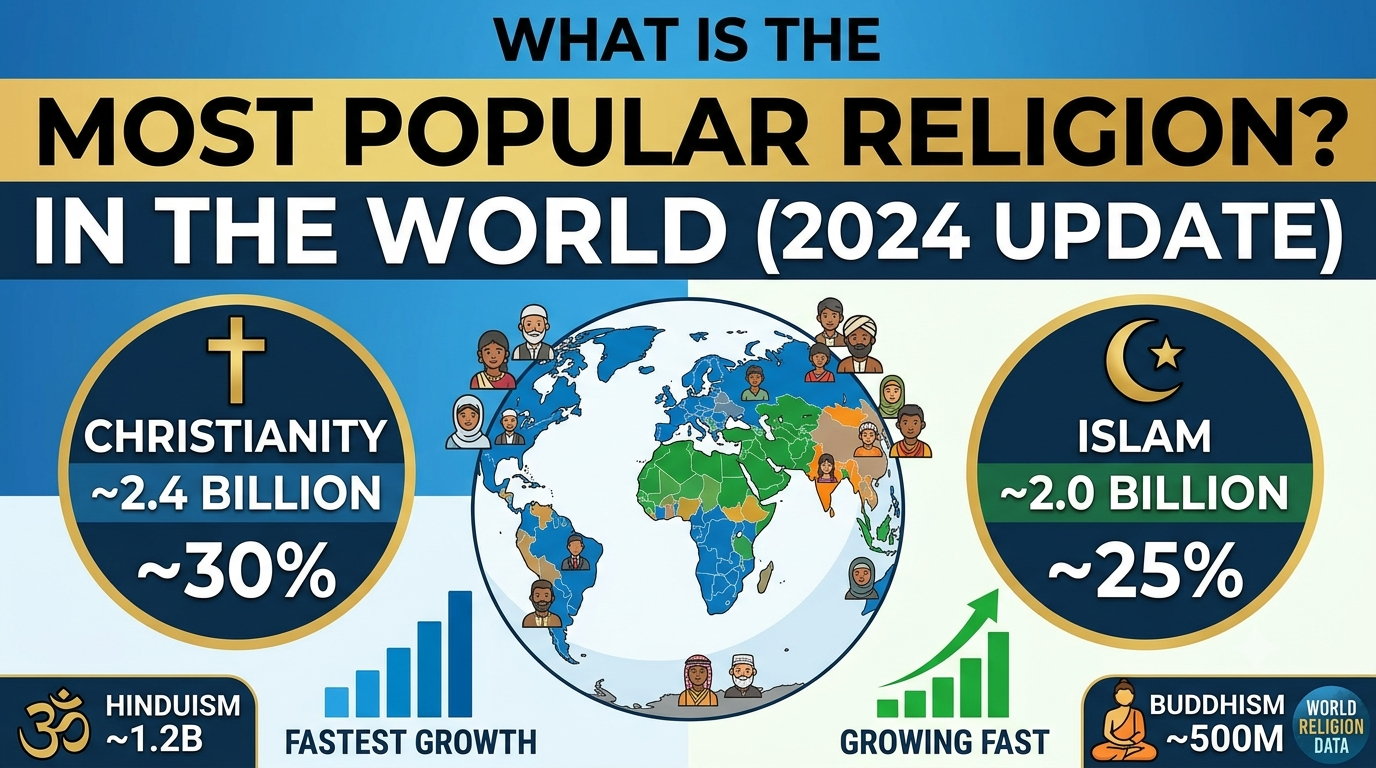
Religion has shaped human civilization, culture, morality, and geopolitics for thousands of years. Today, more than 85% of the world’s population identifies with a specific religious belief system or tradition. But among the thousands of active faiths across the globe, what is the most popular religion in the world?
The short answer is Christianity, which currently holds the largest number of adherents globally, with approximately 2.4 billion followers. However, the global religious landscape is far from static. Islam is the second-largest religion with around 1.9 to 2.1 billion followers and is rapidly growing. Meanwhile, over 1.2 billion people identify as religiously unaffiliated, and major Dharmic faiths like Hinduism and Buddhism command vast populations across Asia.
This comprehensive guide explores the world’s most popular religions by population, examining their history, geographic distribution, and projected demographic shifts in the decades ahead.
Global Religion Population Overview
To understand how global faiths compare, let’s look at the estimated global population breakdown among major religious groups:
| Religion / Group | Estimated Population | Percentage of World Population | Primary Regions |
| Christianity | ~2.38 – 2.40 Billion | ~30% – 31% | Americas, Europe, Sub-Saharan Africa, Oceania |
| Islam | ~1.90 – 2.10 Billion | ~25% – 26% | Middle East, North Africa, South & Southeast Asia |
| Religiously Unaffiliated | ~1.20 – 1.30 Billion | ~15% – 16% | East Asia, Europe, North America |
| Hinduism | ~1.16 – 1.20 Billion | ~15% | South Asia (India, Nepal) |
| Buddhism | ~500 Million | ~6% – 7% | East & Southeast Asia |
| Folk / Indigenous Religions | ~400 – 430 Million | ~5% | Asia-Pacific, Africa, Americas |
| Sikhism | ~30 Million | ~0.4% | India (Punjab), Global Diaspora |
| Judaism | ~15 Million | ~0.2% | Israel, United States |
Data compiled from recent demographic synthesis reports including Pew Research Center and World Population Review estimates.
1. Christianity: The World’s Largest Religion
With roughly 2.4 billion adherents representing approximately 30% of the global population, Christianity remains the most popular religion in the world today.
┌─────────────────────────────────────────────────────────────┐
│                 Global Christian Population                 │
│                                                             │
│   ┌─────────────────────────┬───────────────────┬───────┐   │
│   │     Catholicism         │   Protestantism   │ Orth. │   │
│   │        (~50%)           │      (~37%)       │(~12%) │   │
│   └─────────────────────────┴───────────────────┴───────┘   │
└─────────────────────────────────────────────────────────────┘
Major Branches
Christianity is divided into several major branches and thousands of denominations:
- Roman Catholicism: Accounts for roughly 50% of all Christians worldwide (~1.2 billion), with its central authority at the Vatican in Rome.
- Protestantism: Makes up about 37% of Christians (~800–900 million), encompassing historic traditions like Lutheranism, Anglicanism, and Methodism, as well as fast-growing Evangelical and Pentecostal movements.
- Eastern Orthodoxy: Represents around 12% (~260–300 million), predominantly in Eastern Europe, Greece, and Russia.
- Other Traditions: Includes Oriental Orthodoxy, Restorationist groups, and independent African churches.
Brief History
Christianity originated in the 1st century CE in the Levant (modern-day Israel and Palestine) as a movement within Judaism centered on the life, teachings, death, and resurrection of Jesus of Nazareth.
Despite initial persecution under the Roman Empire, the faith expanded rapidly across Mediterranean trade networks. In 313 CE, Emperor Constantine issued the Edict of Milan, legalizing Christianity, and it eventually became the official religion of Rome. During the Age of Discovery (15th–17th centuries), European colonial expansion, trade, and missionary activity carried Christianity to the Americas, Africa, and Asia.
Worldwide Distribution
Christianity is currently the most geographically widespread religion:
- The Americas: Home to massive Christian populations, including the United States (~250+ million), Brazil (~180+ million), and Mexico (~115+ million).
- Sub-Saharan Africa: Experiencing the fastest growth rate for Christianity; countries like Nigeria, the Democratic Republic of the Congo, and Kenya hold tens of millions of believers.
- Europe: Historically the center of Western Christianity, though secularization has slowed growth in recent decades.
- Asia & Oceania: Strong majorities in countries like the Philippines and East Timor, with substantial growing minorities in South Korea and China.
2. Islam: The Second-Largest and Fastest-Growing Religion
Practiced by an estimated 1.9 to 2.1 billion people (roughly 25–26% of humanity), Islam is the world’s second-largest religion and the fastest-growing major faith.
Major Denominations
- Sunni Islam: The vast majority, comprising approximately 85–90% of all Muslims globally.
- Shia Islam: Comprises about 10–15% of Muslims, centered largely in Iran, Iraq, Azerbaijan, and Bahrain.
- Sufism: Represents the mystical dimension of Islam, practiced across both Sunni and Shia traditions.
Brief History
Islam was founded in the early 7th century CE in the Arabian Peninsula by the Prophet Muhammad, whom Muslims believe received divine revelations recorded in the Quran.
Following Muhammad’s death in 632 CE, Islam spread rapidly across North Africa, the Middle East, Central Asia, and parts of Southern Europe through a combination of trade, diplomatic alliances, and territorial expansion. The Islamic Golden Age (8th–14th centuries) fostered advancements in science, medicine, mathematics, and philosophy, further establishing Islam as a global cultural powerhouse.
Worldwide Distribution
Contrary to popular belief, the majority of the world’s Muslims do not live in the Middle East:
- South and Southeast Asia: Home to the world’s largest Muslim populations. Indonesia is the most populous Muslim-majority country (~240 million), followed closely by Pakistan, India, and Bangladesh.
- Middle East & North Africa (MENA): Contains the highest proportion of Muslim-majority nations, including Saudi Arabia, Egypt, Turkey, and Iran.
- Sub-Saharan Africa: Includes large Muslim populations in Nigeria, Sudan, Niger, and Mali.
- Europe & North America: Growing Muslim communities exist across Western Europe and the United States, driven by immigration and natural demographic growth.
3. Religiously Unaffiliated: The Secular Population
The third-largest demographic category globally is the religiously unaffiliated, representing approximately 1.2 to 1.3 billion people (~15–16% of the global population).
Composition
This group is diverse and includes:
- Atheists: Individuals who explicitly do not believe in the existence of a deity.
- Agnostics: Those who believe the existence of God or the supernatural is unknown or unknowable.
- Secular/Non-religious: People who do not belong to any organized religion, though some may hold personal spiritual beliefs.
Geographic Distribution
- East Asia: The vast majority of religiously unaffiliated people reside in East Asia, particularly in China (where roughly 90% of the population claims no official religious affiliation), Japan, and South Korea.
- Europe & North America: Secularization has caused a significant rise in non-affiliated individuals (“nones”) in countries such as the UK, France, Germany, Canada, and the United States.
4. Hinduism: The World’s Oldest Major Religion
With over 1.16 to 1.2 billion followers (~15% of the world’s population), Hinduism ranks as the fourth-largest religious grouping globally and the largest among Dharmic traditions.
Key Characteristics & History
Unlike Christianity or Islam, Hinduism has no single founder, single holy book, or centralized institutional authority. It is a family of diverse traditions, philosophies, and rituals that evolved on the Indian subcontinent over more than 3,500 years. Core concepts include:
- Dharma: Ethical duty and living in harmony with cosmic law.
- Karma: The universal law of cause and effect.
- Samsara & Moksha: The cycle of rebirth and ultimate liberation.
Worldwide Distribution
Hinduism is heavily concentrated geographically, with nearly 95% of all Hindus living in a single region:
- India: Home to more than 1.1 billion Hindus, making up about 79% of the country’s total population.
- Nepal: The second-largest Hindu-majority country (~81% of its population).
- Global Diaspora: Significant Hindu communities exist in Bangladesh, Sri Lanka, Malaysia, Mauritius, the United Arab Emirates, the United Kingdom, and North America.
5. Buddhism: The Path of Enlightenment
Buddhism counts approximately 500 million followers (~6% to 7% of the world’s population).
Brief History & Teachings
Buddhism was founded in ancient India in the 5th century BCE by Siddhartha Gautama (the Buddha). Central to Buddhism are the Four Noble Truths and the Eightfold Path, which guide adherents toward overcoming suffering and achieving Nirvana (enlightenment).
Major Traditions & Distribution
- Theravada Buddhism: Predominant in Southeast Asia, including Thailand, Myanmar, Sri Lanka, Laos, and Cambodia.
- Mahayana Buddhism: Dominant in East Asia, including China, Japan, Korea, and Vietnam.
- Vajrayana (Tibetan) Buddhism: Practiced widely in Tibet, Nepal, Bhutan, Mongolia, and parts of Russia.
Comparative Breakdown: Top Religions at a Glance
To quickly compare the world’s major belief systems, consider the summary table below:
| Religion | Founder / Origins | Primary Holy Text(s) | Key Beliefs | Major Concentration |
| Christianity | Jesus of Nazareth (c. 30 CE, Middle East) | The Bible (Old & New Testaments) | Monotheism, salvation through Jesus Christ, resurrection | Americas, Europe, Sub-Saharan Africa |
| Islam | Prophet Muhammad (c. 610 CE, Arabia) | The Quran | Absolute Monotheism (Tawhid), Five Pillars of Islam | South Asia, Middle East, North Africa, SE Asia |
| Hinduism | Ancient Indian Subcontinent (c. 1500+ BCE) | Vedas, Upanishads, Bhagavad Gita | Karma, Dharma, Reincarnation, Moksha | India, Nepal, South Asia |
| Buddhism | Siddhartha Gautama (c. 5th century BCE) | Pali Canon, Mahayana Sutras | Four Noble Truths, Eightfold Path, Nirvana | East Asia, Southeast Asia |
| Sikhism | Guru Nanak (15th century CE, Punjab) | Guru Granth Sahib | One Creator, equality of humans, selfless service | India (Punjab region), global diaspora |
| Judaism | Abraham / Moses (c. 2000–1300 BCE, Levant) | The Tanakh (Hebrew Bible), Talmud | Covenant with God, ethical monotheism, Torah study | Israel, United States |
Demographic Shifts: What Will Be the Most Popular Religion in 2050?
While Christianity is currently the most popular religion in the world, demographic trends studied by organizations like the Pew Research Center point toward dramatic shifts over the coming decades.
Key Drivers of Growth:
- Fertility Rates: Muslim populations globally have higher fertility rates (an average of 2.9 children per woman) compared to non-Muslim groups.
- Youthful Age Profile: Islam has the youngest median age among major world religions, meaning a larger percentage of its population is entering childbearing years.
- Geographic Distribution: High-growth developing regions (such as Sub-Saharan Africa) are seeing rapid expansions in both Christian and Muslim demographics.
       PROJECTED POPULATION GROWTH (2010 - 2050)

  Islam       │ ████████████████████████████████████ +73%
  Christianity│ ██████████████████ +35%
  Hinduism    │ ███████████████ +34%
  Unaffiliated│ ███ +9%
The 2050 Projection
If current demographic trends continue:
- By 2050–2070, Islam is projected to grow faster than any other major religion and could equal or slightly surpass Christianity in total followers.
- By 2050, India will remain a Hindu-majority country, but will also house the world’s largest Muslim population, surpassing Indonesia.
- Sub-Saharan Africa will host a significant share of the world’s total Christian and Muslim populations.
Conclusion
So, what is the most popular religion in the world?
As of today, Christianity holds the top spot with approximately 2.4 billion adherents (~30% of the global population). Islam follows closely behind as the second-largest religion with 1.9 to 2.1 billion followers, while over 1.2 billion people remain religiously unaffiliated.
However, religion is a dynamic force. Fueled by high birth rates and a young demographic base, Islam is expanding rapidly and may challenge Christianity’s place as the world’s largest religion in the second half of the 21st century. Understanding these population figures, historical origins, and geographic distributions offers valuable insight into the diverse cultural fabrics that define our interconnected world.
Penulis: W.S






Post Comment