Religion has shaped human history, culture, governance, and daily life for thousands of years. Out of Earth’s population of over 8 billion people, more than 85% identify with a specific religious belief system or spiritual tradition.
Understanding the global religious landscape offers profound insights into cultural identity, demographic shifts, and geopolitical dynamics. This updated 2026 global analysis explores the world’s most popular religions, ranked by total number of followers, alongside key demographic facts and emerging demographic trends.
Global Religion Rankings at a Glance (2026 Data)
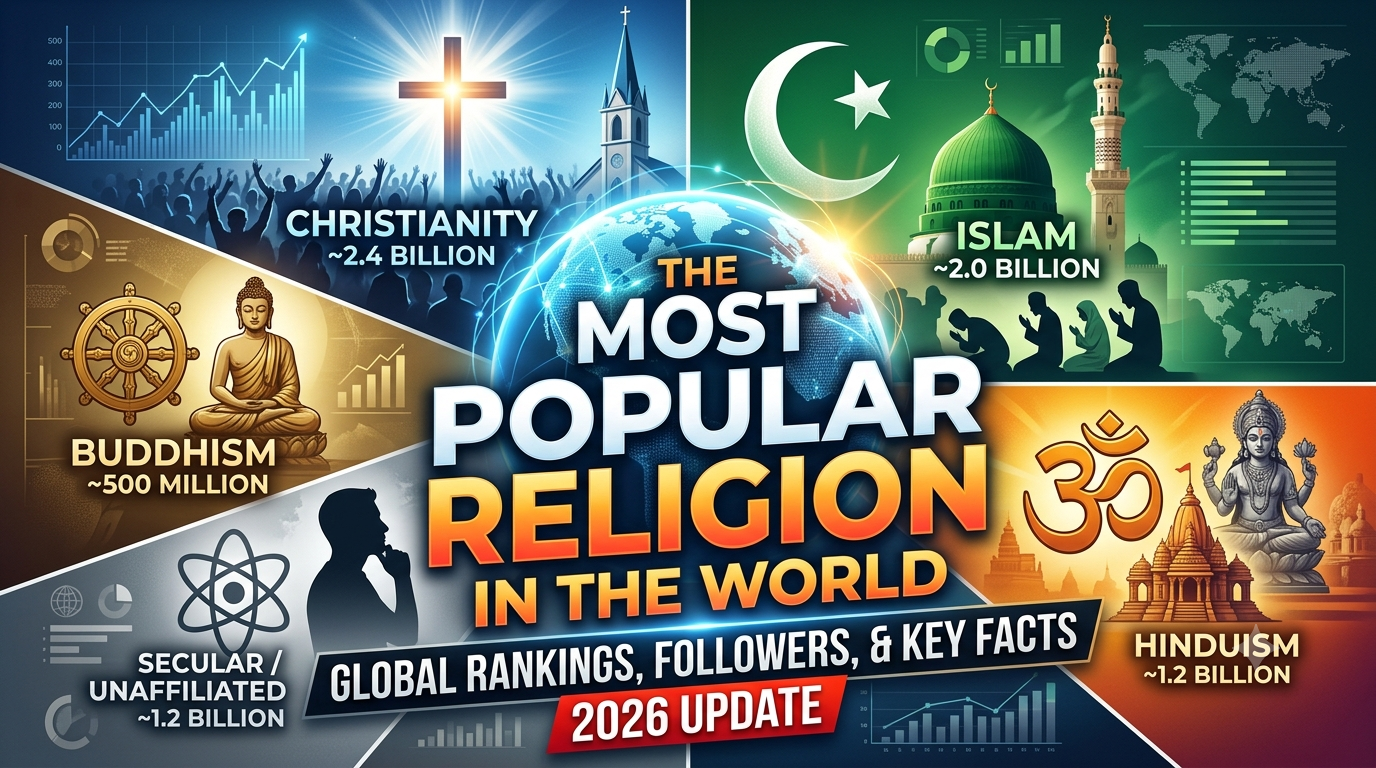
Below is an overview of the world’s major religions and belief systems, ranked by total estimated followers and global population share.
| Rank | Religion / Belief System | Estimated Followers | Global Share (%) | Primary Geographic Regions |
| 1 | Christianity | ~2.38 – 2.40 Billion | ~30.5% | Americas, Europe, Sub-Saharan Africa |
| 2 | Islam | ~1.91 – 2.10 Billion | ~25.0% – 26.0% | Middle East, North Africa, South & SE Asia |
| 3 | Secular / Unaffiliated | ~1.20 Billion | ~15.0% – 16.0% | East Asia, Western Europe, North America |
| 4 | Hinduism | ~1.16 – 1.20 Billion | ~15.0% | South Asia (India, Nepal) |
| 5 | Buddhism | ~500 Million | ~6.0% – 6.5% | East and Southeast Asia |
| 6 | Folk & Traditional | ~430 Million | ~5.0% | Africa, China, Indigenous regions |
| 7 | Other Traditions | ~60 Million | ~0.8% | Global (Sikhism, Judaism, Jainism, etc.) |
Detailed Breakdown of the Top Religions
1. Christianity — World’s Largest Religion
- Estimated Adherents: ~2.38 to 2.40 Billion
- Percentage of Global Population: ~30.5%
- Origins: 1st Century AD (Levant / Middle East)
Christianity remains the largest single religion on Earth. Centered on the life, teachings, death, and resurrection of Jesus Christ, Christianity spread from the Roman Empire to encompass every continent.
Major Denominations:
- Roman Catholicism: Approximately 1.25 billion followers. It is the largest single ecclesiastical body, led by the Pope in Vatican City. Catholicism is predominant in Latin America, Southern Europe, and parts of Central Africa.
- Protestantism: Approximately 850–900 million adherents across diverse denominations (e.g., Pentecostal, Baptist, Lutheran, Methodist, Anglican). Protestantism dominates in North America, Northern Europe, and is growing exponentially in Sub-Saharan Africa.
- Eastern Orthodoxy: Approximately 290 million followers, concentrated heavily in Eastern Europe, Russia, and the Balkans.
Key Geographic Centers:
The countries with the largest Christian populations are the United States (~230M+), Brazil (~170M), Mexico (~106M), and Nigeria (~80M+). Notably, the demographic center of Christianity has shifted dramatically over the past century from Western nations toward the Global South, particularly Sub-Saharan Africa and Latin America.
2. Islam — The Fastest-Growing Major Religion
- Estimated Adherents: ~1.91 to 2.10 Billion
- Percentage of Global Population: ~25.0% to 26.0%
- Origins: 7th Century AD (Arabian Peninsula)
Islam is the second-largest religion worldwide and holds the distinction of being the fastest-growing major religion. Established through the revelations conveyed to the Prophet Muhammad as recorded in the Quran, Islam is a monotheistic faith based on absolute submission to God (Allah) and the practice of the Five Pillars.
Major Branches:
- Sunni Islam: Comprises roughly 85%–90% of all Muslims globally (~1.6 billion adherents). Sunni traditions emphasize the community consensus (Ijma) and the practice (Sunnah) of the Prophet.
- Shia Islam: Represents approximately 10%–15% of the Muslim population (~220–250 million). Shias form the majority in Iran, Iraq, Azerbaijan, and Bahrain.
Key Geographic Centers:
While commonly associated with the Middle East, the majority of the world’s Muslims actually reside in the Asia-Pacific region. The nations with the largest Muslim populations are Indonesia (~240M), Pakistan (~235M), India (~210M), and Bangladesh (~150M).
Demographic Insight: Due to higher fertility rates and a younger median age compared to other religious groups, demographers project that Islam could nearly rival Christianity in total numbers by the mid-21st century.
3. Religiously Unaffiliated — Secular, Agnostic, & Atheist
- Estimated Adherents: ~1.20 Billion
- Percentage of Global Population: ~15.0% – 16.0%
The third-largest “group” globally consists of people who do not identify with any formal religion. This category—often referred to in sociological studies as the “Nones”—is highly diverse and encompasses:
- Atheists: People who do not believe in the existence of a deity.
- Agnostics: People who believe the existence of God or the ultimate reality is unknown or unknowable.
- Secular / Humanists: Individuals who live without religious adherence, prioritizing human reason and ethics over spiritual dogma.
- Spiritual but Not Religious (SBNR): Individuals who maintain personal spiritual beliefs without institutional ties.
Key Geographic Centers:
Over 60% of the world’s unaffiliated population resides in Asia, particularly in China (where secular or traditional non-institutional worldviews predominate). Significant concentrations are also found in Japan, Western Europe (e.g., the UK, France, Scandinavia), and North America, where secularization has risen steadily among younger generations.
4. Hinduism — The Oldest Living Major Religion
- Estimated Adherents: ~1.16 to 1.20 Billion
- Percentage of Global Population: ~15.0%
- Origins: Circa 1500–500 BC (Indus Valley / Indian Subcontinent)
Hinduism is the world’s third-largest religion and is widely considered the oldest living major religious tradition. Unlike Abrahamic faiths, Hinduism has no single founder, single holy text, or centralized authority. Instead, it represents a rich family of philosophical, spiritual, and cultural traditions unified by core concepts such as:
- Dharma: Duty, ethics, and order.
- Karma: The law of cause and effect governing actions and consequences.
- Samsara: The cycle of rebirth and reincarnation.
- Moksha: Liberation from the cycle of rebirth.
Key Geographic Concentration:
Hinduism is unique among major global faiths for its intense geographic concentration: over 95% of all Hindus live in a single nation: India. Nepal is the only other country with a Hindu-majority population, alongside sizable diaspora populations in Bangladesh, Mauritius, Fiji, Guyana, the Middle East, North America, and Europe.
5. Buddhism — The Path to Enlightenment
- Estimated Adherents: ~500 Million
- Percentage of Global Population: ~6.0% – 6.5%
- Origins: 5th–6th Century BC (Ancient Magadha / Modern-day India & Nepal)
Founded by Siddhartha Gautama (the Buddha or “Awakened One”), Buddhism focuses on personal spiritual development, attaining wisdom, and understanding the nature of suffering to achieve Nirvana (liberation from cycle of rebirth).
Major Traditions:
- Mahayana: The largest tradition, prevalent in China, Japan, South Korea, and Vietnam.
- Theravada: Prominent in Southeast Asian nations including Thailand, Myanmar, Sri Lanka, Cambodia, and Laos.
- Vajrayana (Tibetan Buddhism): Practiced mainly in Tibet, Mongolia, Bhutan, and parts of the Indian Himalayas.
Other Major Global Faiths and Folk Traditions
Beyond the top five, hundreds of millions of people follow traditional, indigenous, or localized faith systems:
- Folk & Traditional Religions (~430 Million): Includes African traditional religions, Chinese folk religions (combining Confucianism, Taoism, and ancestor veneration), and Indigenous traditions across Native American and Australian Aboriginal communities.
- Sikhism (~25–30 Million): Founded in the 15th century by Guru Nanak in the Punjab region of India. Monotheistic, emphasizing equality, selfless service (Sewa), and devotion to God.
- Judaism (~15 Million): One of the oldest monotheistic faiths and the foundation of Abrahamic traditions. The global Jewish population is primarily concentrated in Israel (~7 million) and the United States (~6 million).
- Bahá’í Faith (~5–8 Million): Established in 19th-century Persia, emphasizing the essential worth of all religions and the unity of all people.
- Jainism (~4–5 Million): Ancient Indian religion practicing strict non-violence (Ahimsa), asceticism, and spiritual purity.
Key Demographic Trends Shaping Global Religion in 2026
When analyzing global religion, numerical rankings tell only half the story. Demographic forces are rapidly shifting where religions thrive and how global populations practice faith:
1. Rapid Growth of Islam
Driven by younger populations and higher fertility rates in developing nations, Islam is expanding faster than any other major global religion. Demographic models suggest that by 2050, the global Muslim population will almost equal the Christian population for the first time in recorded history.
2. The Shift toward the Global South
Christianity’s center of gravity has permanently migrated away from Western Europe and North America. Today, Sub-Saharan Africa, Latin America, and parts of Asia account for the vast majority of active church engagement and growth. By contrast, many Western nations are experiencing declining church attendance and rising secularization.
3. Growth of the “Nones” in Developed Economies
In North America and Europe, the percentage of young adults identifying as religiously unaffiliated continues to climb. However, globally, the unaffiliated percentage is projected to shrink slightly as a total share of world population, primarily because secular nations (like East Asian and European countries) tend to have lower birth rates than highly religious regions.
Summary
In 2026, Christianity remains the world’s most popular religion by total followers (~2.4 billion), closely followed by Islam (~1.91–2.1 billion). Together, Abrahamic faiths account for over half of humanity. Coupled with Secularism (~1.2 billion), Hinduism (~1.2 billion), and Buddhism (~500 million), these major worldviews encompass the beliefs and identity of over 85% of Earth’s population.
As global demographics evolve throughout the 21st century, the distribution of world religions will continue to adapt—reflecting changes in birth rates, migration, urbanization, and cultural shifts around the globe.
Penulis: W.S






Post Comment