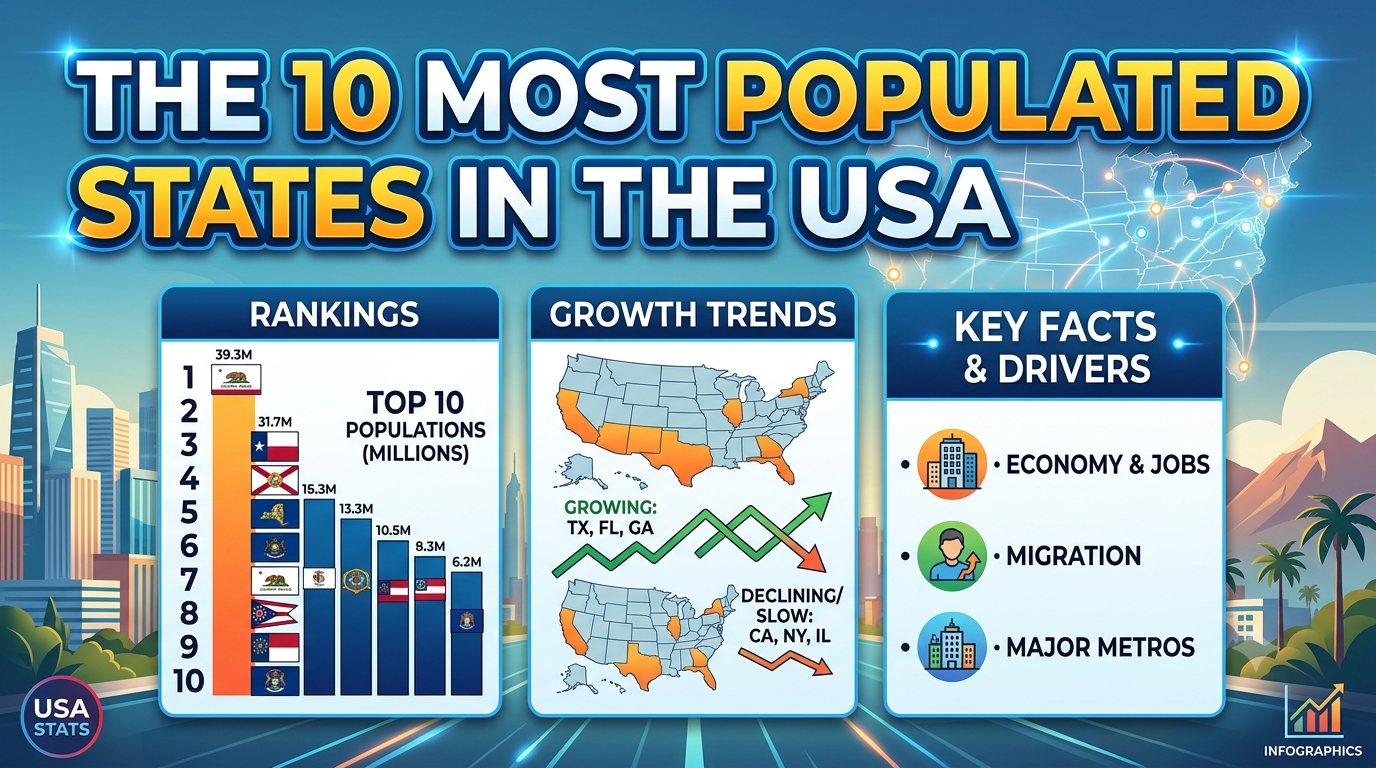
The United States is home to over 335 million people spread across 50 distinct states, but its population is surprisingly concentrated. In fact, more than half of the entire U.S. population resides in just ten states. From coastal economic powerhouses like California and New York to rapidly expanding Sun Belt titans like Texas and Florida, these top ten states play a massive role in shaping the nation’s economy, culture, and political landscape.
In this comprehensive guide, we analyze the 10 most populated states in the USA, examining their latest population figures, growth rates, economic drivers, and key demographic trends.
At a Glance: Top 10 Most Populated U.S. States
Here is a quick summary table detailing the top 10 most populous states based on the latest U.S. Census Bureau estimates:
| Rank | State | Estimated Population | Capital | Most Populous City | Region |
| 1 | California | ~39.3 Million | Sacramento | Los Angeles | West |
| 2 | Texas | ~31.7 Million | Austin | Houston | South |
| 3 | Florida | ~23.5 Million | Tallahassee | Jacksonville | South |
| 4 | New York | ~20.0 Million | Albany | New York City | Northeast |
| 5 | Pennsylvania | ~13.0 Million | Harrisburg | Philadelphia | Northeast |
| 6 | Illinois | ~12.7 Million | Springfield | Chicago | Midwest |
| 7 | Ohio | ~11.9 Million | Columbus | Columbus | Midwest |
| 8 | Georgia | ~11.3 Million | Atlanta | Atlanta | South |
| 9 | North Carolina | ~11.2 Million | Raleigh | Charlotte | South |
| 10 | Michigan | ~10.1 Million | Lansing | Detroit | Midwest |
Detailed Rankings: The 10 Most Populous U.S. States
1. California (~39.3 Million Residents)
- Capital: Sacramento
- Largest City: Los Angeles
- Growth Trend: Stabilized / Slight Net Out-Migration to Other States
California remains the undisputed heavyweight of American demographics. Home to roughly 1 in every 9 Americans, California’s population rivals that of entire major countries like Canada. If California were an independent nation, its economy would rank as the 5th largest in the world.
Key Factors & Economy:
- Economic Drivers: Silicon Valley technology, entertainment (Hollywood), agriculture (Central Valley), global trade, and biotechnology.
- Demographics: Highly diverse with vibrant multicultural hubs across Greater Los Angeles, the San Francisco Bay Area, and San Diego.
- Recent Trends: While California expanded rapidly for decades, high living costs and housing expenses have led to domestic out-migration, though high international immigration helps maintain its lead.
2. Texas (~31.7 Million Residents)
- Capital: Austin
- Largest City: Houston
- Growth Trend: Rapid Growth (Booming In-Migration)
Texas is the second-most populous state and one of the fastest-growing regions in the country. Gaining millions of new residents over the past decade, the Lone Star State has become a top destination for both individuals and major corporate headquarters relocations.
Key Factors & Economy:
- Economic Drivers: Energy (oil, natural gas, renewables), technology (Austin’s “Silicon Hills”), aerospace, healthcare, and corporate logistics.
- Attraction Factors: Zero personal state income tax, lower cost of living relative to coastal states, and strong job expansion.
- Metro Powerhouses: Texas is home to four major megacity areas: Houston, Dallas-Fort Worth, San Antonio, and Austin.
3. Florida (~23.5 Million Residents)
- Capital: Tallahassee
- Largest City: Jacksonville
- Growth Trend: High Annual Growth Rate
Florida permanently overtook New York in the 2010s to claim the #3 spot and continues to experience robust population gains. Famous for its sunshine, beaches, and lack of state income tax, the Sunshine State attracts thousands of new domestic transplants every week.
Key Factors & Economy:
- Economic Drivers: Tourism, international business, real estate, construction, agriculture, and healthcare.
- Demographics: Florida features a unique demographic mix: a large retiree community drawn by warm weather and tax advantages, alongside a young, fast-growing Hispanic population in South Florida and Central Florida.
- Growth Hotspots: The Orlando, Tampa Bay, and Miami metro corridors remain prime population magnets.
4. New York (~20.0 Million Residents)
- Capital: Albany
- Largest City: New York City
- Growth Trend: Slow Growth / Net Domestic Outflow
Despite steady outbound migration to Sun Belt states, New York holds firm as the 4th most populous state. Nearly 42% of the state’s total population resides within New York City alone—the largest city in the United States with over 8.3 million residents.
Key Factors & Economy:
- Economic Drivers: Global finance (Wall Street), media, fashion, technology, healthcare, and higher education.
- Cultural Influence: New York City serves as a global financial and cultural center, attracting international talent and immigrants from across the world.
- Challenges: Upstate New York experiences slow demographic growth, while downstate faces high urban housing costs.
5. Pennsylvania (~13.0 Million Residents)
- Capital: Harrisburg
- Largest City: Philadelphia
- Growth Trend: Stable / Flat Growth
As one of the original 13 colonies, Pennsylvania has consistently maintained a large population throughout American history. Situated strategically between the East Coast and the Midwest, the state blends urban hubs with vast rural landscapes.
Key Factors & Economy:
- Economic Drivers: Healthcare (“eds and meds”), higher education, manufacturing, agriculture, and natural gas production (Marcellus Shale).
- Population Centers: Anchor cities Philadelphia in the east and Pittsburgh in the west house the majority of economic and cultural activity.
- Demographics: Possesses an aging population, balanced by steady international immigration in major metro areas.
6. Illinois (~12.7 Million Residents)
- Capital: Springfield
- Largest City: Chicago
- Growth Trend: Slight Population Decline / Plateau
Illinois serves as the economic hub of the Midwest, dominated by the Chicago metropolitan area (chicagoland), which houses nearly 9.5 million people across its tri-state suburban footprint.
Key Factors & Economy:
- Economic Drivers: Financial trading, corporate management, transportation and logistics, manufacturing, and commercial agriculture.
- Transport Hub: Chicago’s O’Hare International Airport and extensive rail network make Illinois a key crossroads for U.S. logistics and commerce.
- Challenges: High property taxes and fiscal challenges have contributed to steady domestic out-migration toward southern states.
7. Ohio (~11.9 Million Residents)
- Capital & Largest City: Columbus
- Growth Trend: Slow, Steady Growth
Ohio represents the industrial and agricultural heartland of America. While traditional rust-belt manufacturing centers like Cleveland and Cincinnati have shifted toward modern service economies, the central capital of Columbus has blossomed into one of the fastest-growing cities in the Midwest.
Key Factors & Economy:
- Economic Drivers: Advanced manufacturing, health sciences, automotive production, financial services, and tech investments (such as major semiconductor fabrication facilities).
- Affordability: Low living costs make Ohio attractive for middle-class families and young professionals seeking affordable housing.
8. Georgia (~11.3 Million Residents)
- Capital & Largest City: Atlanta
- Growth Trend: Rapid Growth
Georgia is a major success story of the modern American South. Driven by the explosive expansion of the Atlanta metropolitan area—which accounts for over half of the state’s total population—Georgia continues to climb the demographic charts.
Key Factors & Economy:
- Economic Drivers: Film and entertainment production (“Hollywood of the South”), logistics, aviation (Hartsfield-Jackson Airport), technology, and corporate headquarters.
- Demographic Appeal: Strong diversity, vibrant job opportunities, mild winters, and a booming suburban market make Georgia a top destination for inward domestic migration.
9. North Carolina (~11.2 Million Residents)
- Capital: Raleigh
- Largest City: Charlotte
- Growth Trend: Strong, Consistent Growth
North Carolina is one of the fastest-expanding states on the East Coast. Featuring a balance of scenic mountain ranges, coastal beaches, and economic centers, the state attracts young professionals, families, and retirees alike.
Key Factors & Economy:
- Economic Drivers: Banking and finance (Charlotte is the 2nd largest banking hub in the U.S. after New York), technology, research, and pharmaceuticals (Research Triangle Park in Raleigh-Durham).
- Migration Trends: Consistently ranks among the top states for net domestic migration due to high job growth and strong quality of life.
10. Michigan (~10.1 Million Residents)
- Capital: Lansing
- Largest City: Detroit
- Growth Trend: Flat / Slow Recovery
Rounding out the top 10 is Michigan, the Great Lakes State. Known globally as the birthplace of the modern American automotive industry, Michigan has diversified its economy significantly over recent decades.
Key Factors & Economy:
- Economic Drivers: Automotive innovation (EV manufacturing and autonomous vehicles), engineering, healthcare, agriculture, and freshwater tourism.
- Regional Dynamics: Metro Detroit remains the central population engine, complemented by rapid growth in Western Michigan cities like Grand Rapids.
Major Trends Shaping U.S. Population Distribution
When analyzing the top 10 most populated states, three overarching demographic trends stand out:
                  U.S. DEMOGRAPHIC SHIFTS
 ┌───────────────────────────────────────────────────────┐
 │  1. The Sun Belt Boom                                 │
 │     • Migration toward TX, FL, GA, and NC             │
 │     • Driven by jobs, lower taxes, and warmer weather │
 └───────────────────────────────────────────────────────┘
                            │
                            ▼
 ┌───────────────────────────────────────────────────────┐
 │  2. The Rust Belt & Northeast Plateau                 │
 │     • Modest growth or out-migration in NY, IL, PA    │
 │     • Transition from heavy industry to technology    │
 └───────────────────────────────────────────────────────┘
                            │
                            ▼
 ┌───────────────────────────────────────────────────────┐
 │  3. Megacity Concentration                            │
 │     • Top 10 states house over 54% of U.S. population │
 │     • Growth concentrated in suburban metro rings     │
 └───────────────────────────────────────────────────────┘
- The Great Sun Belt Migration: States like Texas, Florida, Georgia, and North Carolina are seeing rapid population growth driven by domestic relocation. Americans are increasingly moving south in search of lower taxes, cheaper housing, job opportunities, and warmer climates.
- Shift in Political Power: Electoral College votes and U.S. House of Representatives seats are reallocated every decade based on census counts. Continued growth in southern states means political influence is steadily shifting toward the Sun Belt.
- Urban-Suburban Concentration: Across almost every state in the top 10, population growth is heavily concentrated in major metropolitan areas and their surrounding suburbs, while rural populations remain stable or decline.
What is the most populated state in the USA?
California is the most populated state in the United States, with an estimated population of approximately 39.3 million residents.
Which U.S. state is growing the fastest?
While Texas and Florida lead in total numerical growth, states like Florida, South Carolina, Texas, and Idaho consistently post some of the highest percentage growth rates in the nation.
What percentage of the U.S. population lives in the top 10 states?
The top 10 most populated states account for roughly 54% of the total U.S. population.
What is the least populated state in the USA?
Wyoming is the least populated state in the USA, with a population of under 600,000 residents.
Conclusion
The 10 most populated states in the USA reflect the dynamic nature of American demographics. While traditional powerhouses like California, New York, and Illinois continue to maintain massive economic and cultural footprints, fast-growing states like Texas, Florida, North Carolina, and Georgia represent the future trajectory of U.S. population distribution. Understanding these state rankings and demographic shifts provides valuable insight into where Americans are living, working, and moving today.
Penulis: W.S







Post Comment