The urban landscape of the United States is dynamic, vast, and constantly shifting. From bustling coastal metropolises to sprawling inland centers in the Sunbelt, understanding where Americans live requires looking at demographic data through two distinct lenses: city limits proper and Metropolitan Statistical Areas (MSAs).
While a city proper measures only the population residing within official municipal borders, metropolitan areas paint a broader picture by including connected suburbs, bedroom communities, and surrounding commuter zones.
Here is a comprehensive look at the most populated places in the United States, breaking down both the largest individual cities and the massive metro regions that power the American economy.
City Limits vs. Metropolitan Areas: What’s the Difference?
Before diving into the numbers, it is essential to understand why a city’s official population can differ significantly from its regional footprint:
- City Proper (Municipal Boundaries): The administrative territory governed by a city council or mayor. For instance, the city proper of Miami has roughly 450,000 residents, but its metro area exceeds 6 million residents because it includes surrounding cities like Fort Lauderdale and West Palm Beach.
- Metropolitan Statistical Area (MSA): Defined by the U.S. Office of Management and Budget (OMB), an MSA consists of a core urban area with a high population density alongside adjacent communities that share close economic and social ties through commuting patterns.
Over 86% of the U.S. population lives within metropolitan statistical areas, making MSAs the standard metric for economic research, real estate development, and regional infrastructure planning.
Top 5 Largest U.S. Cities by Population (City Proper)
When looking strictly within municipal boundaries, the top five largest cities in the United States represent a mix of traditional financial powerhouses and rapidly growing Sunbelt hubs.
1. New York City, New York (~8.58 Million)
New York City remains the undisputed heavyweight of American urban centers. Composed of five distinct boroughs—Manhattan, Brooklyn, Queens, The Bronx, and Staten Island—NYC is the financial, cultural, and media capital of the nation. With over 28,000 people per square mile, it is also by far the most densely populated major city in the United States.
2. Los Angeles, California (~3.87 Million)
Stretching across Southern California, Los Angeles is the second-largest city in the country. Famous for entertainment, international trade, aerospace, and culture, LA operates differently than NYC—it features a more decentralized urban model characterized by expansive highways, diverse neighborhoods, and distinct commercial hubs.
3. Chicago, Illinois (~2.73 Million)
Known as the “Windy City,” Chicago sits on the shores of Lake Michigan and serves as the economic heart of the Midwest. Chicago boasts iconic architectural skyscrapers, a major global financial exchange (CME Group), world-class transportation networks, and rich cultural traditions.
4. Houston, Texas (~2.40 Million)
Houston is the largest city in Texas and the fourth-largest in the nation. Driven by energy, medical research (home to the Texas Medical Center), aeronautics (NASA Johnson Space Center), and international shipping, Houston’s sprawling, unzoned growth model has attracted rapid population growth over recent decades.
5. Phoenix, Arizona (~1.67 Million)
Phoenix anchors the Valley of the Sun and stands as one of the fastest-growing major metropolitan hubs in the Southwest. Driven by affordable housing relative to coastal states, strong job creation in tech and manufacturing, and warm weather, Phoenix has cemented its status as a top destination for inward migration.
Top 10 Largest U.S. Metropolitan Statistical Areas (MSAs)
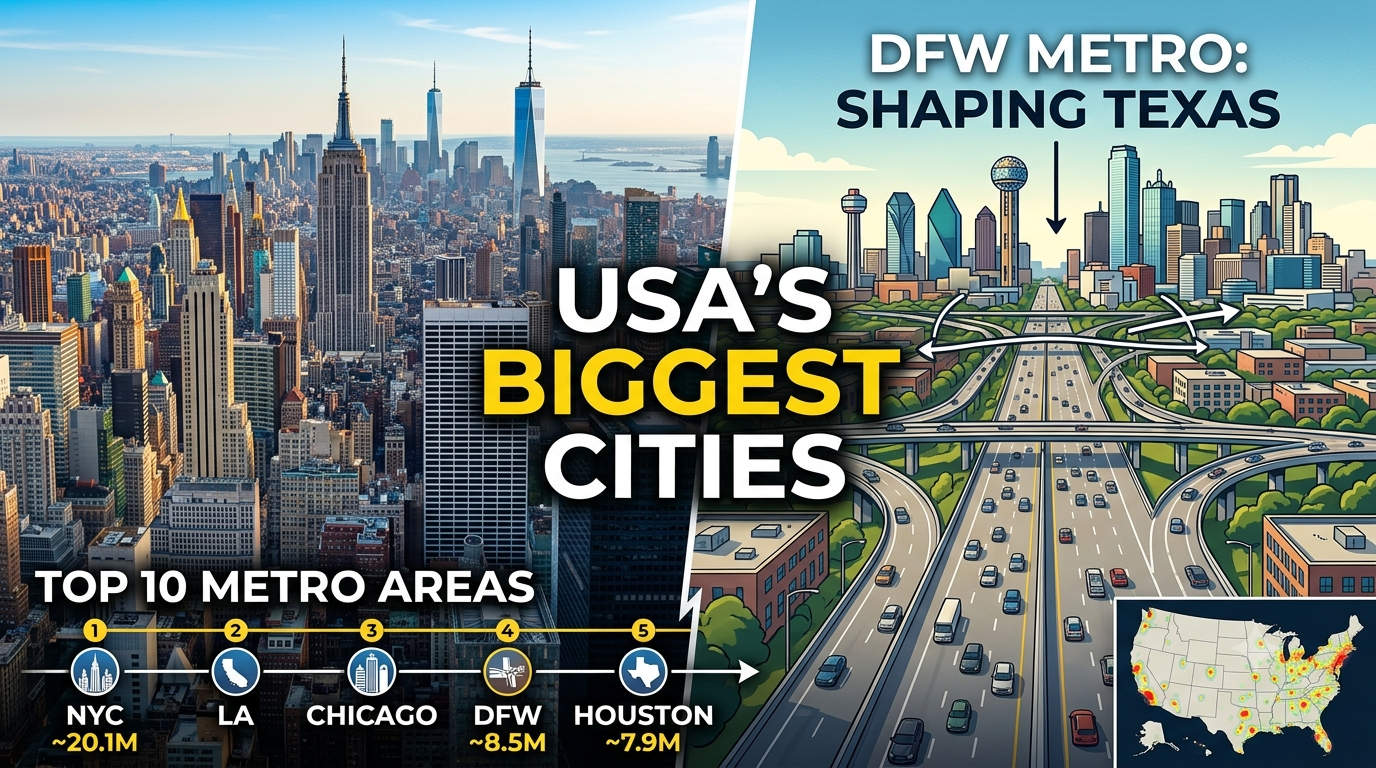
Looking beyond municipal lines reveals the true economic scale of American urban centers. Below is an overview of the top 10 most populated metropolitan areas in the United States:
| Rank | Metropolitan Area | Key States Included | Estimated Population |
| 1 | New York–Newark–Jersey City | NY, NJ, PA | ~20.1 Million |
| 2 | Los Angeles–Long Beach–Anaheim | CA | ~12.8 Million |
| 3 | Chicago–Naperville–Elgin | IL, IN, WI | ~9.4 Million |
| 4 | Dallas–Fort Worth–Arlington | TX | ~8.5 Million |
| 5 | Houston–Pasadena–The Woodlands | TX | ~7.9 Million |
| 6 | Atlanta–Sandy Springs–Roswell | GA | ~6.5 Million |
| 7 | Washington–Arlington–Alexandria | DC, VA, MD, WV | ~6.5 Million |
| 8 | Miami–Fort Lauderdale–West Palm Beach | FL | ~6.4 Million |
| 9 | Philadelphia–Camden–Wilmington | PA, NJ, DE, MD | ~6.3 Million |
| 10 | Phoenix–Mesa–Chandler | AZ | ~5.2 Million |
Key Takeaway: The top 10 metropolitan areas alone house more than 85 million residents—representing over a quarter of the entire U.S. population.
Key Population Trends and Demographic Shifts
Understanding where Americans live isn’t just about static numbers; it’s about tracking demographic migration patterns. Several major trends define the current U.S. urban landscape:
1. The Continued Rise of the Sunbelt
Over the past decade, states across the Sunbelt—specifically Texas, Florida, Georgia, and Arizona—have experienced explosive population growth. Metros like Dallas–Fort Worth and Houston have added hundreds of thousands of new residents due to favorable tax policies, lower cost of living, corporate relocations, and booming housing markets.
2. Suburbanization and the “Metropolitan Sprawl”
While city centers remain vibrant hubs for commerce and entertainment, suburban counties surrounding major cities are growing at a faster percentage rate than urban cores. Modern remote and hybrid work models have accelerated this migration, enabling families to prioritize space and affordability without severing ties to major regional job markets.
3. Coastal Legacy Giants Retain Economic Dominance
Despite outward migration trends toward southern and inland regions, long-established legacy metros—such as New York, Los Angeles, Chicago, and San Francisco—continue to hold unmatched advantages in total GDP, venture capital, financial markets, higher education, and global connectivity.
Conclusion
Whether measured by individual municipal lines or expansive regional footprints, America’s most populated places showcase incredible diversity, economic vitality, and geographic range. From the towering skyline of New York City to the sprawling developments across Texas and Arizona, these urban hubs continue to drive the nation’s future.
Penulis: W.S







Post Comment