
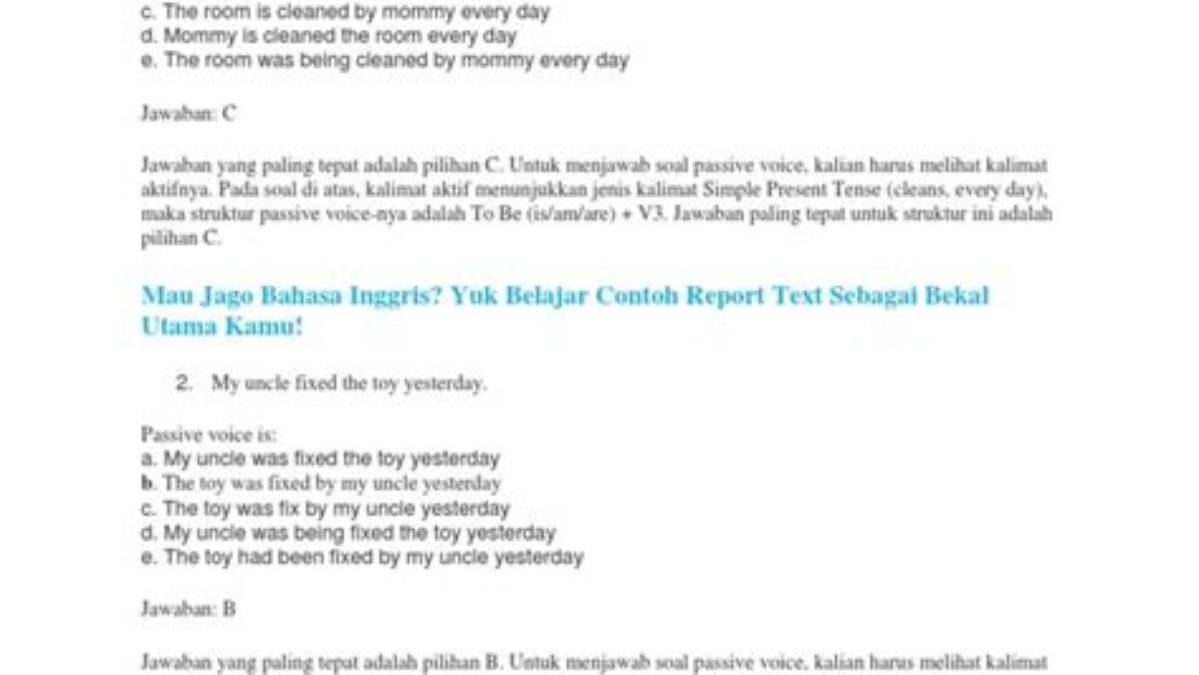
Passive voice untuk mahasiswa sering menjadi topik yang membingungkan, padahal penguasaannya penting untuk menulis akademik dan memahami teks bahasa Inggris. Artikel ini menyajikan tips praktis, contoh kalimat, kesalahan umum, dan soal latihan agar pemahaman Anda semakin kuat.
Pengertian Passive Voice
Passive voice adalah bentuk kalimat di mana subjek dikenai tindakan, bukan melakukan tindakan. Dalam bahasa Indonesia, passive voice setara dengan kalimat pasif yang sering diawali dengan “di-” atau “ter-”.
Perbedaan utama dengan active voice terletak pada fokus: active voice menekankan pelaku, sedangkan passive voice menekankan tindakan atau objek yang dikenai tindakan.
Rumus Dasar Passive Voice
Rumus umum passive voice adalah be + past participle (verb-3). Bentuk “be” menyesuaikan tenses dan subjek. Berikut variasi untuk tenses yang sering dipakai mahasiswa:
- Simple Present: am/is/are + V3
- Simple Past: was/were + V3
- Present Continuous: am/is/are being + V3
- Present Perfect: has/have been + V3
- Simple Future: will be + V3
- Modal: modal + be + V3
Contoh Kalimat Active ke Passive
Perhatikan perubahan berikut:
- Active: The professor explains the theory. → Passive: The theory is explained by the professor.
- Active: Students submitted the assignment. → Passive: The assignment was submitted by students.
- Active: The committee is reviewing the proposal. → Passive: The proposal is being reviewed by the committee.
- Active: They have finished the research. → Passive: The research has been finished by them.
Perhatikan bahwa objek active berubah menjadi subjek passive, dan pelaku active menjadi objek dengan “by” (jika perlu).
Tips Menguasai Passive Voice untuk Mahasiswa
1. Pahami Fungsi “Be”
Bentuk “be” harus sesuai dengan subjek dan tenses. Jika subjek tunggal dan present, gunakan “is”. Jika subjek jamak dan past, gunakan “were”. Latihlah mengenali subjek dan tenses terlebih dahulu.
2. Hafalkan Bentuk Past Participle
Past participle (V3) dari kata kerja tidak beraturan perlu dihafal. Buatlah daftar kata kerja umum di akademik seperti write–wrote–written, do–did–done, make–made–made, dan take–took–taken.
3. Fokus pada Objek
Passive voice dibentuk dari objek kalimat active. Jika kalimat active tidak memiliki objek, kalimat tersebut tidak dapat dipasifkan. Contoh: “She sleeps” tidak bisa menjadi passive karena tidak ada objek.
4. Gunakan “By” Hanya Jika Perlu
Pelaku dalam passive voice bersifat opsional. Jika pelaku tidak penting atau sudah jelas, hilangkan “by”. Contoh: “The window was broken” lebih natural daripada “The window was broken by someone”.
5. Perhatikan Verbs with Two Objects
Kata kerja seperti give, send, offer dapat memiliki dua objek. Dalam passive, salah satu objek bisa menjadi subjek. Contoh: Active: “They gave the student a scholarship.” Passive: “The student was given a scholarship” atau “A scholarship was given to the student.”
Kesalahan Umum Mahasiswa
- Salah memilih “be”: Menggunakan “is” untuk subjek jamak atau past tense.
- Lupa V3: Menggunakan V2 atau V-ing setelah “be”.
- Menambahkan “by” berlebihan: Padahal pelaku tidak perlu disebut.
- Menerjemahkan langsung dari bahasa Indonesia: Kalimat pasif bahasa Indonesia belum tentu cocok dipasifkan dalam bahasa Inggris.
Selalu periksa kembali subjek, tenses, dan bentuk kata kerja setelah menulis kalimat passive.
Latihan Soal
Kerjakan soal-soal berikut untuk menguji pemahaman Anda. Soal tidak diambil dari ujian resmi tahun tertentu, melainkan disusun untuk latihan mandiri.
Jika ingin memperdalam, kunjungi situs resmi penyedia materi bahasa Inggris atau buku tata bahasa yang tepercaya. Jangan ragu berkonsultasi dengan dosen atau tutor bahasa Inggris di kampus Anda.
Contoh Soal dan Pembahasan
-
Choose the correct passive form of: ‘The lecturer explains the material.’
- The material is explained by the lecturer.
- The material was explained by the lecturer.
- The material is being explained by the lecturer.
- The material has been explained by the lecturer.
Lihat jawaban dan pembahasan
Jawaban: A. The material is explained by the lecturer.
Kalimat aktif menggunakan simple present tense (explains). Maka passive voice menggunakan am/is/are + V3. Subjek ‘The material’ tunggal, sehingga gunakan ‘is’. V3 dari explain adalah explained. Jadi jawabannya ‘The material is explained by the lecturer.’
-
Which sentence is NOT grammatically correct in passive voice?
- The books were returned to the library.
- The results have been analyzed.
- The experiment is conducting by the researcher.
- The proposal will be submitted tomorrow.
Lihat jawaban dan pembahasan
Jawaban: C. The experiment is conducting by the researcher.
Opsi C salah karena menggunakan ‘is conducting’ (present continuous active) setelah ‘is’. Seharusnya ‘is being conducted’ untuk passive present continuous. Opsi lain sudah benar: were returned (past passive), have been analyzed (present perfect passive), will be submitted (future passive).
-
Change into passive: ‘The students are discussing the project.’
- The project is discussed by the students.
- The project is being discussed by the students.
- The project has been discussed by the students.
- The project was discussed by the students.
Lihat jawaban dan pembahasan
Jawaban: B. The project is being discussed by the students.
Kalimat aktif menggunakan present continuous (are discussing). Passive present continuous menggunakan am/is/are being + V3. Subjek ‘The project’ tunggal, jadi gunakan ‘is being discussed’. Opsi A adalah simple present passive, C present perfect passive, D simple past passive.
-
Complete the passive sentence: ‘A new policy … by the government last month.’
- is announced
- was announced
- has been announced
- will be announced
Lihat jawaban dan pembahasan
Jawaban: B. was announced
Keterangan waktu ‘last month’ menunjukkan simple past tense. Maka passive voice menggunakan was/were + V3. Subjek ‘A new policy’ tunggal, gunakan ‘was’. V3 dari announce adalah announced. Jadi ‘was announced’.
-
Rewrite in passive voice: ‘They have sent the invitation.’
- The invitation is sent by them.
- The invitation has been sent by them.
- The invitation was sent by them.
- The invitation will be sent by them.
Lihat jawaban dan pembahasan
Jawaban: B. The invitation has been sent by them.
Kalimat aktif menggunakan present perfect (have sent). Passive present perfect menggunakan has/have been + V3. Subjek ‘The invitation’ tunggal, gunakan ‘has been sent’. Opsi A simple present passive, C simple past passive, D future passive.
Pertanyaan yang Sering Diajukan
Apa perbedaan utama passive voice dan active voice?
Active voice menekankan pelaku tindakan, sedangkan passive voice menekankan objek yang dikenai tindakan. Dalam passive, subjek tidak melakukan aksi.
Apakah semua kalimat active bisa diubah menjadi passive?
Tidak. Kalimat active hanya bisa dipasifkan jika memiliki objek langsung (transitive verb). Kalimat dengan intransitive verb seperti 'sleep' tidak bisa dipasifkan.
Kapan sebaiknya menggunakan passive voice dalam tulisan akademik?
Passive voice berguna ketika pelaku tidak diketahui, tidak penting, atau ketika ingin menekankan proses atau hasil penelitian. Namun, jangan berlebihan agar tulisan tetap jelas.
Bagaimana cara cepat menentukan bentuk 'be' yang tepat?
Tentukan dulu tenses kalimat dan subjeknya. Untuk simple present, gunakan am/is/are; simple past gunakan was/were; present perfect gunakan has/have been. Latih dengan sering membaca contoh.
Baca Juga
- Tips Vocabulary untuk Wawancara Kerja beserta Contoh dan Pembahasan
- Tips Conditional Sentences beserta Contoh Soal dan Pembahasan
- Tips IELTS Writing Task 1 beserta Contoh Soal dan Pembahasan