
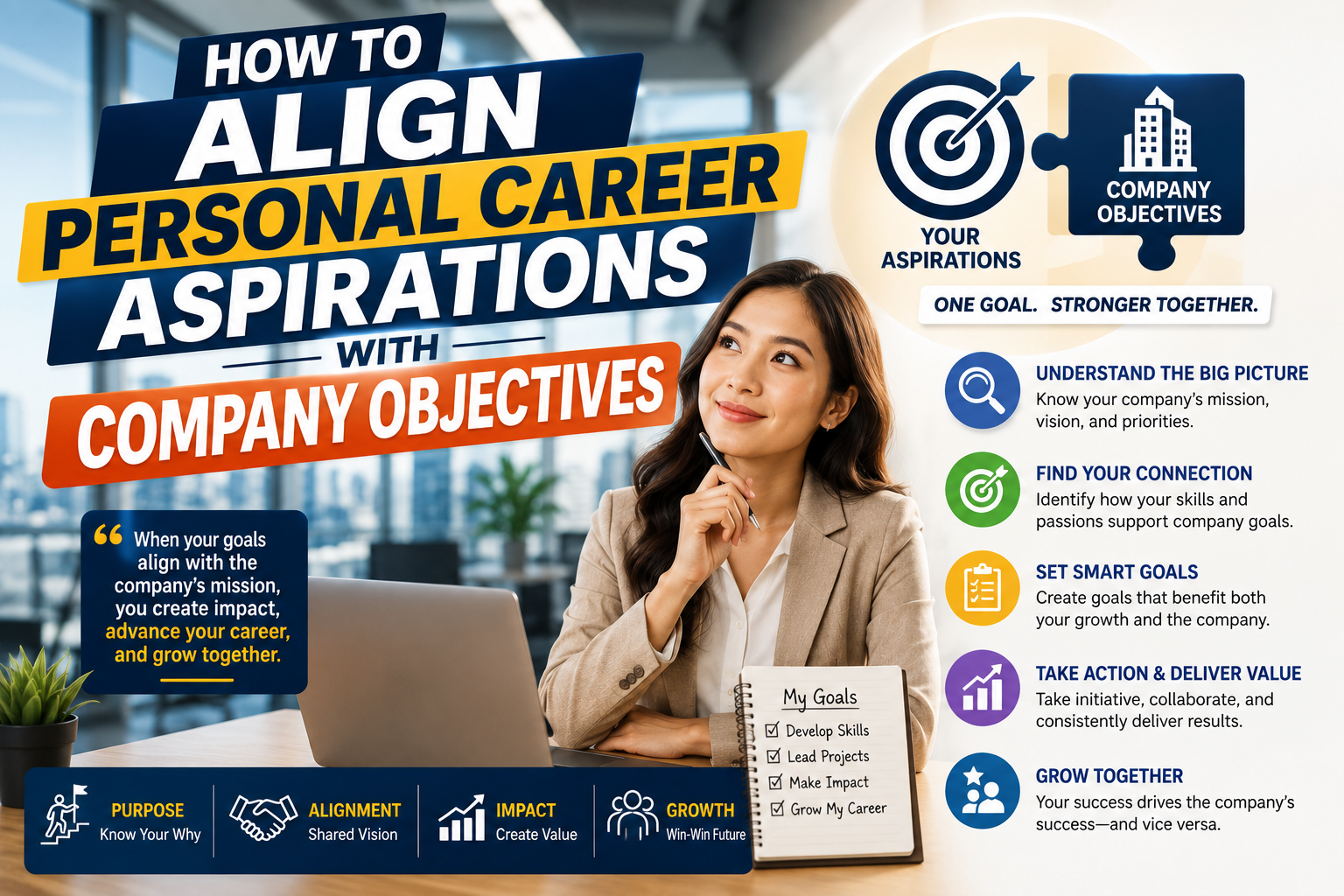
Aligning your personal career aspirations with your company’s objectives is one of the most effective strategies for long-term professional growth and workplace satisfaction. When your individual goals match the direction of your organization, work stops feeling like a series of transactional tasks and transforms into a meaningful journey where both you and your employer win.
This comprehensive guide explores why alignment matters, how to identify shared opportunities, and actionable strategies to map your personal career growth directly to your company’s strategic vision.
Why Alignment Between Personal Goals and Company Objectives Matters
Many professionals view career growth and corporate success as two separate tracks. However, operating in a silo often leads to burnout, disengagement, and stagnant progression. Merging your personal ambition with company targets creates a powerful synergy.
1. Accelerated Career Progression
When your achievements directly drive business outcomes, your value to the organization becomes measurable and unmistakable. Decision-makers naturally notice employees who solve core business challenges, making promotions, salary reviews, and high-visibility projects much easier to secure.
2. Enhanced Job Satisfaction and Purpose
Working toward a larger mission provides a sense of ownership. Understanding how your daily effort moves the needle on company key performance indicators (KPIs) adds intrinsic value to your daily tasks.
3. Increased Professional Resilience
Companies continuously evolve through market shifts, reorgs, and digital transformations. Employees who align their personal skill development with future corporate strategies remain adaptable, indispensable, and highly employable.
Step 1: Clarify Your Personal Career Aspirations
Before you can align with an organization, you must have absolute clarity on what you want out of your career. Without self-awareness, attempting to align with company goals can lead to adopting goals that aren’t genuinely yours.
Assess Your Core Motivators
Ask yourself the following fundamental questions:
-
Skill Acquisition: What specific technical or soft skills do I want to master over the next 12 to 36 months?
-
Leadership Aspirations: Do I want to manage people, oversee complex processes, or become an individual contributor expert?
-
Industry Impact: What kind of problems do I genuinely enjoy solving?
-
Work-Life Values: What environment enables me to perform at my peak (e.g., autonomy, cross-functional collaboration, strategic execution)?
Define Your 3-Year Vision
Write down a clear vision of where you want to be in three years. Focus on competencies, scope of influence, and project complexity rather than just job titles.
Step 2: Decode Your Company’s Strategic Objectives
Companies communicate their priorities constantly, but employees often miss the signal through the noise. To align effectively, you must learn how to read your organization’s strategic landscape.
+-------------------------------------------------------------------+
|                   COMPANY OBJECTIVES & VISION                     |
+-------------------------------------------------------------------+
                                  |
                                  v
+-------------------------------------------------------------------+
|               DEPARTMENTAL KPIs & TEAM TARGETS                    |
+-------------------------------------------------------------------+
                                  |
                                  v
+-------------------------------------------------------------------+
|             YOUR PERSONAL SKILLS & CAREER GOALS                   |
+-------------------------------------------------------------------+
Where to Find Strategic Priorities
-
Town Halls and All-Hands Meetings: Pay close attention to executive presentations, financial quarters reviews, and annual roadmaps.
-
Corporate Mission & Value Statements: Understand the core tenets guiding executive decision-making.
-
Internal KPIs and OKRs: Review team-level Objectives and Key Results (OKRs) to see where resource allocation is heading.
-
Company Annual Reports or Press Releases: For public companies, these documents reveal strategic bets, expansion plans, and risk factors.
Step 3: Identify the Intersection (The Alignment Matrix)
Once you understand both sides of the equation, map where your personal interests overlap with business needs.
| Personal Career Aspiration | Company Strategic Need | Aligned Strategic Action |
| Wanting to gain experience in data analytics | Company needs better customer retention insights | Volunteer to build automated churn prediction dashboards for your team. |
| Aiming to step into a leadership role | Company expanding into a new regional market | Offer to lead a cross-functional project task force for the rollout. |
| Developing public speaking and branding skills | Company focusing on employer branding and recruitment | Represent the company at industry webinars and career fairs. |
Look for “white space”—unaddressed problems in the company that match skills you want to build. Solving an unassigned problem that aligns with corporate strategy is the fastest way to showcase leadership.
Step 4: Communicate and Collaborate with Your Manager
Your direct manager is your primary ally in achieving professional alignment. Managers are tasked with meeting team quotas, but great managers also want to retain top talent by supporting career development.
Frame the Conversation Productively
Avoid framing request conversations purely around personal benefit (e.g., “I want to learn project management so I can get promoted”). Instead, frame them through mutual value:
“I am eager to develop advanced project management competencies this year. I noticed our team is struggling with cross-departmental delivery timelines. I would love to take ownership of organizing our upcoming project workflow to streamline delivery while building my skills in this area.”
Key Talking Points for 1-on-1s
-
Share your medium-term career aspirations openly.
-
Ask your manager about the biggest bottlenecks facing the department over the next six months.
-
Propose specific initiatives where your growth goals directly address those bottlenecks.
-
Establish clear benchmarks to evaluate success.
Step 5: Execute with Intent and Measure Results
Alignment is an ongoing process of execution, measurement, and adaptation. Once you have identified aligned initiatives, focus on delivering measurable impact.
Focus on High-Impact Deliverables
Prioritize work that moves major company metrics. If a personal passion project does not contribute to core business metrics, treat it as a secondary initiative or re-evaluate its immediate relevance.
Track Your Metrics
Keep a dedicated document (a “brag sheet” or impact log) tracking your contributions:
-
Revenue/Efficiency: Did your project save hours, reduce costs, or increase sales?
-
Leadership/Mentorship: Did you onboard new team members or run internal workshops?
-
Skill Progression: What tools or methodologies did you master during execution?
Common Pitfalls to Avoid
-
Over-compromising Your Values: Do not force alignment with company goals that conflict with your core ethics or long-term career trajectory.
-
Passive Expectation: Assuming management will figure out your career path for you. You must drive your own development.
-
Ignoring Market Trends: Ensure that the skills you build within your company are transferable and relevant across the broader industry.
Conclusion
Aligning your personal career aspirations with company objectives transforms your professional growth from a passive wait for promotion into an active, strategic partnership. By understanding company goals, identifying overlapping opportunities, communicating proactively with leadership, and consistently delivering measurable results, you create a sustainable model for career advancement that benefits both you and your organization.
Penulis: W.S