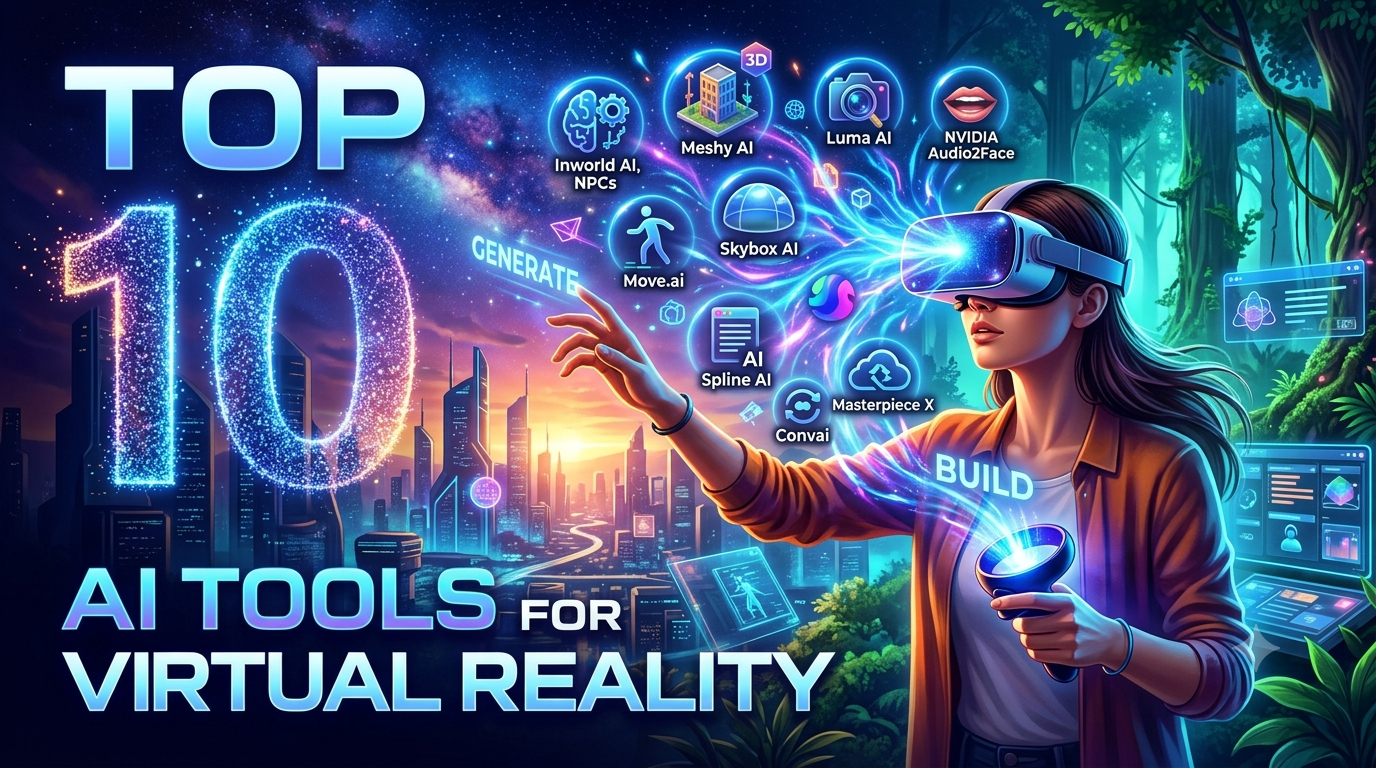
The convergence of Artificial Intelligence (AI) and Virtual Reality (VR) is fundamentally altering how immersive worlds, interactive environments, and spatial applications are built. Historically, constructing high-fidelity VR environments demanded hundreds of hours of manual 3D modeling, complex character rigging, spatial audio programming, and painstaking optimization. Today, generative AI tools are slashing production timelines from months to minutes, enabling indie developers, enterprise training teams, and studio creators to build hyper-realistic spatial experiences with unprecedented speed.
Whether you are developing VR games, enterprise simulations, virtual real estate tours, or social metaverse spaces, leveraging the right AI toolset is essential. This guide explores the top 10 AI tools for Virtual Reality, highlighting their core capabilities, target use cases, and how they streamline the VR production pipeline.
Strategic Summary: Top AI Tools for VR at a Glance
| AI Tool | Key Category / Focus | Primary VR Use Case | Key Strength |
| 1. Inworld AI | AI NPCs & Avatars | Non-player character AI & dynamic dialog | Context-aware, emotionally reactive VR characters |
| 2. Meshy AI | Text/Image-to-3D Asset Gen | Rapid 3D prop & environment creation | Generates textured 3D meshes in under 60 seconds |
| 3. Blockade Labs (Skybox AI) | 360° Panorama Generation | VR skyboxes & ambient world creation | Generates full 8K 360-degree environments from text |
| 4. Luma AI | NeRF & Gaussian Splatting | Real-world scanning & photorealistic assets | Ultra-realistic 3D neural reconstruction of physical spaces |
| 5. Convai | Conversational AI for Spatial Engine | Real-time voice interaction for VR avatars | Low-latency voice-to-action engine for Unreal & Unity |
| 6. Masterpiece X | Generative 3D Mesh & Rigging | Rapid character & prop prototyping | End-to-end 3D model, texture, and animation pipeline |
| 7. Move.ai | Markerless Motion Capture | VR character animation & full-body motion | Extracts full-body Mocap from standard camera footage |
| 8. Scenario | Style-Consistent AI Textures | Tailored texture sets & surface maps | Trains custom AI models on proprietary art styles |
| 9. NVIDIA Audio2Face | AI Facial Animation | Real-time avatar lip-sync & expression | Generates 3D facial animation directly from audio streams |
| 10. Spline AI | Spatial Design & WebVR | Interactive 3D web & VR prototyping | Prompt-assisted 3D web design and real-time editing |
Detailed Review of the Top 10 AI Tools for Virtual Reality
1. Inworld AI
Category: AI Characters & Spatial Dialog
Best For: VR gaming, training simulations, and interactive social environments.
Inworld AI goes beyond basic scripted dialogue, serving as an advanced character engine designed to power intelligent Non-Player Characters (NPCs) in virtual environments. By linking brain modules that manage memory, personality traits, emotional states, and spatial awareness, Inworld allows VR users to hold natural, unscripted voice conversations with virtual entities.
-
Key Features:
-
Contextual memory retention across multiple VR sessions.
-
Real-time spatial perception (characters know where the player is looking or moving).
-
Out-of-the-box integration plugins for Unity, Unreal Engine, and WebXR.
-
-
Why it Matters for VR: Immersive presence breaks down when characters repeat pre-recorded voice clips. Inworld AI delivers lifelike human interaction, making virtual training scenarios and narrative games infinitely replayable.
2. Meshy AI
Category: Generative Text/Image-to-3D
Best For: 3D modelers, game designers, and environment artists needing fast prop generation.
Meshy AI is a leading generative platform that transforms text prompts or 2D concept images into fully textured 3D meshes in less than a minute. It simplifies the complex labor of block-out modeling, UV unwrapping, and PBR (Physically Based Rendering) texture map generation.
-
Key Features:
-
Text-to-3D and Image-to-3D conversion algorithms.
-
Auto-generated PBR texture maps (diffuse, rough, normal, and metallic).
-
Clean topology export options in
.FBX,.OBJ, and.GLTFformats compatible with major VR engines.
-
-
Why it Matters for VR: Populating vast virtual worlds requires thousands of unique assets. Meshy eliminates background asset bottlenecks, freeing artists to focus on hero assets.
3. Blockade Labs (Skybox AI)
Category: Generative 360° Environment Generation
Best For: Concept artists, worldbuilders, and rapid skybox prototyping.
Blockade Labs’ Skybox AI allows creators to generate stunning, seamless 360-degree panoramic environments simply by typing a descriptive text prompt or sketching basic color blocks.
-
Key Features:
-
Instant generation of 8K panoramic skyboxes across various styles (photorealistic, anime, sci-fi, oil painting).
-
Depth map generation to convert 2D panoramas into interactive 3D mesh volumes.
-
Direct mesh and HDRI export for Unity, Unreal Engine, and spatial headsets like Meta Quest and Apple Vision Pro.
-
-
Why it Matters for VR: Skybox AI allows developers to build immersive background environments in seconds, drastically accelerating early-stage worldbuilding and scene conceptualization.
4. Luma AI
Category: Neural Radiance Fields (NeRF) & Gaussian Splatting
Best For: Photogrammetry, spatial capture, and real-world virtual twin creation.
Luma AI utilizes breakthrough NeRF (Neural Radiance Fields) and 3D Gaussian Splatting technologies to convert ordinary video clips recorded on mobile phones into hyper-realistic 3D scenes and assets.
-
Key Features:
-
High-fidelity spatial capturing with realistic reflections and lighting dynamics.
-
Web-based viewing and scene editing tools.
-
Interactive 3D spatial exports optimized for real-time VR rendering engines.
-
-
Why it Matters for VR: Traditional photogrammetry struggles with glossy, transparent, or intricate surfaces. Luma AI captures real-world locations and objects with cinematic accuracy, perfect for virtual tourism, architecture, and e-commerce.
5. Convai
Category: Conversational AI Engine for Virtual Worlds
Best For: Enterprise training, healthcare simulations, and voice-first spatial apps.
Convai provides an end-to-end conversational AI backend tailored specifically for spatial computing and virtual reality engines. It gives virtual avatars speech-to-speech interaction, cognitive reasoning, and the ability to execute physical actions inside a 3D environment based on voice commands.
-
Key Features:
-
Ultra-low latency voice recognition designed for head-mounted displays (HMDs).
-
Action trigger mapping (e.g., asking an avatar to “pick up the wrench and hand it to me”).
-
Robust SDKs for Unity and Unreal Engine.
-
-
Why it Matters for VR: VR is inherently spatial and hands-free. Convai makes virtual training instructors and assistant avatars capable of guiding users through complex physical procedures naturally.
6. Masterpiece X
Category: AI 3D Mesh & Animation Generator
Best For: Indie creators, non-technical developers, and rapid character creation.
Masterpiece X brings AI creation directly into spatial environments. By combining text-to-3D, automatic rigging, and motion generation into an intuitive workflow, creators can construct 3D objects, humanoids, and animations without leaving their VR headset or desktop workstation.
-
Key Features:
-
Generates fully rigged 3D humanoids and creatures from text descriptions.
-
Integrated auto-rigging engine ready for immediate character motion assignment.
-
Browser-based and native VR application access.
-
-
Why it Matters for VR: Character animation and rigging are two of the highest entry barriers in 3D development. Masterpiece X democratizes this process by turning natural language descriptions into game-ready characters.
7. Move.ai
Category: Markerless Motion Capture
Best For: Character animators, indie studios, and enterprise VR developers.
Move.ai uses advanced computer vision and artificial intelligence to extract accurate, full-body 3D motion capture data from standard video feeds (such as iPhones or action cameras), completely eliminating the need for expensive motion capture suits or optical marker setups.
-
Key Features:
-
Markerless tracking of body movements, fingers, and spatial posture.
-
High-precision motion filtering that cleans up jitter and occlusion automatically.
-
Direct skeleton retargeting to custom VR avatars.
-
-
Why it Matters for VR: Realistic human motion is vital for immersion in VR. Move.ai lowers the cost of professional motion capture by up to 90%, enabling small teams to produce AAA-level avatar animations.
8. Scenario
Category: Style-Consistent AI Texture & Asset Generation
Best For: VR game studios requiring consistent art directions across hundreds of assets.
Scenario is an AI platform designed specifically for game developers and 3D artists. Unlike broad generative tools, Scenario lets creators upload their own custom art style datasets to train specialized AI models that generate matching textures, UI elements, and surface materials.
-
Key Features:
-
Fine-tuned model training on proprietary studio art assets.
-
PBR texture generator for realistic physical reflections under variable VR lighting.
-
API integration for dynamic runtime content generation.
-
-
Why it Matters for VR: Maintaining visual consistency across expansive virtual worlds is challenging. Scenario ensures that every AI-generated texture strictly adheres to the project’s art direction.
9. NVIDIA Audio2Face
Category: AI-Driven Facial Animation
Best For: Photorealistic VR character design and cinematic virtual experiences.
Part of the NVIDIA Omniverse suite, Audio2Face uses deep neural networks to generate expressive 3D facial animations instantly from audio sound files. It automatically handles lip-syncing, eye movements, and facial muscular expressions in real time.
-
Key Features:
-
Real-time audio-to-facial performance streaming.
-
Customizable emotional weight parameters (joy, anger, confusion, sorrow).
-
Direct blendshape weight exports for Unreal Engine MetaHumans and custom 3D models.
-
-
Why it Matters for VR: In close-quarters VR interactions, subtle facial cues determine whether an avatar feels realistic or unsettling (“Uncanny Valley”). Audio2Face delivers realistic facial dynamics with minimal animator intervention.
10. Spline AI
Category: WebVR & 3D Spatial Design Platform
Best For: UX/UI designers, web developers, and lightweight WebXR applications.
Spline AI brings conversational prompt engineering into a collaborative, browser-based 3D design workspace. Users can prompt the AI to edit geometries, adjust lighting rigs, create animations, and generate real-time interactive physics models.
-
Key Features:
-
Text-to-scene modeling and lighting setup adjustments.
-
Browser-native real-time collaboration.
-
Export options for WebGL, WebXR, Apple Vision Pro, and interactive spatial websites.
-
-
Why it Matters for VR: Spline AI bridges the gap between traditional 2D web design and 3D spatial computing, making spatial UI prototyping accessible to web designers without deep game-engine knowledge.
How AI is Revolutionizing the VR Development Pipeline
The integration of artificial intelligence into virtual reality development is not just incrementally improving workflows—it is restructuring the entire spatial computing architecture:
[ Traditional VR Pipeline ]
Concept --> Manual 3D Modeling --> UV Mapping --> Rigging --> Scripted Logic --> Manual Optimization
Duration: Weeks to Months

[ AI-Augmented VR Pipeline ]
Text/Voice Prompt --> AI Mesh & Texture Gen --> Auto-Rigging --> AI NPC Behavior --> Real-Time Optimization
Duration: Minutes to Hours
-
Democratization of 3D Worldbuilding: Generative tools like Meshy AI and Skybox AI empower solo creators to build environment scale that previously required team-sized studios.
-
Infinite Interactive Replayability: Non-deterministic AI character engines (Inworld AI, Convai) turn static linear VR narrative scripts into dynamic world ecosystems.
-
Hyper-Realistic Reality Capture: Technologies like NeRFs and Gaussian Splatting (Luma AI) drastically shorten the time required to digitize real-world spaces for industrial twins, medical training, and real estate.
-
Performance Optimization: Machine learning models now optimize real-time frame rates via AI upscaling (such as NVIDIA DLSS) and eye-tracked dynamic foveated rendering, which are vital for preventing motion sickness in head-mounted displays.
Best Practices for Implementing AI Tools in VR Development
To maximize productivity while maintaining visual fidelity and performance, keep these strategic tips in mind:
-
Optimize Mesh Density for Mobile VR: AI-generated 3D meshes often contain dense geometry. Always pass AI-generated models through decimation or auto-retopologizing workflows before importing them into standalone headsets like Meta Quest.
-
Maintain Visual Consistency: Combine text-to-3D tools with style-consistent engines like Scenario to prevent mixed visual art styles within the same virtual scene.
-
Prioritize Low-Latency Audio: When using AI conversational engines for VR avatars, keep response latency under 300 milliseconds. High audio latency breaks user immersion and spatial presence.
-
Leverage Hybrid Workflows: Treat generative AI tools as powerful base-mesh or concept generators. Have experienced 3D artists perform final polish, collision box mapping, and material tuning.
Can I build a complete VR application using only AI tools?
While AI tools can generate up to 80% of assets, audio, dialogue, and code snippets, human developers and designers are still necessary for core spatial UX design, performance profiling, and comfort optimization.
Which AI tools are best for standalone headsets like Meta Quest?
Tools like Skybox AI (for light ambient backgrounds), Meshy AI (with decimated low-poly settings), and Convai (for lightweight cloud-hosted avatar backends) are ideal for mobile VR hardware constraints.
What is the difference between NeRFs and traditional 3D models in VR?
Traditional 3D models use polygonal meshes and texture maps. Neural Radiance Fields (NeRFs) use neural networks to represent volumetric light fields, resulting in higher photorealism and dynamic reflection handling, though they require specific rendering pipelines.
Conclusion
The fusion of AI and Virtual Reality marks the beginning of a new era in spatial computing. By automating repetitive asset generation, streamlining character rigging, and introducing conversational intelligence to virtual worlds, these top 10 AI tools for Virtual Reality empower creators to bring immersive visions to life faster and more cost-effectively than ever before. Integrating these technologies into your pipeline today will position you at the forefront of the spatial web revolution.
Penulis: W.S







Post Comment