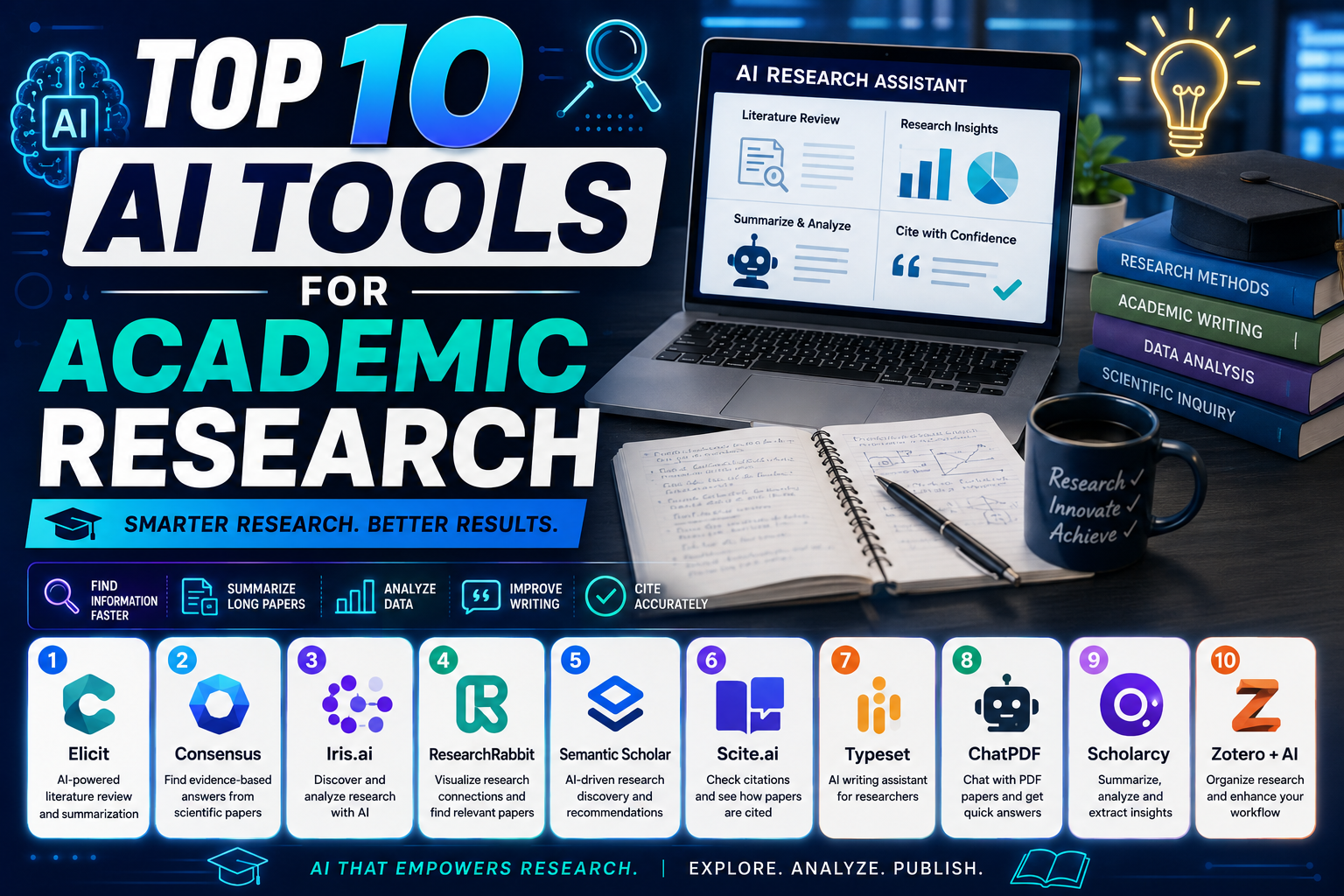
The landscape of higher education and scientific discovery has undergone a monumental shift. With millions of scholarly articles published annually across global repositories, academics, PhD candidates, and research institutions face unprecedented information overload.
Navigating dense literature, synthesizing cross-disciplinary evidence, extracting structured parameters, and verifying citation integrity manually can take months.
Artificial Intelligence (AI) designed specifically for scholarly workflows has emerged as an indispensable partner for modern researchers. By leveraging domain-specific large language models (LLMs), natural language processing (NLP), and semantic citation graphs, academic AI tools reduce administrative literature burdens while maintaining scientific rigor.
Whether you are preparing a systematic literature review, screening references, analyzing complex data, or drafting a journal manuscript, here is your definitive guide to the top 10 AI tools for academic research.
1. Consensus: Best for Evidence Synthesis & Scientific Consensus
Consensus functions as an AI-powered academic search engine connected to a database of over 200 million peer-reviewed research papers. Unlike general commercial search engines that query unverified web pages, Consensus searches academic literature directly and synthesizes findings into evidence-backed answers.
Research Query ──► 200M+ Peer-Reviewed Papers ──► Consensus AI ──► Consensus Meter (% Yes / No / Mixed)
Key Features
-
Consensus Meter: Analyzes hundreds of papers on a specific research question and calculates a visual consensus score (e.g., whether published literature leans “Yes”, “No”, or “Mixed”).
-
Study Snapshots: Automatically extracts sample sizes, study designs, methodologies, and main findings from published papers.
-
Deep Search & Analysis: Synthesizes multiple studies simultaneously to evaluate conflicting scientific findings across disciplines.
-
Best For: Rapid hypothesis testing, validating claims, and evaluating scientific agreement before beginning a deep literature review.
-
Pricing: Free tier available; Pro plan starts at $15/month.
2. Elicit: Best for Automated Literature Reviews & Data Extraction
Elicit is widely recognized as one of the premier tools for automated literature reviews and structured evidence extraction. Built on a corpus of over 138 million papers, Elicit automates the tedious aspects of academic desk research.
Key Features
-
Structured Comparison Tables: Automatically extracts study objectives, methodologies, sample sizes, dependent/independent variables, and main conclusions into customizable tables.
-
Semantic Discovery: Retrieves relevant papers even if they do not match exact keyword phrases by evaluating semantic intent.
-
Custom PDF Extraction: Upload your own private PDF repository and run structured extractions across multiple files simultaneously.
-
Best For: Systematic literature reviews, meta-analyses, and cross-study methodology comparisons.
-
Pricing: Basic free plan available; Pro plan starts at $49/month.
3. scite.ai: Best for Citation Context & Verification
A major risk in academic writing is citing a paper whose findings have since been contradicted, corrected, or retracted. scite.ai solves this problem by analyzing the full text of over 300 million research articles using its signature “Smart Citations”.
Key Features
-
Smart Citation Classification: Categorizes every citation statement as Supporting, Contradicting, or Mentioning the cited claim.
-
Reference Check: Scans uploaded draft manuscripts to verify whether any cited references have been contested or retracted by subsequent studies.
-
Full-Text Indexing: Indexes citation statements directly within the body text rather than relying solely on reference lists at the end of papers.
-
Best For: Citation integrity checks, peer-review quality control, and verifying research replication.
-
Pricing: 7-day free trial; Individual plans start at $20/month.
4. Paperpal: Best for Academic Manuscript Writing & Language Polishing
Publishing in prestigious journals requires strict adherence to academic style, precise domain terminology, and error-free grammar. Trained on millions of published research articles, Paperpal is an AI writing assistant tailored specifically for scholars and non-native English authors.
Key Features
-
Real-time Academic Editing: Refines sentence structure, vocabulary, and technical clarity while preserving scientific meaning.
-
Journal Submission Readiness Check: Scans manuscripts across 30+ structural and language parameters, including ethics statements, citation formatting, and figure references.
-
Contextual Paraphrasing: Reduces wordiness and transforms informal drafting into publication-grade academic prose.
-
Best For: Postgraduates and researchers polishing drafts prior to journal submission.
-
Pricing: Free plan with daily limits; Premium access starts at ~$19/month.
5. SciSpace (Typeset): Best for Interactive PDF Reading & Paper Comprehension
Reading long, dense academic PDFs filled with complex math equations, jargon, and intricate figures can create significant bottlenecks. SciSpace acts as an AI reading copilot, allowing researchers to interact directly with any paper via a natural language chat interface.
Key Features
-
Interactive PDF Copilot: Highlight confusing text, mathematical formulas, or complex charts to receive instant, simplified explanations.
-
Multilingual Translation: Translates and explains scientific papers across 75+ languages in real time.
-
Literature Mapping: Visualizes how papers connect through citations, co-citations, and shared topics.
-
Best For: Early-career researchers, interdisciplinary study, and fast paper screening.
-
Pricing: Free tier available; Premium plan starts at $12/month.
6. ResearchRabbit: Best for Visual Citation Mapping & Discovery
Often referred to as the “Spotify for academic literature”, ResearchRabbit transforms traditional keyword searches into dynamic, visual networks. It tracks citation chains and automatically recommends relevant articles based on user collections.
Key Features
-
Interactive Network Graphs: Visualizes relationships between authors, co-authors, citations, and early/late papers on dynamic graphs.
-
Personalized Recommendations: Learns your research interests from saved paper folders and alerts you when new related studies are published.
-
Zotero Integration: Syncs seamlessly with reference managers to import and export libraries effortlessly.
-
Best For: Mapping historical lineages of research, discovering bridge studies between fields, and visual learners.
-
Pricing: 100% Free for researchers.
7. Semantic Scholar: Best Free AI Academic Search Engine
Developed by the Allen Institute for AI, Semantic Scholar is a free, non-profit academic search engine powered by machine learning. It indexes over 200 million papers across all academic disciplines.
Key Features
-
TLDR Summaries: Uses natural language processing to generate automated one-sentence summaries of a paper’s main contribution.
-
Citation Intent: Classifies whether a paper cites another for methodology, background, or result comparison.
-
Highly Influential Citations: Identifies citations where the cited paper significantly determined the methodology or outcome of the work.
-
Best For: Fast abstract screening, open-access paper discovery, and tracking foundational studies.
-
Pricing: 100% Free.
8. NotebookLM: Best for Source-Grounded Document Synthesis
Google’s NotebookLM is a research assistant that builds a personalized language model grounded strictly in your uploaded materials. Unlike standard LLMs that pull from the open web, NotebookLM relies exclusively on your provided PDFs, transcripts, and notes.
Key Features
-
Zero-Hallucination Grounding: Responds solely based on your uploaded documents, tagging every insight with inline citations to your original files.
-
Audio Overviews: Converts dense research files into dynamic, podcast-style audio discussions for listening on the go.
-
Multi-Document Synthesis: Cross-analyzes and synthesizes findings across dozens of large research papers or primary transcripts simultaneously.
-
Best For: Qualitative data synthesis, organizing thesis notes, and reading private literature archives.
-
Pricing: Free with a Google Account.
9. Julius AI: Best for Natural Language Data Analysis & Visualization
Data analysis usually requires writing code in Python, R, or SPSS. Julius AI acts as a virtual data scientist, allowing researchers to upload structured spreadsheets (CSV, Excel) and analyze them using natural language prompts.
Key Features
-
Natural Language Queries: Generates descriptive statistics, regression models, and hypothesis testing by asking questions in simple prose.
-
Automated Data Visualization: Produces publication-ready scatter plots, box plots, heatmaps, and histograms.
-
Code Transparency: Displays the exact Python or R script used for calculations, ensuring full scientific reproducibility.
-
Best For: Exploratory data analysis, quick statistical visualization, and cleaning structured research data.
-
Pricing: Free tier available; Paid plans start at $20/month.
10. Litmaps: Best for Real-Time Citation Network Mapping
Understanding how a research field evolved over time is crucial when writing comprehensive literature reviews. Litmaps creates real-time, interactive maps of citation trees, showing how landmark papers led to modern developments.
Key Features
-
Chronological Citation Trees: Plots papers along a timeline according to publication date and citation count.
-
Seed Paper Mapping: Input a single foundational paper, and Litmaps automatically generates the surrounding research landscape.
-
Gaps Analysis: Helps researchers spot unexamined areas and missing links between established topics.
-
Best For: Visualizing field overviews, detecting influential foundational papers, and tracking research trends over time.
-
Pricing: Free plan available; Educational Pro starts at $10/month.
Summary Comparison Table
| AI Tool | Primary Research Workflow | Standout Feature | Pricing Model |
| Consensus | Claim verification & evidence check | Consensus Meter & study summaries | Free / $15/mo |
| Elicit | Literature review & data extraction | Structured comparison tables | Free / $49/mo |
| scite.ai | Citation verification & reference check | Classifies citations as Supporting/Contradicting | 7-Day Trial / $20/mo |
| Paperpal | Manuscript editing & journal formatting | 30+ point submission readiness check | Free / ~$19/mo |
| SciSpace | Interactive PDF reading & explanation | AI Copilot for math, charts, and translation | Free / $12/mo |
| ResearchRabbit | Visual literature discovery | Spotify-style network graph suggestions | 100% Free |
| Semantic Scholar | Academic search & abstract screening | AI-generated TLDR summaries | 100% Free |
| NotebookLM | Private document synthesis | Hallucination-free Q&A on uploaded PDFs | Free |
| Julius AI | Data analysis & statistical plotting | Natural language statistical analysis & code generation | Free / $20/mo |
| Litmaps | Citation tree mapping & trend analysis | Interactive chronological citation maps | Free / $10/mo |
How to Build an Effective AI Academic Workflow
No single AI tool covers every phase of an academic project. To build a reliable workflow, combine specialized tools across different research stages:
[Phase 1: Exploration]      Consensus + ResearchRabbit / Litmaps
        │
        ▼
[Phase 2: Extraction]       Elicit + NotebookLM + scite.ai
        │
        ▼
[Phase 3: Analysis]         Julius AI
        │
        ▼
[Phase 4: Manuscript Draft] SciSpace + Paperpal
-
Phase 1: Discovery & Background: Start with Consensus to evaluate scientific agreement and ResearchRabbit or Litmaps to map citation networks visually.
-
Phase 2: Extraction & Reference Check: Use Elicit to build structured comparison tables, synthesis with NotebookLM, and run citations through scite.ai to check for retractions or disputes.
-
Phase 3: Data Analysis: Deploy Julius AI to explore structured datasets and create publication-grade charts.
-
Phase 4: Writing & Proofreading: Read dense references with SciSpace and polish your manuscript with Paperpal before submitting to journals.
Best Practices & Ethical Considerations
When utilizing AI in academic research, maintaining academic integrity is essential:
-
Always Verify Primary Sources: AI tools can occasionally misinterpret text or pull out-of-context quotes. Always read full-text primary articles before citing them.
-
Protect Intellectual Property: Avoid uploading confidential datasets, unpublished patent ideas, or unredacted human subject data into unencrypted AI models.
-
Comply with Institutional Guidelines: Review your university or publisher policy on AI disclosure. Most top journals (e.g., Nature, Elsevier, IEEE) require transparent disclosure of AI assistance during paper writing.
By pairing human critical thinking with domain-specific AI platforms, researchers can eliminate administrative friction and accelerate meaningful discoveries.
Penulis: W.S








Post Comment