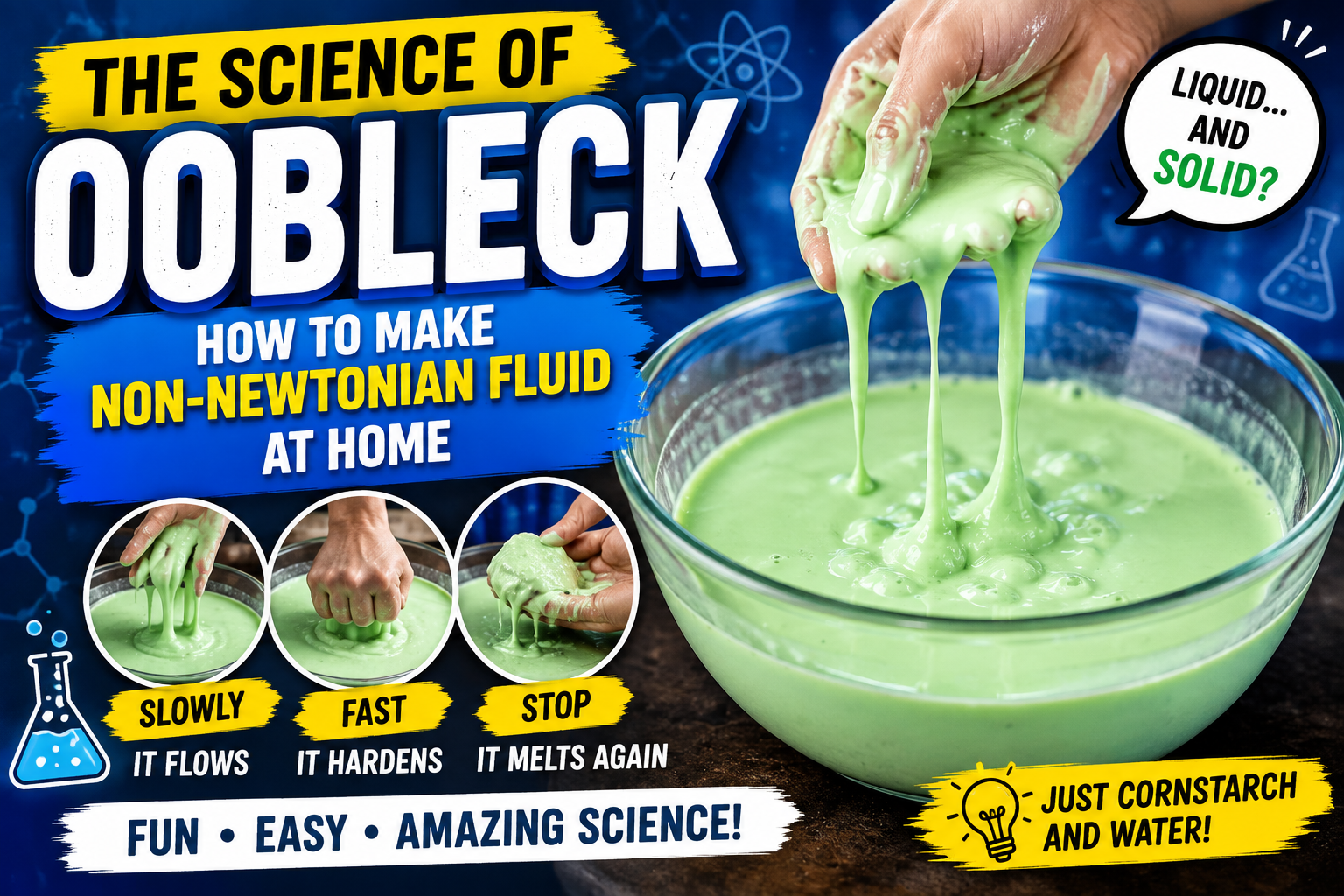
Have you ever touched a substance that feels like a liquid when you move slowly but becomes surprisingly firm when you squeeze or hit it? That fascinating material is called oobleck, a simple mixture that demonstrates the science of a non-Newtonian fluid.
Oobleck is easy to make at home using just cornstarch and water. It is also an excellent hands-on science experiment for students, families, and anyone curious about how materials behave under pressure. Unlike ordinary liquids such as water, oobleck does not have a constant viscosity. Its behavior changes depending on the force applied to it.
In this guide, you will learn what oobleck is, why it behaves differently from normal liquids, how to make it at home, and the science behind this unusual material.
What Is Oobleck?
Oobleck is a mixture made primarily from cornstarch and water. It gets its unusual name from the Dr. Seuss book Bartholomew and the Oobleck, in which a strange substance falls from the sky.
From a scientific perspective, oobleck is a type of non-Newtonian fluid. This means its flow behavior changes when force or stress is applied.
A traditional Newtonian fluid, such as water, has a relatively constant viscosity under normal conditions. Whether you pour water slowly or quickly, its basic resistance to flow remains fairly consistent.
Oobleck behaves differently. When you apply force quickly, it can become temporarily more resistant to movement. When you handle it gently, it can flow more easily.
This makes oobleck an excellent demonstration of fluid mechanics and material science.
What Makes Oobleck a Non-Newtonian Fluid?
The secret behind oobleck is its composition. Unlike a typical liquid, oobleck contains a large number of tiny solid cornstarch particles suspended in water.
When you move your hand slowly through the mixture, the particles have enough time to move around each other. The mixture therefore behaves more like a liquid.
However, when you apply a sudden force, the particles can become tightly packed. The water between the particles cannot move out of the way quickly enough, causing the mixture to resist the applied force.
This phenomenon is often described as shear thickening.
In simple terms, oobleck can become more resistant to flow when it experiences rapid deformation. Once the force is removed, the particles can move apart again, allowing the mixture to behave more like a fluid.
How to Make Oobleck at Home
Making oobleck requires only a few basic ingredients and supplies.
Ingredients
- 2 cups cornstarch
- Approximately 1 cup water
- A large mixing bowl
- A spoon or spatula
- Food coloring, if desired
The exact amount of water may vary. The goal is to create a mixture that feels solid when you apply quick pressure but flows when you handle it slowly.
Step-by-Step Instructions
Step 1: Add the cornstarch
Pour approximately two cups of cornstarch into a large bowl. Make sure the bowl is large enough to allow you to mix everything without making a mess.
Step 2: Add water gradually
Slowly add water while mixing the cornstarch. Do not pour all the water in at once because the consistency can become too thin.
Start with about half a cup and gradually add more as needed.
Step 3: Mix thoroughly
Use a spoon or your hands to combine the ingredients. Continue mixing until there are no large dry areas of cornstarch.
The mixture should feel unusual. When you press it quickly, it should resist your hand. When you move slowly, it should begin to flow.
Step 4: Adjust the consistency
If the oobleck is too watery, add more cornstarch. If it is too dry or difficult to move, add a small amount of water.
Make adjustments gradually until you achieve the desired consistency.
Step 5: Add food coloring
If you want colorful oobleck, add a few drops of food coloring to the water before mixing it with the cornstarch. This can make the experiment more visually interesting.
How to Test Oobleck
Once your oobleck is ready, you can perform several simple experiments to observe its unusual behavior.
Try Moving Your Hand Slowly
Place your hand into the oobleck and move it slowly. You should notice that the mixture allows your hand to move through it relatively easily.
This demonstrates how the material can behave like a fluid when subjected to gentle movement.
Apply Quick Pressure
Now try pressing the surface quickly with your hand or fingers. You may notice that the mixture suddenly feels much firmer.
The rapid force causes the suspended particles to interact differently, increasing the material’s resistance to movement.
Pick It Up
Try grabbing a small amount of oobleck and squeezing it gently. When you apply pressure, it can temporarily hold together like a solid.
Then stop squeezing and allow it to rest in your hand. It will begin flowing again.
This simple activity demonstrates why oobleck is often called a non-Newtonian fluid.
Oobleck vs. Ordinary Water
The easiest way to understand oobleck is to compare it with water.
Water is considered a Newtonian fluid because its viscosity remains relatively consistent under ordinary changes in applied force. If you stir water slowly or quickly, it still behaves like a conventional liquid.
Oobleck has a different response to force. Its viscosity can increase dramatically when it is subjected to rapid stress.
This difference makes oobleck a useful demonstration of how materials can behave differently depending on the conditions around them.
Why Does Oobleck Feel Solid?
One of the most interesting questions is why a mixture of powder and water can suddenly feel solid.
The answer involves the movement of cornstarch particles. At rest or during slow movement, the particles can rearrange and allow the mixture to flow.
When a rapid force is applied, the particles become crowded and interact more strongly. The surrounding water cannot immediately move through the crowded particle network.
As a result, the mixture temporarily resists deformation.
This does not mean that oobleck permanently becomes a solid. When the force is removed, the particles can rearrange again, and the material returns to its more fluid-like behavior.
Common Oobleck Mistakes
Making oobleck is simple, but a few mistakes can affect the result.
Adding Too Much Water
Excess water can make the mixture too runny. If this happens, gradually add more cornstarch.
Adding Too Much Cornstarch
A mixture with too much cornstarch may become difficult to move. Add small amounts of water until the desired consistency is reached.
Not Mixing Properly
Dry pockets of cornstarch can make the mixture inconsistent. Mix thoroughly until the ingredients are evenly combined.
Pouring It Down the Drain
Oobleck should not be washed directly down a household drain because cornstarch can accumulate and contribute to blockages. Instead, allow the mixture to dry and dispose of it in the appropriate household waste, following local disposal guidance.
Is Oobleck Safe for a Science Experiment?
Oobleck is generally a simple, low-risk science activity when made with ordinary food-grade cornstarch and water. However, it can create a significant mess, so it is best to perform the experiment on a protected surface.
Avoid getting the mixture into your eyes, and wash your hands after the experiment. Young children should conduct the activity with adult supervision.
Also remember that oobleck is not intended to be eaten, even though cornstarch itself is a common food ingredient.
Why Is Oobleck a Great STEM Experiment?
Oobleck combines several important science concepts in one easy activity. It can introduce students to physics, chemistry, fluid mechanics, viscosity, force, pressure, and material science.
Instead of simply reading about non-Newtonian fluids, students can observe the behavior directly. They can test different amounts of force and compare how the mixture responds.
This makes oobleck particularly useful for hands-on STEM education.
Final Thoughts
Oobleck is one of the simplest ways to explore the fascinating science of non-Newtonian fluids at home. With just cornstarch and water, you can create a material that flows like a liquid under gentle movement but becomes much more resistant when exposed to rapid force.
The science behind oobleck comes from the interaction between suspended cornstarch particles and water. When force is applied quickly, the particles become crowded and resist movement, producing the unusual behavior that makes oobleck so fascinating.
Whether you are conducting a school science project, looking for a fun STEM activity, or simply curious about material science, making oobleck at home is an easy experiment that turns a few everyday ingredients into an impressive lesson in physics.
Penulis: Shofiya M.P







Post Comment