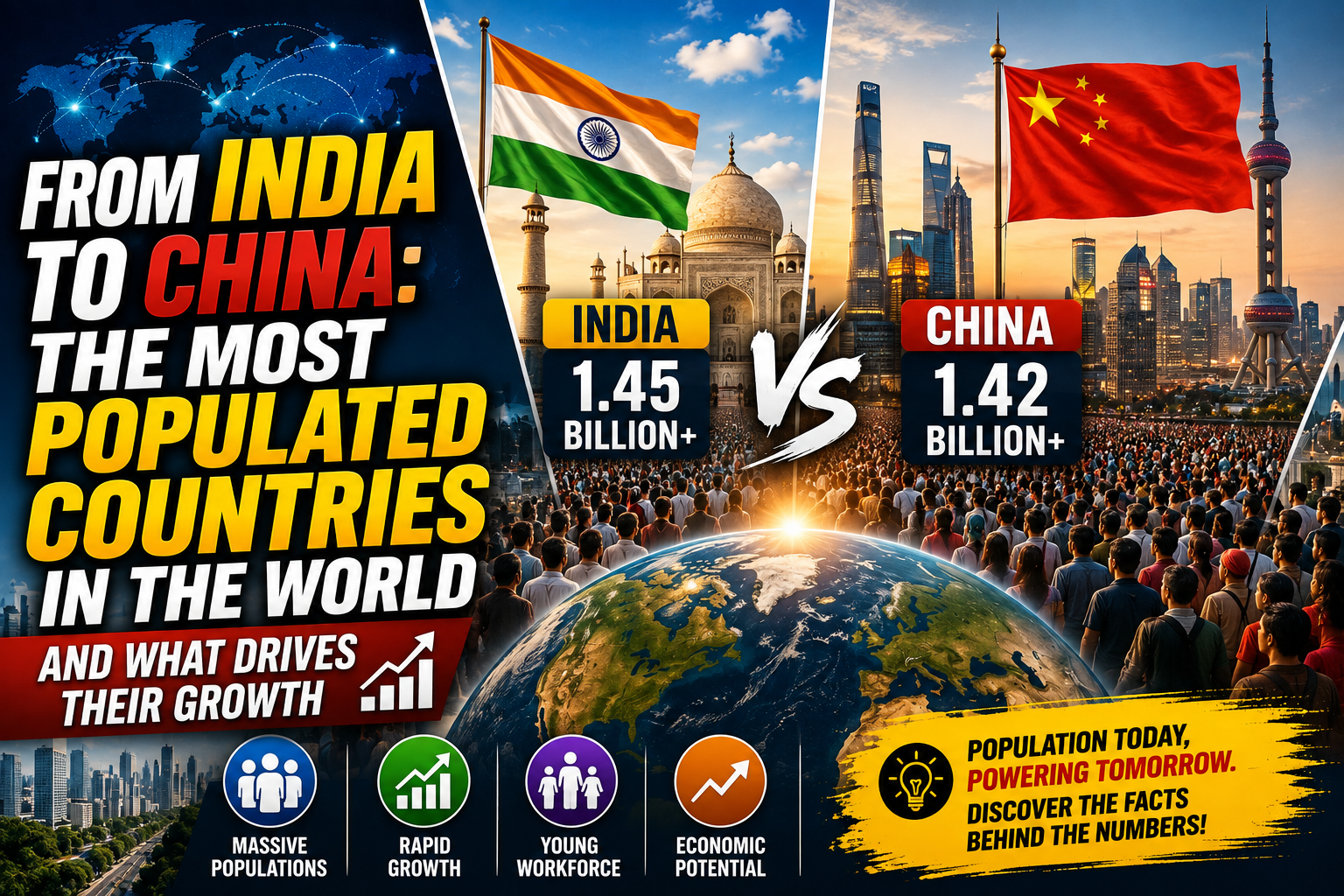
The human population stands at approximately 8.3 billion people. Global demographic patterns are undergoing a profound transformation. While the overall planetary growth rate has slowed down significantly compared to the late 20th century, the spatial distribution of humanity is shifting rapidly toward South Asia and Sub-Saharan Africa.
Understanding current population dynamics is essential for evaluating global trade markets, labor supplies, resource sustainability, and geopolitical shifts.
This 2026 Update provides a comprehensive ranking of the world’s most populous nations, examining their current demographic statistics, annual growth trajectories, and key socioeconomic trends shaping their futures.
At a Glance: Complete Ranking of the Top 10 Most Populated Countries
The table below summarizes the world’s ten largest nations by population according to the latest United Nations demographic estimates and national statistical projections:
| Rank | Country | Region | Estimated Population (2026) | Global Population Share | Annual Growth Rate |
|---|---|---|---|---|---|
| 1 | India | Southern Asia | ~1.477 Billion | 17.8% | +0.87% |
| 2 | China | Eastern Asia | ~1.413 Billion | 17.0% | -0.22% |
| 3 | United States | Northern America | ~349 Million | 4.2% | +0.51% |
| 4 | Indonesia | Southeastern Asia | ~288 Million | 3.5% | +0.76% |
| 5 | Pakistan | Southern Asia | ~259 Million | 3.1% | +1.60% |
| 6 | Nigeria | Western Africa | ~242 Million | 2.9% | +2.06% |
| 7 | Brazil | South America | ~214 Million | 2.6% | +0.35% |
| 8 | Bangladesh | Southern Asia | ~178 Million | 2.1% | +1.21% |
| 9 | Russia | Eastern Europe / Asia | ~143 Million | 1.7% | -0.42% |
| 10 | Ethiopia | Eastern Africa | ~139 Million | 1.7% | +2.53% |
Key Demographic Takeaway: Together, India and China account for nearly 35% of all human life on Earth. However, their pathways have permanently diverged: India is expanding steadily toward its peak, whereas China has officially entered an era of sustained structural population decline.
Detailed Profiles of the Top 10 Nations
1. India — ~1.477 Billion
- Capital: New Delhi
- Global Share: ~17.8%
- Annual Growth: +0.87%
India officially claimed the title of the world’s most populous nation in 2023 and continues to widen its lead over China. With over 50% of its population under the age of 25 and a median age of roughly 28 years, India possesses an unprecedented “demographic dividend.”
Key Statistics & Drivers:
- A expanding labor force of over 600 million working-age citizens is fueling rapid economic expansion, technological manufacturing, and service exports.
- Fertility rates have dropped near replacement levels (~2.0 births per woman) nationally, though population momentum will carry growth through the early 2060s.
- Urbanization is accelerating around key economic hubs including Mumbai, Delhi NCR, Bengaluru, and Hyderabad.
2. China — ~1.413 Billion
- Capital: Beijing
- Global Share: ~17.0%
- Annual Growth: -0.22% (Declining)
After holding the top spot for centuries, China’s population is now actively shrinking. Decades of the mandatory One-Child Policy (1980–2016), combined with high living costs and changing social dynamics, have created a historically low total fertility rate (~1.0–1.2 births per woman).
Key Statistics & Drivers:
- China faces a severe aging demographic; by 2050, roughly one-third of its population will be aged 60 or older.
- The working-age population has been contracting for over a decade, accelerating automation, robotics, and economic structural reforms.
- Demographers estimate China’s population could drop below 1.26 billion by 2050.
3. United States — ~349 Million
- Capital: Washington, D.C.
- Global Share: ~4.2%
- Annual Growth: +0.51%
The United States remains the third most populous nation and the only high-income, developed economy in the top ten. Unlike its Western European and East Asian peers, the U.S. continues to expand at a steady pace.
Key Statistics & Drivers:
- Net International Migration: Immigration accounts for the vast majority of net population gains, offsetting declining domestic birth rates.
- High geographic diversity, with major sunbelt states (Texas, Florida) and metropolitan centers absorbing rapid inward migration.
- Projections suggest the U.S. will maintain its #3 or #4 position through mid-century, approaching 380 million residents by 2050.
4. Indonesia — ~288 Million
- Capital: Jakarta (Transitioning to Nusantara)
- Global Share: ~3.5%
- Annual Growth: +0.76%
Indonesia ranks 4th globally as Southeast Asia’s largest economy and demographic center. Over half of its population resides on the island of Java, creating extreme population density in and around Jakarta.
Key Statistics & Drivers:
- Indonesia holds the world’s largest Muslim-majority population.
- To combat severe environmental pressure and land subsidence in Jakarta, the nation is actively constructing a new administrative capital, Nusantara, in East Kalimantan.
- A young, digitally native consumer base is driving rapid growth in Southeast Asia’s technology and e-commerce markets.
5. Pakistan — ~259 Million
- Capital: Islamabad
- Global Share: ~3.1%
- Annual Growth: +1.60%
Pakistan ranks 5th globally, featuring one of the highest birth rates among major Asian economies. With a median age under 23, Pakistan is home to a massive youth population.
Key Statistics & Drivers:
- Rapid numerical growth has placed structural strains on educational systems, energy grids, and water infrastructure.
- Megacities like Karachi and Lahore rank among the world’s most populous and densely inhabited urban centers.
- UN models project Pakistan could cross 370 million people by 2050, potentially overtaking Indonesia.
6. Nigeria — ~242 Million
- Capital: Abuja
- Global Share: ~2.9%
- Annual Growth: +2.06%
Nigeria is Africa’s premier demographic heavyweight. Expanding at over 2% per year, Nigeria represents the rapid population growth taking place across Sub-Saharan Africa.
Key Statistics & Drivers:
- Median Age: Just 18 years, making it one of the youngest societies on the planet.
- Lagos is expanding into a hyper-megacity projected to become one of the world’s largest urban centers by the end of the century.
- Long-Term Projection: Nigeria is on track to surpass the United States around 2045–2050 to become the 3rd most populous country in the world.
7. Brazil — ~214 Million
- Capital: Brasília
- Global Share: ~2.6%
- Annual Growth: +0.35%
Brazil is South America’s largest nation in both geographical territory and population. Over the last two decades, Brazil’s total fertility rate has dropped to ~1.6 births per woman, causing growth to slow dramatically.
Key Statistics & Drivers:
- Highly urbanized population: over 87% of Brazilians live in major cities such as São Paulo and Rio de Janeiro.
- Brazil is entering an aging phase faster than historically anticipated, with total population expected to peak before 2050.
8. Bangladesh — ~178 Million
- Capital: Dhaka
- Global Share: ~2.1%
- Annual Growth: +1.21%
Bangladesh ranks 8th globally despite occupying a compact land area of ~147,000 square kilometers, resulting in an extraordinary density exceeding 1,300 people per square kilometer.
Key Statistics & Drivers:
- Successful public health initiatives and voluntary community family planning have brought fertility rates down significantly over recent decades.
- As a low-lying nation, Bangladesh faces severe climate vulnerability, making urban planning in Dhaka a critical national priority.
9. Russia — ~143 Million
- Capital: Moscow
- Global Share: ~1.7%
- Annual Growth: -0.42% (Declining)
Spanning 11 time zones across Europe and Asia, Russia possesses vast territorial landmass but suffers from structural demographic contraction (-0.42% annually).
Key Statistics & Drivers:
- Low birth rates combined with elevated mortality rates among working-age demographics drive long-term declines.
- Government initiatives such as “Maternity Capital” grants attempt to boost birth rates, but total numbers are projected to fall toward 136 million by 2050.
10. Ethiopia — ~139 Million
- Capital: Addis Ababa
- Global Share: ~1.7%
- Annual Growth: +2.53%
Ethiopia completes the top ten list as East Africa’s central demographic hub. Growing at +2.53% annually, Ethiopia is expanding faster than any other nation in the global top ten.
Key Statistics & Drivers:
- High fertility rates and a large rural population transitioning toward light-manufacturing urban hubs.
- Ethiopia’s population is projected to exceed 200 million before mid-century.
Major Global Demographic Shifts
+--------------------------------------------------------------------------+
|                     GLOBAL DEMOGRAPHIC PARADIGMS                         |
+--------------------------------------------------------------------------+
| 1. Sub-Saharan Africa  --> Dominates global growth (>50% of total gains) |
| 2. East Asia & Europe  --> Facing acute aging and contraction            |
| 3. South Asia          --> Peak working-age workforce & expansion        |
+--------------------------------------------------------------------------+
Analyzing current global population data reveals three overarching structural trends:
1. The Sub-Saharan Growth Engine
While growth has stalled in North America, Europe, and East Asia, Sub-Saharan Africa is driving the majority of global population expansion. Nations like Nigeria, Ethiopia, the Democratic Republic of the Congo, and Tanzania will contribute more than half of all global population gains through 2050.
2. Acute Aging and Depopulation in East Asia & Europe
East Asian nations (South Korea, Japan, China, Taiwan) and parts of Eastern and Southern Europe (Italy, Greece, Ukraine, Russia) are experiencing historically low fertility rates. Shrinking workforces in these regions are pushing rapid adoption of artificial intelligence, industrial automation, and pension system overhauls.
3. Accelerated Urbanization & Megacities
By 2050, roughly 70% of the global population will reside in urban environments. The growth of megacities (urban zones with >10 million people)—such as Greater Delhi, Tokyo, Shanghai, Dhaka, Lagos, and Cairo—requires unprecedented investments in sustainable transportation, housing, clean water, and energy infrastructure.
Long-Term Future Projections (2050 Outlook)
According to United Nations Medium-Variant projections, the total human population is expected to reach approximately 9.7 billion by 2050, peaking at roughly 10.3 billion in the 2080s.
Here is how the top rankings are projected to look by mid-century:
      PROJECTED TOP 7 POPULATIONS BY 2050 (UN PROJECTIONS)
      ====================================================
      1. INDIA          | ############################ ~1.68 Billion
      2. CHINA          | ##################### ~1.26 Billion
      3. USA            | ###### ~380 Million
      4. PAKISTAN       | ###### ~371 Million
      5. NIGERIA        | ###### ~359 Million
      6. INDONESIA      | ##### ~320 Million
      7. ETHIOPIA       | #### ~225 Million
What is the most populated country in the world?
India is the most populated country in the world, with an estimated population of 1.477 billion people.
What is the total world population?
The global human population stands at approximately 8.30 billion people.
Why is China’s population shrinking?
China’s population contraction is driven by decades under the strict One-Child Policy, high urban living expenses, and shifting cultural preferences toward smaller families, resulting in a fertility rate well below the replacement level of 2.1.
Which country will be the 3rd most populous in the world by 2050?
Demographic projections indicate that Nigeria will pass the United States around 2045–2050 to claim the #3 spot globally, reaching over 350 million inhabitants.
Penulis: W.S





Post Comment