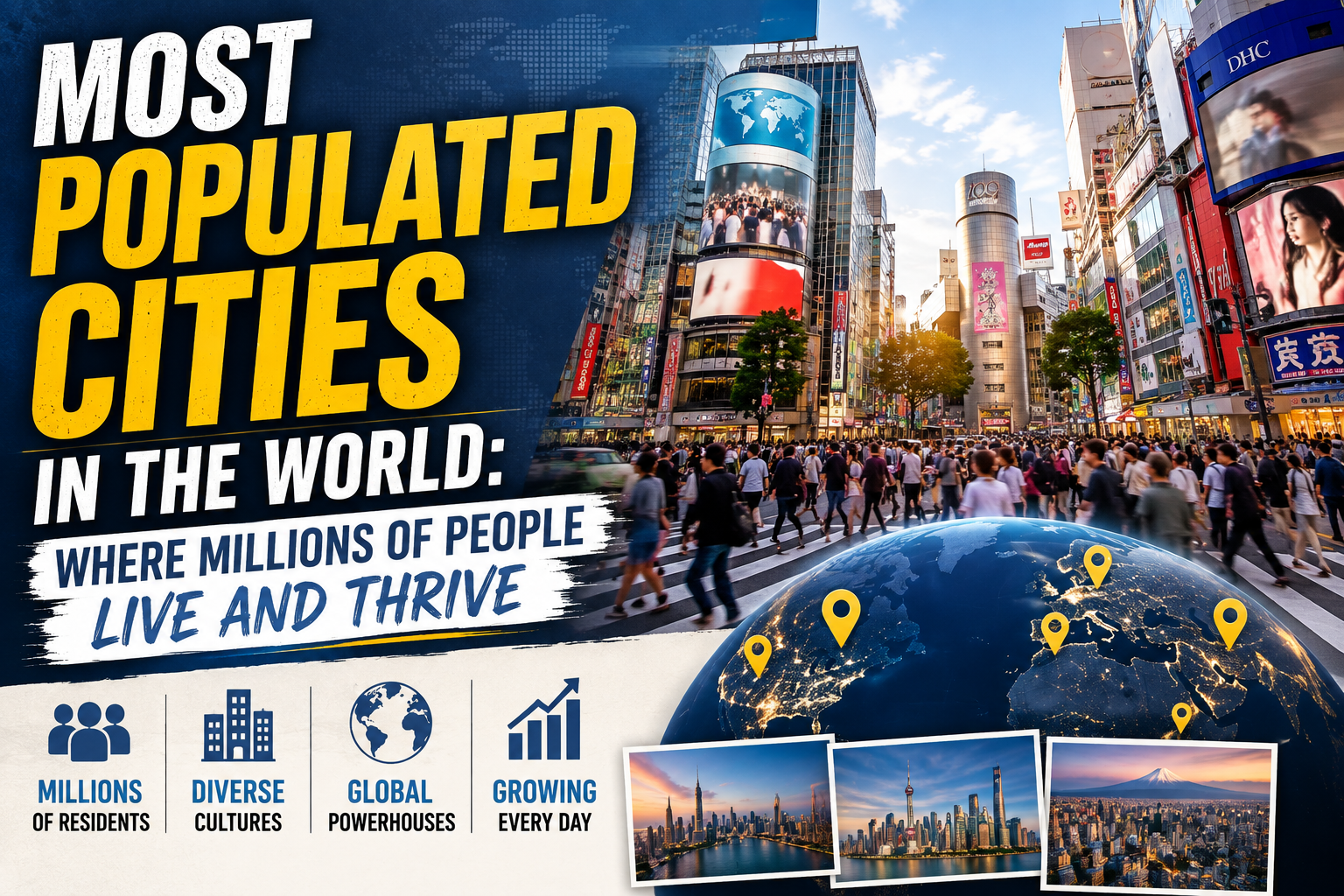
The story of human civilization is increasingly a story of urbanization. Over 57% of the world’s population currently lives in urban areas, and demographers project that this figure will reach nearly 70% by mid-century. At the heart of this rapid transition are the world’s megacities—vast, dynamic metropolitan areas home to over 10 million people.
These urban giants are more than just dense demographic hubs; they are global engines of economic growth, technological innovation, and cultural synthesis. Understanding how these megacities function requires looking beyond administrative borders to examine urban agglomerations—the continuous built-up areas where millions of residents live, commute, and thrive every single day.
Here is an in-depth exploration of the world’s most populated cities, the dynamics driving their growth, and how urban centers adapt to sustain tens of millions of inhabitants.
The Landscape of Global Megacities
Measuring city populations accurately depends heavily on how municipal borders are defined:
- City Proper: Strictly follows administrative and legal boundaries.
- Metropolitan Area: Includes the economic hinterland and commuter belt connected to the core city.
- Urban Agglomeration / Conurbation: Encompasses contiguous built-up urban land that merges surrounding cities into a single physical entity.
When measured by metropolitan footprint and urban agglomeration, Asia stands out as the global epicenter of megacities, housing over 60% of the world’s top urban populations.
Ranking the Top 10 Most Populated Urban Agglomerations
| Rank | Megacity / Urban Region | Primary Country | Estimated Metropolitan Population | Key Defining Feature |
| 1 | Jakarta (Jabodetabek) | Indonesia | ~42,400,000 | Fast-growing economic capital of Southeast Asia |
| 2 | Dhaka | Bangladesh | ~37,400,000 | Dynamic textile & service export hub |
| 3 | Tokyo (Greater Tokyo Area) | Japan | ~33,300,000 | Benchmark for public transit efficiency & safety |
| 4 | Delhi (National Capital Region) | India | ~30,400,000 | Northern India’s political & commercial core |
| 5 | Shanghai | China | ~29,900,000 | Global financial powerhouse & world’s largest container port |
| 6 | Guangzhou (Pearl River Delta) | China | ~27,700,000 | World-leading manufacturing & trade node |
| 7 | Cairo (Greater Cairo) | Egypt | ~25,800,000 | Historic & industrial center of the Arab World |
| 8 | Manila (Metro Manila) | Philippines | ~24,800,000 | High-density service & digital economy engine |
| 9 | Kolkata | India | ~22,600,000 | Cultural capital & commercial gateway of Eastern India |
| 10 | Seoul (Capital Area) | South Korea | ~22,500,000 | High-tech smart city housing half of Korea’s population |
(Note: Extended conurbation models that merge the entire Pearl River Delta into a single contiguous region estimate Guangzhou-Shenzhen-Foshan’s combined footprint at up to 73.6 million residents).
In-Depth Look: Where Millions Thrive
1. Jakarta (Jabodetabek Conurbation), Indonesia
Anchoring the Indonesian economy, Greater Jakarta—known locally as Jabodetabek (comprising Jakarta, Bogor, Depok, Tangerang, and Bekasi)—houses over 42 million people in its extended commuting region.
- How It Thrives: Jakarta serves as the retail, startup, and financial heart of Southeast Asia’s largest economy. Infrastructure initiatives, including the Mass Rapid Transit (MRT) network and high-speed rail connections, continue to modernize urban movement across the metropolis.
2. Dhaka, Bangladesh
Dhaka is among the fastest-expanding megacities on Earth, driven by steady rural-to-urban migration and a global manufacturing trade.
- How It Thrives: As the center of Bangladesh’s garment export economy, Dhaka has transformed into a resilient commercial powerhouse. The rollout and expansion of the Dhaka Metro Rail system have significantly improved daily mobility for millions of urban commuters.
3. Tokyo (Greater Tokyo Area), Japan
For decades, Tokyo held the top spot as the world’s most populous single metropolitan area. While Japan’s overall national population is gradually aging, Greater Tokyo—including Yokohama, Kawasaki, and Saitama—remains an unbeatable benchmark for high-density living.
- How It Thrives: Tokyo thrives through hyper-efficient public transportation, impeccably timed rail transit, extremely low crime rates, and world-class culinary and technological ecosystems.
4. Delhi (National Capital Region), India
Delhi NCR connects New Delhi with rapidly growing satellite cities like Gurgaon, Noida, Ghaziabad, and Faridabad.
- How It Thrives: Combining ancient heritage with a sprawling modern tech footprint, Delhi functions as the political, cultural, and logistics hub of Northern India.
5. Shanghai, China
Positioned at the mouth of the Yangtze River, Shanghai is the crown jewel of China’s global trade network.
- How It Thrives: Shanghai hosts the world’s busiest container port and a financial district (Lujiazui) that competes directly with London and New York. Its public transit system is among the longest and most sophisticated globally.
Why People Move to Megacities: The Pull Factors
The concentration of human civilization into megacities is driven by powerful economic, social, and structural forces:
1. Agglomeration Economies
Businesses locate where deep talent pools and supply chains exist. This creates a positive feedback loop: more corporate headquarters generate higher employment, which in turn attracts top-tier talent from across the globe.
2. Infrastructure & Higher Education
Megacities centralize critical assets—specialized healthcare facilities, top research universities, international airports, and venture capital firms—that rural or mid-sized cities cannot match at scale.
3. Social & Cultural Diversity
Large urban centers act as melting pots. Independent creative industries, culinary arts, fashion, and global entertainment sectors flourish where diverse populations collide.
How Megacities Solve Big Challenges
Managing cities with 20 to 40+ million residents requires monumental planning. Modern megacities are pioneering innovative urban solutions to maintain quality of life:
- Transit-Oriented Development (TOD): Cities are designing mixed-use high-density zones centered around mass transit stations, allowing residents to live, work, and shop without relying on personal automobiles.
- Smart Grid Management: Utilizing IoT sensors to manage energy distribution, optimize traffic light timing in real time, and monitor water supply networks.
- Green Infrastructure: Integrating urban forests, rooftop gardens, and permeable pavements (sponge city concepts) to mitigate urban heat island effects and manage stormwater run-off.
Frequently Asked Questions (FAQ)
What is the most populated city in the world?
Depending on measurement methodology:
- By metropolitan area / urban agglomeration, Jakarta (Indonesia) leads with approximately 42.4 million residents.
- By broadest continuous build-up conurbation, China’s Pearl River Delta (anchored by Guangzhou and Shenzhen) reaches up to 73.6 million residents.
Why do population numbers vary between different ranking lists?
Sources disagree because they apply different boundary definitions:
- City Proper: Strictly legal corporate limits.
- Metropolitan Area: Commuter zones linked economically.
- Urban Agglomeration: Continuous physically built-up urban footprint.
Which megacity is growing the fastest?
Cities in South Asia (like Dhaka, Bangladesh) and Sub-Saharan Africa (like Kinshasa, DR Congo, and Luanda, Angola) report the world’s highest annual urban growth rates, often exceeding 2% to 5% annually.
Penulis: W.S





Post Comment