Language is the backbone of human civilization. It connects cultures, drives international trade, facilitates global diplomacy, and fuels the exchange of ideas across borders. While there are over 7,000 living languages spoken across the globe today, human communication is remarkably concentrated. A small fraction of these languages accounts for the majority of global interaction.
Whether you are a business leader expanding into international markets, a student deciding which language to learn next, or a digital creator aiming for global reach, understanding which languages dominate global communication is essential.
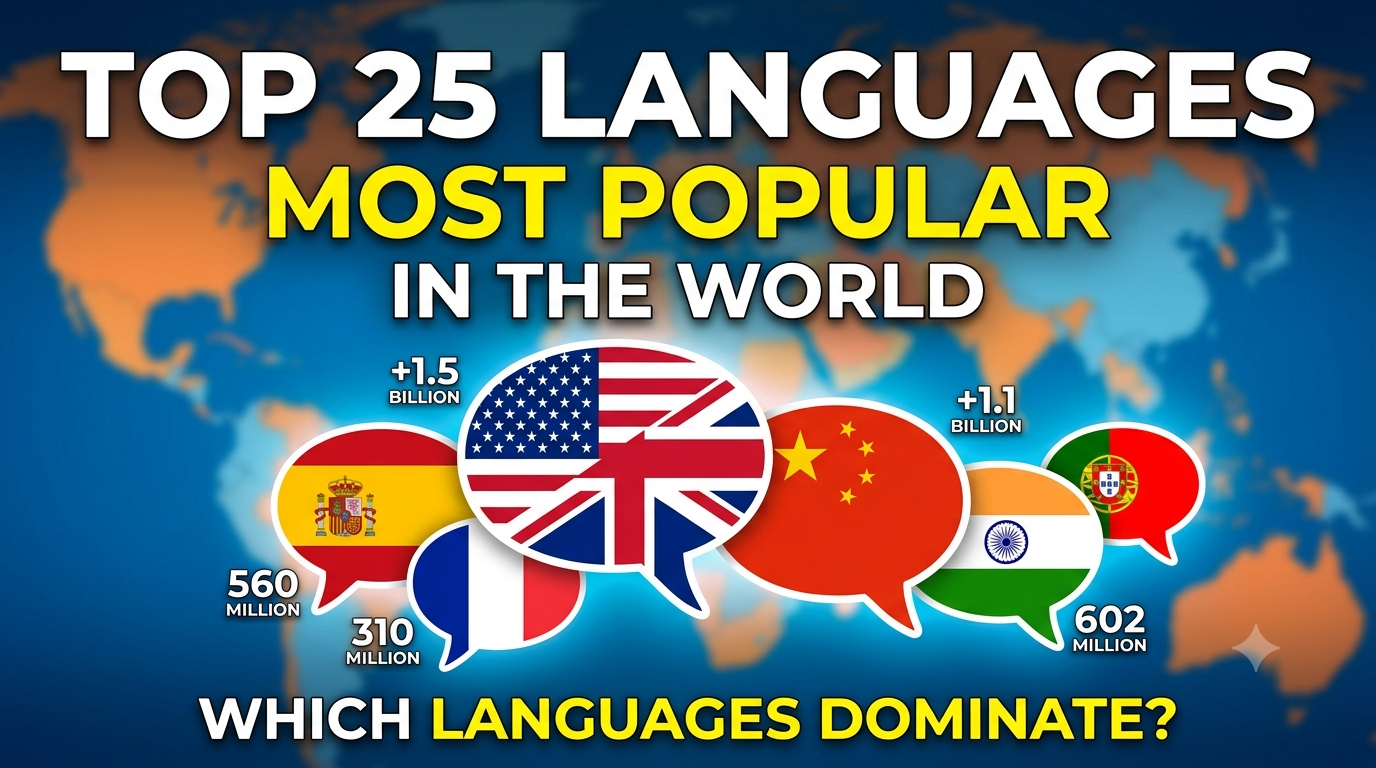
This comprehensive guide breaks down the Top 25 most popular languages in the world based on total speakers (native and second-language speakers combined), explores the factors driving their dominance, and looks at where global communication is headed next.
Understanding the Numbers: Native vs. Second-Language Speakers
When measuring a language’s popularity, linguists separate speakers into two main categories:
- L1 Speakers (Native): People who learned the language as their first language in early childhood.
- L2 Speakers (Second Language): People who learned the language for work, education, or social integration and use it alongside their native tongue.
Some languages, like Mandarin Chinese, possess massive numbers due to immense native populations. Others, like English, dominate primarily because of their widespread adoption as a global lingua franca (a common language used between speakers of different native tongues).
Quick Reference Table: Top 25 Most Spoken Languages
| Rank | Language | Primary Regions / Origin | Approx. Total Speakers |
| 1 | English | Global (USA, UK, Canada, Australia, India, etc.) | ~1.5 Billion |
| 2 | Mandarin Chinese | China, Taiwan, Singapore, Southeast Asia | ~1.12 Billion |
| 3 | Hindi | India, Nepal | ~602 Million |
| 4 | Spanish | Latin America, Spain, United States | ~560 Million |
| 5 | French | France, West & Central Africa, Canada | ~310 Million |
| 6 | Modern Standard Arabic | Middle East, North Africa | ~274 Million |
| 7 | Bengali | Bangladesh, India (West Bengal) | ~272 Million |
| 8 | Portuguese | Brazil, Portugal, Angola, Mozambique | ~264 Million |
| 9 | Russian | Russia, Eastern Europe, Central Asia | ~255 Million |
| 10 | Urdu | Pakistan, India | ~231 Million |
| 11 | Indonesian | Indonesia | ~200 Million |
| 12 | German | Germany, Austria, Switzerland | ~133 Million |
| 13 | Japanese | Japan | ~123 Million |
| 14 | Nigerian Pidgin | Nigeria | ~120 Million |
| 15 | Egyptian Arabic | Egypt | ~102 Million |
| 16 | Marathi | India (Maharashtra) | ~99 Million |
| 17 | Telugu | India (Andhra Pradesh, Telangana) | ~96 Million |
| 18 | Turkish | Turkey, Northern Cyprus | ~90 Million |
| 19 | Tamil | India (Tamil Nadu), Sri Lanka, Singapore | ~86.6 Million |
| 20 | Yue / Cantonese | China (Guangdong, Hong Kong), Macao | ~86.6 Million |
| 21 | Vietnamese | Vietnam | ~85.8 Million |
| 22 | Wu Chinese | China (Shanghai, Zhejiang) | ~83.4 Million |
| 23 | Tagalog | Philippines | ~83 Million |
| 24 | Korean | South Korea, North Korea | ~81.7 Million |
| 25 | Farsi / Persian | Iran, Afghanistan, Tajikistan | ~78.6 Million |
In-Depth Analysis: The Top 10 Global Powerhouses
1. English — The World’s Lingua Franca
- Total Speakers: ~1.5 Billion
- Native Speakers: ~380 Million
- Key Regions: USA, UK, Canada, Australia, New Zealand, Ireland, India, Singapore
English holds the undisputed title of the world’s global lingua franca. While it ranks third in native speaker count, its massive adoption as a second language—over 1.1 billion non-native speakers—makes it the primary operating system for international aviation, science, maritime communication, digital technology, and global commerce. More than half of all digital content on the internet is published in English.
2. Mandarin Chinese — The Demographic Titan
- Total Speakers: ~1.12 Billion
- Native Speakers: ~929 Million
- Key Regions: China, Taiwan, Singapore
Mandarin Chinese boasts the largest number of native speakers on the planet. As the primary official language of China, its influence is tightly bound to China’s status as a global economic super-power. Although its tonal structure and logographic writing system pose a steep learning curve for non-native learners, Mandarin’s importance in international supply chains, manufacturing, and technology continues to drive its global study.
3. Hindi — South Asia’s Communication Hub
- Total Speakers: ~602 Million
- Native Speakers: ~344 Million
- Key Regions: India, Nepal, South Asian Diasporas
Hindi serves as a crucial inter-state language across India’s linguistically diverse subcontinent. Written in the Devanagari script, Hindi benefits from India’s surging population, rapidly expanding technology sector, and massive cultural exports, notably Bollywood cinema. Millions across North and Central India utilize Hindi as their primary bridge for business and daily interaction.
4. Spanish — The Cross-Continental Giant
- Total Speakers: ~560 Million
- Native Speakers: ~485 Million
- Key Regions: Spain, Latin America (20+ countries), United States
Spanish is the world’s second most spoken native language. Spanning 21 official countries across Europe and the Americas, Spanish is renowned for its relative grammatical accessibility and consistent phonetic spelling. Interestingly, the United States now boasts the second-largest Spanish-speaking population globally after Mexico, highlighting its growing influence in North American commerce and culture.
5. French — The Language of Culture and Diplomacy
- Total Speakers: ~310 Million
- Native Speakers: ~80 Million
- Key Regions: France, Canada, Western & Central Africa, Switzerland, Belgium
Once the undisputed language of European aristocracy and diplomacy, French remains an official working language of major international bodies, including the United Nations, European Union, and International Olympic Committee. What makes French uniquely poised for future growth is its footprint in Sub-Saharan Africa, one of the fastest-growing demographic regions on Earth.
6. Modern Standard Arabic (MSA) — The Pan-Arab Connector
- Total Speakers: ~274 Million
- Native Speakers: ~0 (L2/Formal)
- Key Regions: 22 countries across North Africa and the Middle East
Modern Standard Arabic (MSA) presents a unique linguistic phenomenon: it is nobody’s mother tongue, yet it connects hundreds of millions of people. While daily conversations across the Arab world take place in distinct regional dialects (such as Egyptian, Levantine, or Maghrebi Arabic), MSA serves as the unified standard for news broadcasts, legal codes, formal literature, and international diplomacy.
7. Bengali — The Vibrant Subcontinental Anchor
- Total Speakers: ~272 Million
- Native Speakers: ~230+ Million
- Key Regions: Bangladesh, India (West Bengal, Tripura)
Bengali is the official language of Bangladesh and the second most widely spoken language in India. Known for its rich literary tradition—immortalized by Nobel laureate Rabindranath Tagore—Bengali is spoken in one of the most densely populated geographic regions in the world.
8. Portuguese — The Lusophone Powerhouse
- Total Speakers: ~264 Million
- Native Speakers: ~230+ Million
- Key Regions: Brazil, Portugal, Angola, Mozambique, Cabo Verde
Driven heavily by Brazil’s economic and cultural dominance in South America, Portuguese is also experiencing rapid population growth in Lusophone African nations like Angola and Mozambique. It is the most spoken language in the Southern Hemisphere.
9. Russian — The Eurasian Highway
- Total Speakers: ~255 Million
- Native Speakers: ~150 Million
- Key Regions: Russia, Kazakhstan, Belarus, Kyrgyzstan, Post-Soviet States
As the largest native language in Europe, Russian remains a primary lingua franca for trade, politics, and daily life across Eastern Europe, the Caucasus, and Central Asia. It is also one of the six official languages of the United Nations.
10. Urdu — The Cultural Gem of South Asia
- Total Speakers: ~231 Million
- Native Speakers: ~70 Million
- Key Regions: Pakistan, India
Urdu is the national language of Pakistan and a recognized regional language in India. Mutually intelligible with spoken Hindi in casual settings, Urdu utilizes the Perso-Arabic script and carries a deep history of poetry, literature, and regional media.
Languages 11 to 25: Regional Dominance & Cultural Impact
Moving beyond the top 10 reveals regional giants that dictate trade, regional entertainment, and digital culture:
- 11. Indonesian (~200M): The standardized form of Malay used across Indonesia’s vast archipelago. It acts as a unifying language for over 700 ethnic groups speaking local dialects.
- 12. German (~133M): The economic motor of the European Union. German is the most widely spoken native language within the EU and a cornerstone for engineering, philosophy, and scientific research.
- 13. Japanese (~123M): Concentrated primarily in Japan, this language carries immense weight due to Japan’s technological leadership, industrial exports, and global pop culture phenomena like anime, gaming, and manga.
- 14. Nigerian Pidgin (~120M): An English-based creole language spoken as a major lingua franca across Nigeria. Fueled by West Africa’s vibrant Afrobeats music and film industries, its speaker base is expanding rapidly.
- 15. Egyptian Arabic (~102M): The most widely understood spoken dialect of Arabic, thanks to Egypt’s historical hegemony in cinema, television, and music across the Arab world.
- 16. Marathi (~99M): Spoken primarily in Maharashtra, India—home to Mumbai, the economic capital and epicenter of Bollywood.
- 17. Telugu (~96M): A major Dravidian language of Southern India (Andhra Pradesh and Telangana) with a massive surge in global tech representation and a booming film industry (“Tollywood”).
- 18. Turkish (~90M): The official language of Turkey, with significant minority populations across Southeastern Europe and Western Europe (especially Germany).
- 19. Tamil (~86.6M): One of the longest-surviving classical languages in the world, spoken in Southern India, Sri Lanka, Singapore, and across a widespread global diaspora.
- 20. Yue / Cantonese (~86.6M): A major Chinese language variety spoken in Guangdong, Hong Kong, Macao, and prominent overseas Chinese communities worldwide.
- 21. Vietnamese (~85.8M): An Austroasiatic language experiencing rising prominence due to Vietnam’s emerging role as a global manufacturing hub.
- 22. Wu Chinese (~83.4M): Concentrated in the Yangtze River Delta, including Shanghai and Zhejiang—one of China’s most affluent economic zones.
- 23. Tagalog / Filipino (~83M): The foundation of the national language of the Philippines, backed by a large global workforce and diaspora.
- 24. Korean (~81.7M): Powered by the “Hallyu” (Korean Wave), Korean has seen explosive growth in international learners due to the global popularity of K-Pop, K-Dramas, and technological powerhouses like Samsung and Hyundai.
- 25. Farsi / Persian (~78.6M): The historic language of Greater Iran, Tajikistan (as Tajik), and Afghanistan (as Dari), rich in literature and strategic regional trade connections.
What Determines Global Language Dominance?
Why do certain languages conquer the globe while thousands of others remain hyper-localized? Linguists and demographers point to four primary engines:
┌─────────────────────────────────────────────────────────────┐
│              DRIVERS OF GLOBAL LANGUAGE REACH               │
├──────────────────────────────┬──────────────────────────────┤
│ 1. Historical & Colonial     │ European expansion spread    │
│    Footprint                 │ English, Spanish, French.    │
├──────────────────────────────┼──────────────────────────────┤
│ 2. Demographic Vitality      │ High birth rates expansion   │
│    & Youth                   │ in Africa & South Asia.      │
├──────────────────────────────┼──────────────────────────────┤
│ 3. Economic Output           │ Trade, supply chains, tech   │
│    & Trade Weight            │ adoption (Mandarin, German). │
├──────────────────────────────┼──────────────────────────────┤
│ 4. Media & Digital          │ Web content, entertainment,  │
│    Dominance                 │ AI training datasets.        │
└──────────────────────────────┴──────────────────────────────┘
- Economic Weight: Languages associated with global supply chains, international banking, and innovation naturally attract non-native learners.
- Demographics and Youth: Sub-Saharan Africa and South Asia are experiencing population growth, rapidly expanding the speaker counts of French, Portuguese, Hindi, and local lingua francas.
- Media and Digital Infrastructure: Over 60% of all websites are in English, followed by Spanish, German, Japanese, and Russian. Languages that integrate seamlessly into digital platforms, search engines, and AI models maintain a significant lead in global communication.
What is the single most spoken language in the world?
When counting total speakers (native + non-native), English ranks #1 with approximately 1.5 billion speakers globally. When counting native speakers only, Mandarin Chinese takes first place with over 920 million native speakers.
What is the easiest language to learn for English speakers?
Languages within the Romance family (like Spanish and French) or Germanic family (like Dutch and Swedish) are generally considered the easiest due to shared vocabulary and similar Latin alphabet structures.
Which language is growing the fastest?
Driven by demographic trends in Sub-Saharan Africa, French and Portuguese are currently projected to experience some of the highest percentage growth rates over the coming decades.
Conclusion: The Evolving Future of Human Speech
Global communication is far from static. While English continues to serve as the global default for international business and technology, the multi-polar world is giving rise to powerful regional hubs. Languages like Mandarin, Spanish, Hindi, and French are shaping commerce, culture, and digital landscapes across entire continents.
Mastering any of these top 25 languages unlocks access to millions—or even billions—of potential customers, collaborators, and cultural experiences worldwide. As artificial intelligence and real-time translation technologies continue to evolve, the ability to communicate across these top linguistic bridges will remain one of humanity’s greatest strategic assets.
Penulis: W.S






Post Comment