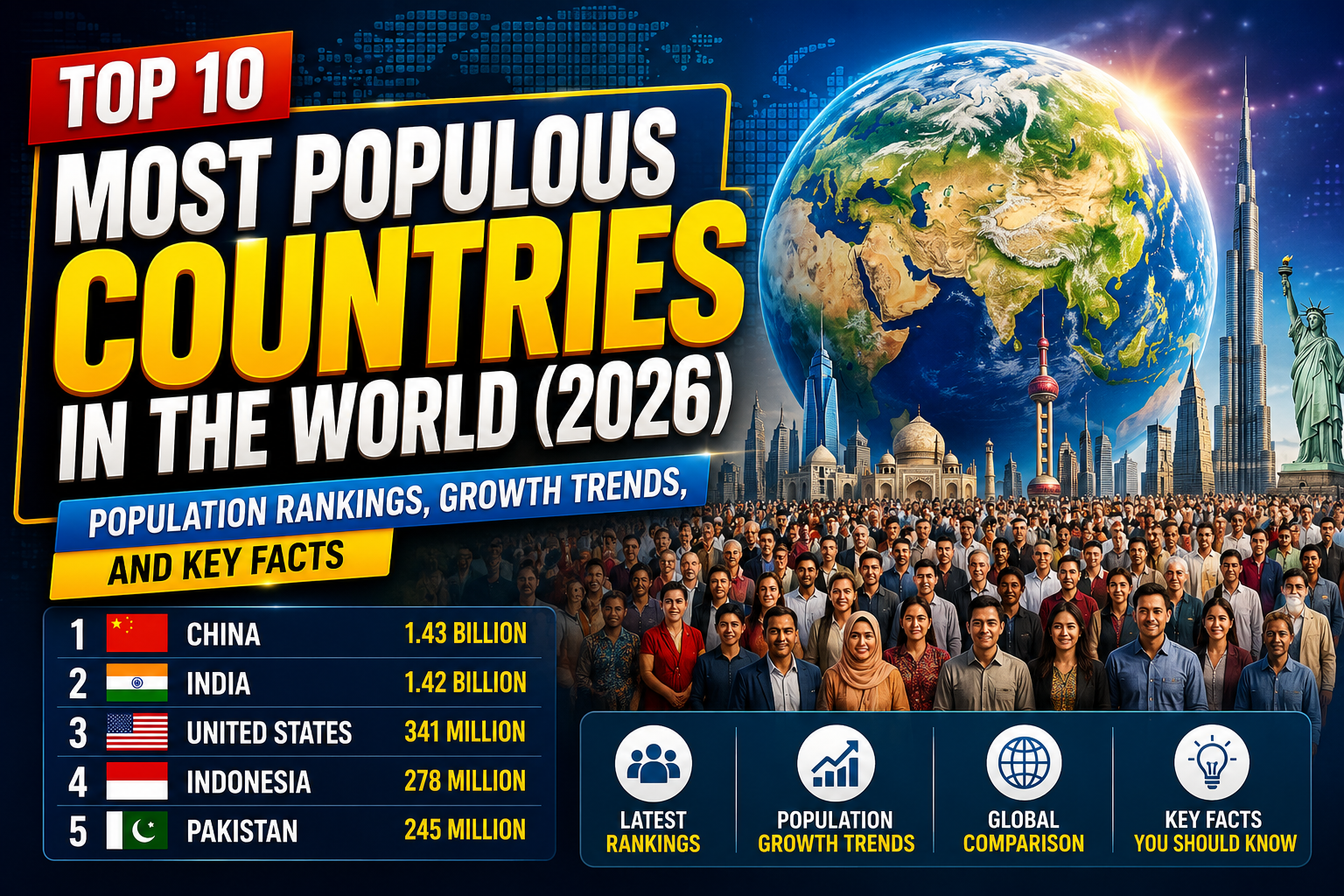
The global demographic landscape is undergoing a monumental shift. As of 2026, the world’s population has surpassed 8.2 billion people. While human growth continues across many regions, the overall pace of global population expansion is gradually slowing. Fascinatingly, more than 56% of the world’s total population resides within just ten nations.
Understanding global demographic shifts is crucial for economists, policymakers, business leaders, and global researchers. From Asia’s dense economic hubs to Sub-Saharan Africa’s rapid youth boom, this comprehensive guide explores the Top 10 Most Populous Countries in 2026, analyzing their population rankings, growth trajectories, and defining socio-economic challenges.
Global Overview: Key Demographic Trends in 2026
The year 2026 marks an era defined by two contrasting demographic stories:
- Rapid Growth in Developing Regions: Sub-Saharan Africa and South Asia continue to experience vibrant population expansion driven by high fertility rates and youthful demographics.
- Aging and Contraction in Developed Nations: Much of East Asia and Europe are experiencing fertility declines, negative growth rates, and rapidly aging populations.
The global annual growth rate currently sits at approximately 0.85%, down from nearly 1.25% a decade ago. Despite this slowdown, the global population is on track to reach 9 billion around 2037.
At a Glance: Top 10 Population Rankings (2026 Data)
The table below summarizes the top 10 most populous countries in 2026, including population counts, global share, and estimated annual growth rates.
| Rank | Country | Estimated Population (2026) | Share of Global Population | Annual Growth Rate |
| 1 | India | 1,476,625,576 | ~18.45% | +0.87% |
| 2 | China | 1,412,914,089 | ~17.65% | -0.22% |
| 3 | United States | 349,035,494 | ~4.36% | +0.51% |
| 4 | Indonesia | 287,886,782 | ~3.60% | +0.76% |
| 5 | Pakistan | 259,299,791 | ~3.24% | +1.60% |
| 6 | Nigeria | 242,431,832 | ~3.03% | +2.06% |
| 7 | Brazil | 213,562,666 | ~2.67% | +0.35% |
| 8 | Bangladesh | 177,818,044 | ~2.22% | +1.21% |
| 9 | Russia | 143,394,458 | ~1.79% | -0.42% |
| 10 | Ethiopia | 138,902,185 | ~1.74% | +2.53% |
Data Source: UN Population Division & World Population Review (2026 Estimates)
Detailed Profiles: The Top 10 Most Populous Countries
1. India (~1.476 Billion)
- Capital: New Delhi
- Global Population Share: 18.45%
- Growth Rate: +0.87% annually
India solidly holds the crown as the world’s most populous nation, having surpassed China. Boasting a median age under 29 years, India possesses one of the youngest workforces among major economies.
Key Fact: India’s massive “demographic dividend” is driving rapid expansion in technology, manufacturing, and consumer spending. Projections indicate India’s population will continue growing until peaking around the 2060s at approximately 1.65–1.68 billion people.
2. China (~1.412 Billion)
- Capital: Beijing
- Global Population Share: 17.65%
- Growth Rate: -0.22% annually
China remains the world’s second-largest demographic giant, but its long-term trajectory has fundamentally shifted. Following decades under the one-child policy, China entered a phase of structural population contraction.
Key Fact: Despite government incentives encouraging larger families, China’s fertility rate remains well below the replacement level (~2.1). The country faces an urgent structural challenge as its workforce shrinks and its retirement-age population expands rapidly.
3. United States (~349 Million)
- Capital: Washington, D.C.
- Global Population Share: 4.36%
- Growth Rate: +0.51% annually
The United States ranks third globally and remains the most populous country in the Western Hemisphere. Unlike many other industrialized nations facing demographic decline, the U.S. continues to sustain modest population growth.
Key Fact: International immigration serves as the primary engine for U.S. demographic growth, offsetting lower domestic birth rates and keeping the median age relatively lower than European or East Asian peers.
4. Indonesia (~287.8 Million)
- Capital: Jakarta (Transitioning to Nusantara)
- Global Population Share: 3.60%
- Growth Rate: +0.76% annually
Indonesia holds fourth place globally and ranks as the most populous country in Southeast Asia. Spread across more than 17,000 islands, the archipelago features both high urban density on Java and expansive resource-rich territories on Kalimantan and Sumatra.
Key Fact: Indonesia is actively building its new capital city, Nusantara, to relieve extreme urban congestion, land subsidence, and population pressure on the island of Java.
5. Pakistan (~259.2 Million)
- Capital: Islamabad
- Global Population Share: 3.24%
- Growth Rate: +1.60% annually
Pakistan stands out as one of Asia’s fastest-growing nations. High fertility rates in rural regions have sustained rapid population growth, making it the fifth most populous country globally.
Key Fact: Over 60% of Pakistan’s population is under the age of 30. While this youthful demographic creates immense potential for labor productivity, it also places immense pressure on education, urban housing, healthcare, and water resources.
6. Nigeria (~242.4 Million)
- Capital: Abuja
- Global Population Share: 3.03%
- Growth Rate: +2.06% annually
Nigeria is Africa’s demographic powerhouse. Growth continues at over 2% per year, driven by high total fertility rates.
Key Fact: By 2050, Nigeria is projected to double its current population and potentially surpass the United States to become the third most populous nation on Earth. Managing urban infrastructure in mega-cities like Lagos remains a top economic priority.
7. Brazil (~213.5 Million)
- Capital: Brasília
- Global Population Share: 2.67%
- Growth Rate: +0.35% annually
Brazil is the largest nation in South America in both physical landmass and population size. However, Brazil’s growth rate has slowed dramatically in recent decades due to rapid urbanization and shifting socio-economic norms.
Key Fact: Over 90% of Brazil’s residents live in urban centers. Brazil’s fertility rate has fallen below replacement level, pushing the nation toward an aging demographic profile sooner than previously expected.
8. Bangladesh (~177.8 Million)
- Capital: Dhaka
- Global Population Share: 2.22%
- Growth Rate: +1.21% annually
Despite its modest geographic size (~147,000 km²), Bangladesh ranks eighth worldwide in total population, making it one of the most densely populated sovereign nations on Earth (~1,366 people per km²).
Key Fact: Successful family planning initiatives and women’s economic empowerment over the past two decades have helped Bangladesh stabilize its fertility rate near replacement level (~2.1), serving as a global model for demographic management.
9. Russia (~143.3 Million)
- Capital: Moscow
- Global Population Share: 1.79%
- Growth Rate: -0.42% annually
Spanning 11 time zones, Russia is geographically the largest country on Earth, yet its population ranks ninth. Russia faces severe demographic headwinds characterized by a negative growth rate, low birth rates, high mortality among working-age males, and net emigration.
Key Fact: Russia’s population peaked in the 1990s and has experienced persistent structural decline, prompting state programs aimed at subsidizing family sizes and attracting regional migrants.
10. Ethiopia (~138.9 Million)
- Capital: Addis Ababa
- Global Population Share: 1.74%
- Growth Rate: +2.53% annually
Rounding out the top ten is Ethiopia, the second most populous nation in Africa. With an annual growth rate exceeding 2.5%, Ethiopia represents one of the fastest-expanding demographic landscapes in the world.
Key Fact: Ethiopia’s young, rapidly growing population is driving major investments in agriculture, industrial parks, and clean energy (such as the Grand Ethiopian Renaissance Dam), positioning it as a major political and economic hub in East Africa.
Strategic Implications of Global Population Trends
+---------------------------------------------------------------------------------+
|                         GLOBAL DEMOGRAPHIC SHIFTS                               |
+---------------------------------------------------------------------------------+
|                                                                                 |
|  [ SUB-SAHARAN AFRICA & SOUTH ASIA ]              [ EAST ASIA & EUROPE ]        |
|  * High Youth Ratios                              * Aging Workforce             |
|  * Rapid Urbanization                             * Shrinking Birth Rates       |
|  * Expanding Labor Force                          * Healthcare Strain           |
|                                                                                 |
+---------------------------------------------------------------------------------+
1. The Shift to Africa and South Asia
Over the coming decades, global population growth will be disproportionately concentrated in Sub-Saharan Africa and South Asia. Nations like Nigeria, Ethiopia, Pakistan, and the Democratic Republic of the Congo will supply much of the world’s incremental labor force.
2. Economic Opportunities: The Demographic Dividend
Countries with large youth populations (India, Indonesia, Nigeria) stand to reap significant economic gains if they invest effectively in education, digital technology, and industrial job creation.
3. Aging Crisis in Industrialized Nations
Conversely, nations experiencing population declines (China, Russia, Japan, Germany) must adapt to shrinking labor pools, increased healthcare budgets, and pension pressures by accelerating automation, artificial intelligence, and immigration policies.
Frequently Asked Questions (FAQ)
Q1: What is the most populous country in the world in 2026?
India is the most populous country in the world in 2026, with an estimated population of over 1.476 billion people, representing roughly 18.45% of the total global population.
Q2: Why is China’s population declining?
China’s population decline stems from decades of the one-child policy, rapid urbanization, high costs of raising children, and changing social attitudes toward marriage and family size.
Q3: Which country has the highest population growth rate among the top 10?
Among the top 10 most populous nations, Ethiopia holds the highest growth rate at approximately +2.53% per year, closely followed by Nigeria (+2.06%).
Q4: Which countries are expected to enter the top 10 by 2050?
Demographic projections suggest that the Democratic Republic of the Congo (DRC) and Egypt will experience massive growth and could displace shrinking or slower-growing nations in the global top 10 rankings by 2050.
Final Thoughts
The 2026 population rankings highlight a global population in transition. While total global population continues to climb toward 9 billion, the distribution of growth is deeply uneven. Emerging economies in Asia and Africa hold the mantle of youth and demographic expansion, whereas mature economies must innovate to maintain economic productivity amid aging populations.
Penulis: W.S








Post Comment