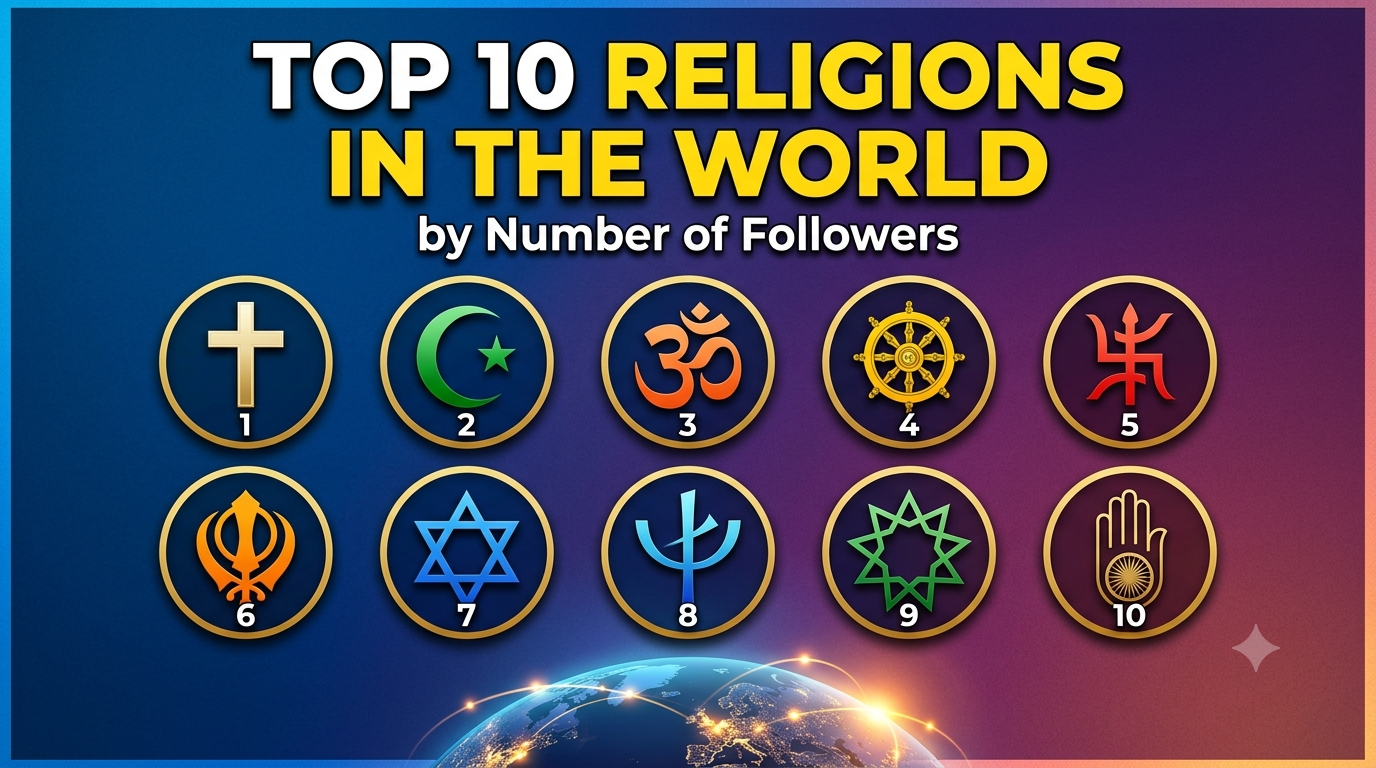
Religion has played a foundational role in shaping human culture, history, laws, and moral frameworks across continents. With over 85% of the global population identifying with a specific religious belief or tradition, faith remains a primary driving force behind community identity, daily rituals, and cultural values.
Understanding the demographic breakdown of world religions offers valuable insight into global shifts, migration patterns, and cultural evolution. According to global demographic data from research institutions like the Pew Research Center and World Population Review, here is a comprehensive guide to the Top 10 most popular religions in the world by number of followers.
Global Religious Demographics at a Glance
Before diving into individual faiths, it helps to look at how world religions compare in size, origin, and geographical concentration.
| Rank | Religion / Faith Category | Estimated Followers | Primary Regional Hubs | Key Sacred Texts / Roots |
| 1 | Christianity | ~2.4 Billion | Americas, Europe, Sub-Saharan Africa | The Holy Bible |
| 2 | Islam | ~2.1 Billion | Middle East, North Africa, South & Southeast Asia | The Holy Qur’an |
| 3 | Hinduism | ~1.2 Billion | India, Nepal, South Asia | The Vedas, Upanishads, Bhagavad Gita |
| 4 | Buddhism | ~500 Million | East Asia, Southeast Asia | Tripitaka (Pali Canon), Mahayana Sutras |
| 5 | Folk / Traditional Religions | ~400 Million | Africa, Asia, Indigenous Americas | Oral Traditions, Sacred Rituals |
| 6 | Sikhism | ~30 Million | India (Punjab region), Global Diaspora | Guru Granth Sahib |
| 7 | Judaism | ~15 Million | Israel, United States, Europe | The Tanakh (Hebrew Bible), Talmud |
| 8 | Spiritism | ~10–15 Million | Latin America (Brazil), Europe | Works of Allan Kardec |
| 9 | Bahá’í Faith | ~7.3 Million | South Asia, Africa, Middle East, Americas | Kitáb-i-Aqdas |
| 10 | Jainism | ~4–5 Million | India | Agamas |
Note on the Unaffiliated Population: Approximately 1.3 to 1.9 billion people worldwide identify as religiously unaffiliated (including atheists, agnostics, and those who practice secular spirituality without adhering to organized religion). While not a religion itself, this group represents roughly 15% to 24% of the global population, making it the third-largest demographic category overall.
Detailed Breakdown of the World’s Top 10 Religions
1. Christianity (~2.4 Billion Followers)
- Percentage of Global Population: ~30%
- Founded: 1st Century CE (Judaea, Middle East)
- Major Branches: Roman Catholicism, Protestantism, Eastern Orthodoxy
Christianity remains the largest religion in the world by total adherents. Founded on the life, teachings, death, and resurrection of Jesus Christ, Christianity spread rapidly from the Roman province of Judaea across Europe, later expanding globally through trade, exploration, and missionary work.
The faith centers around monotheism—the belief in one God existing in three persons: God the Father, Jesus Christ the Son, and the Holy Spirit (the Holy Trinity). Christianity is demographically diverse, with heavy concentrations across North and South America, Europe, and rapidly growing communities across Sub-Saharan Africa and Asia-Pacific.
2. Islam (~2.1 Billion Followers)
- Percentage of Global Population: ~26%
- Founded: 7th Century CE (Mecca, Arabian Peninsula)
- Major Branches: Sunni, Shia
Islam is the second-largest religion globally and currently holds the distinction of being the world’s fastest-growing major religion. Founded in the 7th century CE following the revelations to the Prophet Muhammad, Islam is an Abrahamic monotheistic tradition built upon submission to the divine will of Allah.
The core tenets of Islam are structured around the Five Pillars:
- Shahada (Declaration of Faith)
- Salah (Daily Prayers)
- Zakat (Almsgiving/Charity)
- Sawm (Fasting during Ramadan)
- Hajj (Pilgrimage to Mecca)
Geographically, Indonesia holds the largest single Muslim population in the world, while South Asia (Pakistan, India, Bangladesh) and the Middle East-North Africa region account for massive concentrations of adherents.
3. Hinduism (~1.2 Billion Followers)
- Percentage of Global Population: ~15%
- Origin: Indian Subcontinent (dating back over 3,000–4,000 years)
- Key Concepts: Dharma, Karma, Samsara, Moksha
Hinduism is widely recognized as one of the oldest living religions in the world. Unlike many major religions, Hinduism lacks a single founder, centralized authority, or single primary holy book. Instead, it encompasses a diverse synthesis of philosophical, spiritual, and cultural traditions.
Hinduism emphasizes Dharma (duty/cosmic order), Karma (cause and effect), Samsara (the cycle of rebirth), and Moksha (liberation from the cycle of rebirth). While featuring a rich pantheon of deities—including Brahma, Vishnu, and Shiva—most branches of Hinduism interpret these figures as manifestations of a single ultimate reality known as Brahman. Over 95% of the world’s Hindu population resides in India and Nepal.
4. Buddhism (~500 Million Followers)
- Percentage of Global Population: ~5%–6%
- Founded: 5th Century BCE (Ancient India)
- Major Traditions: Theravada, Mahayana, Vajrayana
Founded by Siddhartha Gautama (known as the Buddha, or “The Enlightened One”), Buddhism arose as a spiritual path toward overcoming suffering and achieving Nirvana. Central to Buddhist philosophy are the Four Noble Truths and the Noble Eightfold Path, which outline a practical framework for ethical living, mindfulness, and meditation.
Buddhism spread throughout East and Southeast Asia, deeply influencing the cultures of China, Japan, Thailand, Vietnam, Korea, Sri Lanka, and Myanmar. Unlike strictly monotheistic or polytheistic traditions, Buddhism primarily focuses on spiritual liberation and mental transformation rather than creator deities.
5. Folk & Indigenous Religions (~400 Million Followers)
- Percentage of Global Population: ~5%
- Distribution: Africa, Asia, Americas, Pacific Islands
- Key Characteristics: Ancestor reverence, animism, community rituals
Folk or Traditional Religions represent a broad umbrella category encompassing indigenous belief systems tied closely to local cultures, ethnicities, and geographic ecosystems. These faiths rarely rely on standardized written scriptures, instead transmitting teachings through oral history, sacred music, and community ceremonies.
Examples include African Traditional Religions (such as Yoruba and Vodun), Chinese Traditional Folk Religions, and Native American spiritual practices. Central themes typically include deep respect for natural forces, belief in spiritual guardians, and ritual devotion to ancestors.
6. Sikhism (~30 Million Followers)
- Founded: Late 15th Century CE (Punjab region, South Asia)
- Founder: Guru Nanak
- Core Value: Equality, selfless service (Sewa), devotion to one God
Sikhism is a monotheistic religion founded by Guru Nanak and developed by nine successive human Gurus, with the spiritual authority now resting in the sacred scripture, the Guru Granth Sahib.
Sikhism rejects caste discrimination, superstitious rituals, and social inequalities, emphasizing that all human beings are equal regardless of gender, race, or class. A defining practice in Sikhism is Langar—a free community kitchen open to everyone without distinction. While Punjab remains the heartland of Sikhism, vibrant diaspora communities thrive in North America, Europe, and East Africa.
7. Judaism (~15 Million Followers)
- Founded: 2nd Millennium BCE (Middle East)
- Key Texts: The Tanakh (Torah), Talmud
- Major Movements: Orthodox, Conservative, Reform
Judaism is the oldest monotheistic Abrahamic religion, serving as the historical foundation for both Christianity and Islam. The faith is centered on the covenant between God and the Children of Israel, as detailed in the Torah.
Judaism integrates strict monotheism, ethical responsibility, and community tradition. Despite its relatively small global demographic footprint, Judaism has exerted a monumental influence on global philosophy, law, literature, and morality. The world’s Jewish population is heavily concentrated in Israel and the United States.
8. Spiritism (~10–15 Million Followers)
- Founded: Mid-19th Century (France)
- Founder/Codifier: Allan Kardec
- Primary Hub: Brazil
Spiritism is a philosophical and spiritual doctrine codified in 19th-century France that later experienced immense growth in Latin America, particularly Brazil. It posits that human beings are immortal spirits inhabiting physical bodies through successive reincarnations to achieve moral and intellectual perfection.
Spiritists emphasize charitable works, moral self-improvement, mediumship, and the harmony between science, philosophy, and religion. In Brazil, Spiritist organizations operate extensive networks of free hospitals, schools, and social welfare programs.
9. Bahá’í Faith (~7.3 Million Followers)
- Founded: 19th Century CE (Persia/Iran)
- Founder: Bahá’u’lláh
- Core Philosophy: Oneness of God, religion, and humanity
The Bahá’í Faith is one of the youngest global religions. Established by Bahá’u’lláh in 1863, the faith teaches that all major world religions stem from the same divine source and represent progressive revelations tailored to different historical eras.
The Bahá’í Faith emphasizes international unity, gender equality, the elimination of prejudice, and the balance between science and religion. Its international governing body, the Universal House of Justice, is headquartered in Haifa, Israel, with adherents living across almost every nation on Earth.
10. Jainism (~4–5 Million Followers)
- Founded: Ancient India (6th–7th Century BCE reform era)
- Key Figures: Lord Mahavira (24th Tirthankara)
- Core Principle: Ahimsa (Absolute Non-Violence)
Jainism is an ancient Indian religion dedicated to spiritual purity, self-discipline, and non-violence (Ahimsa). Jains follow the teachings of 24 spiritual teachers known as Tirthankaras, with Lord Mahavira being the most recent.
A central belief in Jainism is that every living entity—from humans and animals to plants and microorganisms—possesses a soul. Consequently, Jains practice strict vegetarianism and go to great lengths to avoid harming any living creature. The majority of Jain adherents live in India, alongside notable immigrant communities in North America and Europe.
What Factors Are Driving Global Religious Trends?
The demographic landscape of world religions is shifting continuously. Demographic projections highlights three primary forces driving these changes:
- Fertility Rates & Demographics: Regions with younger populations and higher birth rates (such as Sub-Saharan Africa and South Asia) are experiencing faster religious growth compared to regions with aging populations (such as Europe and East Asia).
- Secularization and Disaffiliation: In Western nations, an increasing proportion of young adults identify as “religiously unaffiliated”.
- Migration Patterns: Global movement spreads religious communities beyond their traditional geographic boundaries, creating diverse multicultural hubs in North America and Western Europe
What is the fastest-growing religion in the world?
Islam is currently the fastest-growing major religion globally due to demographic factors, including younger median ages and higher fertility rates in predominant regions.
Which religion is the oldest in the world?
While precise dates vary, Hinduism is widely considered the world’s oldest active religion still practiced today, with roots extending back thousands of years on the Indian subcontinent. Judaism is recognized as the oldest Abrahamic monotheistic faith.
What is the difference between a monotheistic and a polytheistic religion?
A monotheistic religion believes in one single God (e.g., Christianity, Islam, Judaism, Sikhism). A polytheistic religion recognizes or worships multiple deities (e.g., ancient Roman/Greek belief systems or specific streams of traditional folk religions).
Conclusion
From Christianity’s 2.4 billion followers to Jainism’s dedicated 4 million practitioners, global religions continue to shape world culture, moral values, and social structures. While demographic shifts will alter the balance of populations over the coming decades, the enduring human quest for spiritual meaning ensures that faith remains a vital force in our interconnected world.
Penulis: W.S








Post Comment