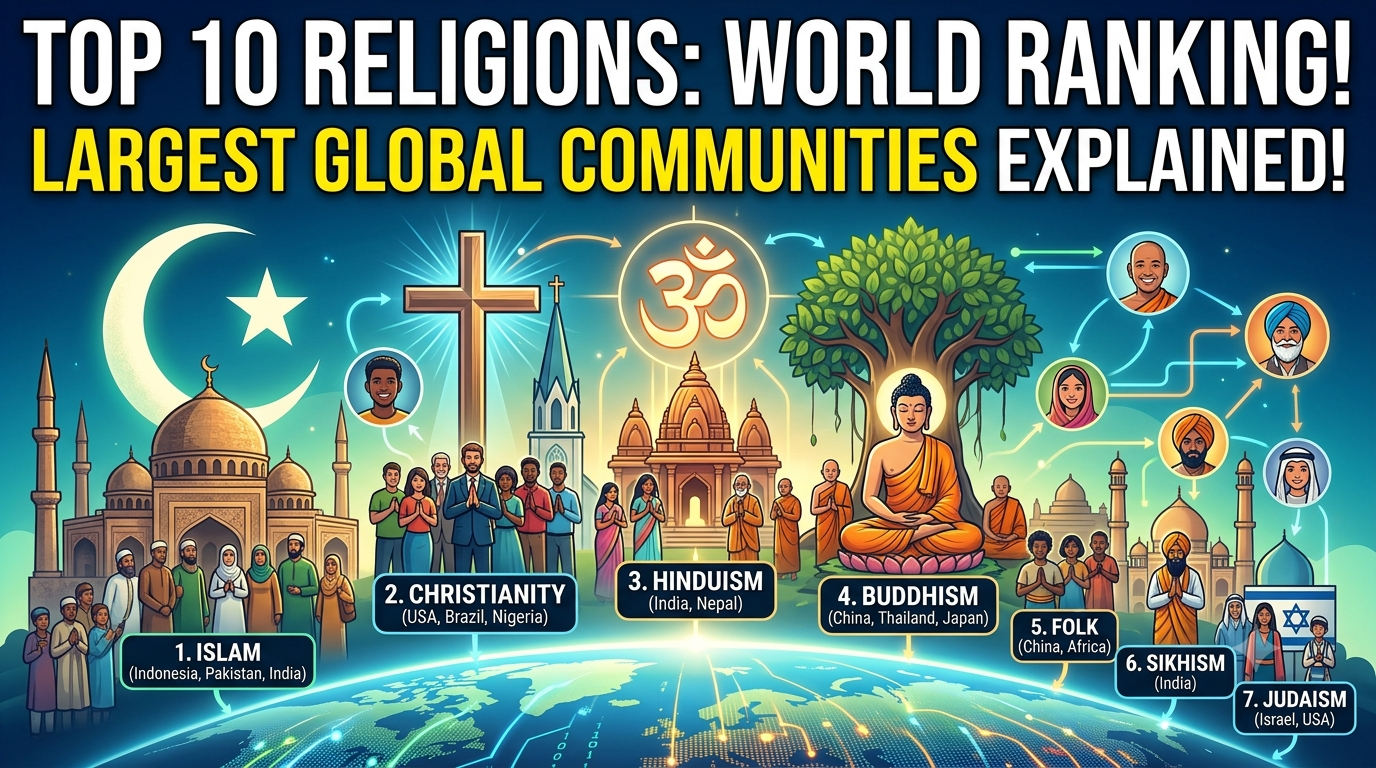
Religion has served as a foundational pillar of human civilization for millennia, influencing global arts, moral philosophies, social structures, and international relations. In an increasingly interconnected global society, demographic trends, migration, and cultural changes continue to reshape the world’s spiritual landscape.
Understanding the global distribution of organized belief systems requires looking at demographic data, core theological tenets, and regional concentrations. Based on demographic tracking and global census updates, this analysis covers the Top 10 most popular religions in the world and details where their largest communities reside today.
Global Religious Landscape at a Glance
Before diving into each specific tradition, it is helpful to visualize how global adherents are distributed across organized world faiths.
| Rank | Religion | Estimated Global Adherents | Major Concentration / Largest National Community |
| 1 | Christianity | ~2.38 – 2.45 Billion | United States, Brazil, Mexico, Nigeria |
| 2 | Islam | ~1.91 – 2.00 Billion | Indonesia, Pakistan, India, Bangladesh |
| 3 | Hinduism | ~1.16 – 1.20 Billion | India, Nepal, Bangladesh |
| 4 | Buddhism | ~480 – 507 Million | China, Thailand, Japan, Myanmar |
| 5 | Folk & Traditional Religions | ~400 – 430 Million | China, Sub-Saharan Africa, Vietnam |
| 6 | Sikhism | ~28 – 30 Million | India (Punjab region), Canada, United Kingdom |
| 7 | Judaism | ~15 – 15.2 Million | Israel, United States, France |
| 8 | Baháʼí Faith | ~7 – 8 Million | India, Iran, United States, Sub-Saharan Africa |
| 9 | Jainism | ~5 – 6 Million | India, United States |
| 10 | Shintoism | ~3 – 4 Million (Active practitioners) | Japan |
(Note: The Religiously Unaffiliated—comprising atheists, agnostics, and those with no formal preference—represent ~1.2 to 1.3 billion people globally, making them the third-largest demographic grouping. However, as an unorganized non-belief category, they are treated separately from formal religious traditions).
1. Christianity — ~2.4 Billion Followers
Christianity holds the title of the world’s largest religion by population. Originating in the 1st century CE in Judea (modern-day Palestine/Israel), Christianity centers on the life, teachings, death, and resurrection of Jesus of Nazareth. Its scriptures consist of the Old and New Testaments of the Holy Bible.
                            CHRISTIANITY (~2.4 Billion)
                                         │
        ┌────────────────────────────────┼────────────────────────────────┐
        ▼                                ▼                                ▼
Roman Catholicism (~1.27B)      Protestantism (~625M)          Eastern Orthodoxy (~295M)
Core Beliefs & Structure
- Monotheism & Trinity: Belief in one God existing as God the Father, Son (Jesus Christ), and Holy Spirit.
- Salvation: Redemption from sin through faith in Jesus Christ.
- Branches: Roman Catholicism (largest single branch), Protestantism (including Evangelical, Anglican, Lutheran, and Pentecostal traditions), and Eastern Orthodoxy.
Largest Communities
- United States: Hosts the world’s largest overall Christian population (~200+ million).
- Brazil: Holds the largest single Roman Catholic community worldwide.
- Sub-Saharan Africa: Represents the fastest-growing region for Christianity globally. Countries like Nigeria, the Democratic Republic of the Congo, and Ethiopia host massive vibrant Christian populations.
2. Islam — ~2.0 Billion Followers
Islam is the second-largest and fastest-growing major world religion. Founded in the early 7th century CE in Mecca by the Prophet Muhammad, Islam emphasizes strict monotheism (Tawhid) and submission to the will of God (Allah). Its sacred text is the Quran.
                                  ISLAM (~2.0 Billion)
                                           │
                       ┌───────────────────┴───────────────────┐
                       ▼                                       ▼
              Sunni Islam (~85-90%)                   Shia Islam (~10-15%)
Core Beliefs & Structure
- Five Pillars: Profession of faith (Shahada), daily prayers (Salah), charity (Zakat), fasting during Ramadan (Sawm), and pilgrimage to Mecca (Hajj).
- Branches: Sunni Islam represents 85%–90% of all Muslims globally, while Shia Islam accounts for 10%–15%.
Largest Communities
Contrary to popular assumption, the majority of Muslims reside in the Asia-Pacific region rather than the Middle East:
- Indonesia: The world’s most populous Muslim-majority country (~240+ million Muslims).
- Pakistan & India: Host huge communities exceeding 200 million Muslims each.
- Bangladesh & Nigeria: Major demographic strongholds in South Asia and Africa.
3. Hinduism — ~1.2 Billion Followers
Hinduism ranks third globally and stands as the world’s oldest living major religion, with roots stretching back over 4,000 years to the Indus Valley region. Known to practitioners as Sanatana Dharma (Eternal Law), Hinduism is a diverse family of spiritual philosophies without a single founder or centralized authority.
                             HINDUISM (~1.2 Billion)
                                        │
    ┌───────────────────────────────────┼───────────────────────────────────┐
    ▼                                   ▼                                   ▼
Vaishnavism                         Shaivism                             Shaktism
Core Beliefs & Structure
- Key Concepts: Karma (cause and effect), Dharma (cosmic duty/ethics), Samsara (cycle of rebirth), and Moksha (liberation).
- Major Traditions: Vaishnavism, Shaivism, Shaktism, and Smartism.
Largest Communities
Hinduism is geographically concentrated:
- India: Over 90% of all Hindus worldwide live in India, where they make up nearly 79% of the national population.
- Nepal & Mauritius: The only other Hindu-majority nations in the world.
- Global Diaspora: Significant communities exist in Bangladesh, North America, the United Kingdom, and the Persian Gulf region.
4. Buddhism — ~480 to 507 Million Followers
Founded in ancient India during the 5th century BCE by Siddhartha Gautama (the Buddha), Buddhism is the fourth-largest organized religion. It focuses on mental cultivation, ethical living, and spiritual liberation.
                              BUDDHISM (~500 Million)
                                         │
                 ┌───────────────────────┴───────────────────────┐
                 ▼                                               ▼
      Mahayana Buddhism (~60%)                      Theravada Buddhism (~30%)
Core Beliefs & Structure
- Four Noble Truths & Eightfold Path: Frameworks designed to understand suffering and achieve enlightenment (Nirvana).
- Main Branches: Mahayana (dominant in East Asia) and Theravada (dominant in Southeast Asia), alongside Vajrayana (Tibetan Buddhism).
Largest Communities
- China: Home to the world’s largest overall Buddhist population (~240+ million adherents).
- Thailand, Myanmar, & Cambodia: Boast the highest percentage concentrations of Theravada Buddhists.
- Japan & Vietnam: Host large historical Mahayana communities.
5. Folk and Traditional Religions — ~400 to 430 Million Followers
Folk religions encompass indigenous, animist, and traditional tribal belief systems deeply rooted in specific local cultures, ethnic identities, and geographic regions.
                   FOLK & TRADITIONAL RELIGIONS (~400M+)
                                     │
      ┌──────────────────────────────┼──────────────────────────────┐
      ▼                              ▼                              ▼
Chinese Folk Traditions     African Traditional / Animist    Indigenous Americas
Core Beliefs & Practices
- Ancestor Reverence & Nature Spirits: Heavy emphasis on respecting ancestors, natural spirits, and localized deities.
- Examples: Chinese Folk Religion (incorporating Taoist/Confucian elements), African Traditional Religions (Yoruba, Vodun), and Native American spiritual practices.
Largest Communities
- China: Represents the single largest population practicing folk customs alongside Confucian and Taoist traditions.
- Sub-Saharan Africa: Widely practiced across West, Central, and Southern Africa, frequently syncretized with Christianity or Islam.
6. Sikhism — ~28 to 30 Million Followers
Founded in the late 15th century CE in the Punjab region of South Asia by Guru Nanak, Sikhism is a monotheistic religion emphasizing social equality, selfless service (Sewa), and devotion to God (Ik Onkar).
                         SIKHISM (~30 Million)
                                   │
              ┌────────────────────┴────────────────────┐
              ▼                                         ▼
Punjab Region (India) (~80%)                   Global Diaspora (~20%)
Core Beliefs & Practices
- Sacred Scripture: The Guru Granth Sahib, treated as the eternal living Guru.
- Articles of Faith (5 Ks): Kesh (uncut hair), Kangha (wooden comb), Kara (iron bracelet), Kachera (cotton undergarment), and Kirpan (ceremonial blade).
Largest Communities
- India (Punjab State): Home to over 80% of all Sikhs worldwide.
- Diaspora Strongholds: Canada, the United Kingdom, the United States, and Australia host large, influential Sikh communities.
7. Judaism — ~15 Million Followers
Judaism is one of the world’s oldest monotheistic Abrahamic faiths, dating back over 3,500 years. It encompasses religious, cultural, and national heritage centered on the covenant between God and the Children of Israel.
                          JUDAISM (~15 Million)
                                    │
           ┌────────────────────────┼────────────────────────┐
           ▼                        ▼                        ▼
     State of Israel          United States               Europe
Core Beliefs & Structure
- Sacred Texts: The Hebrew Bible (Tanakh / Torah) and the Talmud (oral law traditions).
- Branches: Orthodox, Conservative, Reform, and Reconstructionist movements.
Largest Communities
The global Jewish population is primarily concentrated in two countries:
- Israel: Home to ~7.2 million Jews (~46% of the global Jewish total).
- United States: Home to ~6.3 million Jews (~41% of the global total).
- France, Canada, & United Kingdom: Host smaller historical communities.
8. The Baháʼí Faith — ~7 to 8 Million Followers
Established in 19th-century Persia (modern-day Iran) by Bahá’u’lláh, the Baháʼí Faith teaches the essential worth of all religions and the unity of all people.
                       BAHÁʼÍ FAITH (~7-8 Million)
                                    │
            ┌───────────────────────┼───────────────────────┐
            ▼                       ▼                       ▼
       South Asia          Sub-Saharan Africa            Americas
Core Beliefs
- Three Unities: The unity of God, the unity of religion (progressive revelation), and the unity of humanity.
- Global Harmony: Advocates for world peace, gender equality, and universal education.
Largest Communities
- India: Hosts the world’s largest Baháʼí population (~2+ million members).
- Iran: Historical homeland, though practitioners face institutional restrictions.
- Sub-Saharan Africa & the Americas: Hold dispersed growing communities.
9. Jainism — ~5 to 6 Million Followers
Originating in ancient India, Jainism is a non-theistic Indian religion centered on absolute non-violence (Ahimsa), truth, and ascetic self-discipline.
                         JAINISM (~5-6 Million)
                                    │
                 ┌──────────────────┴──────────────────┐
                 ▼                                     ▼
        Digambara Tradition                  Svetambara Tradition
Core Beliefs
- Ahimsa: Non-injury to all living beings, including microscopic life.
- Anekantavada: The doctrine of many-sidedness or non-absolutism in perspective.
Largest Communities
- India: Over 95% of all Jains reside in India, particularly in states like Gujarat, Rajasthan, Maharashtra, and Karnataka.
- United States & UK: Host wealthy, highly educated diaspora populations.
10. Shintoism — ~3 to 4 Million Followers (Active)
Shintoism is the indigenous spiritual tradition of Japan. Focused on ritual practices, purity, and devotion to spiritual essences known as Kami (spirits inhabiting nature, animals, and ancestors).
                        SHINTOISM (~3-4 Million)
                                   │
              ┌────────────────────┴────────────────────┐
              ▼                                         ▼
Active Shrine Practitioners                      Cultural Folk Customs
Core Beliefs & Practices
- Kami Worship: Respecting spiritual forces found in natural features like mountains, waterfalls, and trees.
- Purity Rituals (Harae): Ritual cleansing rites performed at shrines across Japan.
Largest Communities
- Japan: Virtually all Shinto shrines and active practitioners reside in Japan. While tens of millions of Japanese people participate in Shinto festivals culturally, active formal membership is estimated at roughly 3 to 4 million.
Which religion is the largest in the world?
Christianity remains the world’s largest religion, with approximately 2.4 billion followers globally.
Which religion is growing the fastest?
Islam is the world’s fastest-growing major religion, driven primarily by demographic factors like higher fertility rates and a younger median age.
Where do the majority of the world’s Muslims live?
The majority of the world’s Muslims live in the Asia-Pacific region, with Indonesia, Pakistan, and India holding the largest individual Muslim populations.
Why are the religiously unaffiliated not listed as a religion?
The “religiously unaffiliated” (atheists, agnostics, and non-religious individuals) form a non-belief category rather than an organized religion. If counted alongside religions, they would rank as the third-largest group worldwide.
Summary
The global distribution of faith reflects a dynamic, evolving world. While Christianity and Islam dominate overall global numbers, geographically concentrated faiths like Hinduism, Buddhism, and Sikhism maintain deep regional cultural strongholds. Understanding where these communities flourish helps foster global cultural literacy and demographic awareness.
Penulis: W.S








Post Comment