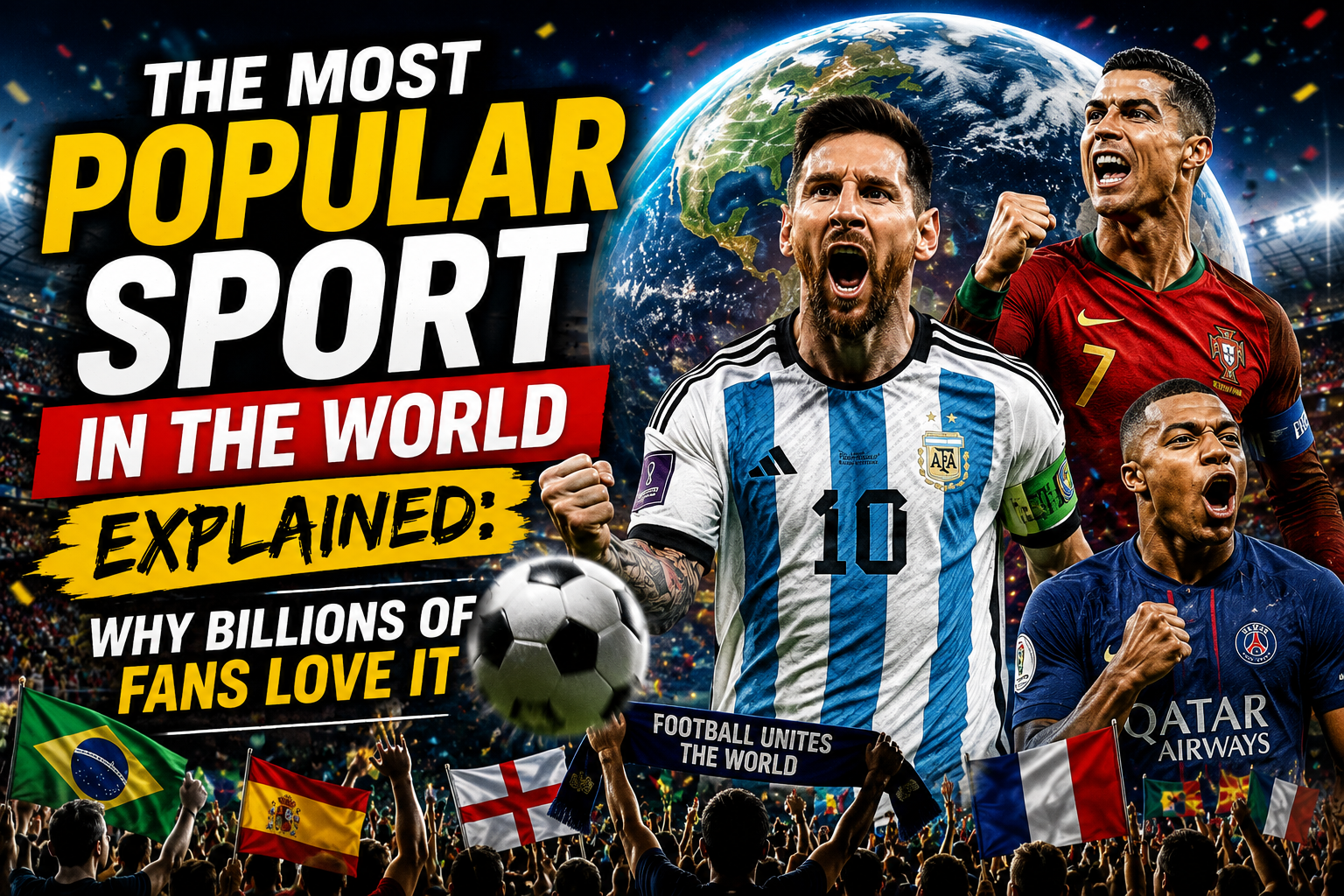
Across every continent, from bustling megacities like Tokyo and Rio de Janeiro to quiet rural villages in Sub-Saharan Africa and high-altitude towns in the Andes, one universal obsession unites humanity: association football (known as soccer in North America).
With an estimated 4 billion followers—over half of the planet’s total population—football isn’t merely a sport. It is a global religion, a shared language, and a multi-billion-dollar cultural phenomenon. But how did a simple game involving 22 players and a leather sphere capture the hearts and minds of billions?
What is the Most Popular Sport in the World?
Before diving into why it is loved, let’s establish the numbers. By every major metric used to measure athletic popularity, association football ranks undisputed at the top:
- Global Fan Base: ~4.0 Billion
- Primary Regions: Europe, South America, Africa, Asia, Middle East
- Global Participation: Over 250 million registered players in 200+ countries
- World Cup Viewership: Over 5 billion viewers engaged across the FIFA World Cup tournament.
While cricket commands immense loyalty in South Asia (around 2.5 billion fans) and basketball boasts strong international reach (~2.2 billion), neither matches the sheer geographical ubiquity and cultural footprint of football.
1. Unmatched Accessibility: Anyone, Anywhere Can Play
The foundation of football’s global dominance lies in its radical simplicity and low barrier to entry.
To play sports like ice hockey, American football, or golf, participants require expensive equipment, specialized venues, and rigorous logistical setups. To play association football, all you need is a ball—or something resembling one.
- Minimal Equipment: Children worldwide play with scuffed leather balls, taped-together rags, or rolled-up plastic bags.
- Versatile Pitch: Any flat surface becomes a field. A paved street, a sandy beach, a dusty patch of dirt, or a grassy park immediately serves as a pitch.
- Flexible Goalposts: Two plastic bottles, wooden sticks, or backpacks placed a few feet apart serve as perfectly functional goalposts.
Because financial constraints never prevent a child from falling in love with the game, football naturally becomes the sport of the people. It flourishes equally in impoverished neighborhoods and affluent suburban academies.
2. Simple Rules with Infinite Tactical Depth
At its core, football’s premise is straightforward enough for a child to understand within seconds: kick the ball into the opponent’s net without using your hands or arms.
Unlike sports weighed down by complex officiating, intricate penalty structures, or frequent play stoppages (such as American football or rugby), football flows continuously with minimal interruptions. A standard match consists of two 45-minute halves with a running clock, offering spectators an uninterrupted 90-minute spectacle.
The Paradox of Tactical Complexity
Despite these easy-to-understand rules, the game offers infinite strategic depth. Managers and tacticians view football like high-speed physical chess:
| Tactical Framework | Core Philosophy | Famous Example |
| Total Football | Fluid positional switching where any outfield player can take any role. | Ajax & Netherlands (1970s) |
| Tiki-Taka | Possession-heavy, short passing to wear down the opposition. | FC Barcelona & Spain (2008–2012) |
| Gegenpressing | High-intensity counter-pressing immediately after losing the ball. | Liverpool FC under Jürgen Klopp |
| Catenaccio | Ultra-disciplined defensive structure focused on swift counter-attacks. | Classic Italian League (Serie A) teams |
This blend of high visual accessibility and deep tactical nuance means casual viewers can enjoy a match instantly, while seasoned analysts can dissect movement patterns for hours.
3. The Power of Storytelling, Unpredictability, and Drama
Sports entertainment relies on drama, and football is arguably the world’s greatest unscripted drama.
Because goals in professional football are relatively rare—often ending in low-scoring affairs like 1–0, 2–1, or 0–0—each goal carries immense emotional weight. A single strike in the 93rd minute can reverse a team’s destiny, turn an under-dog into a national hero, or trigger wild celebrations across an entire country.
The Underdog Factor
Football is uniquely notorious for upset victories. Because scorelines are low, a underdog team can defend valiantly, absorb pressure for 89 minutes, and score on a single counter-attack to defeat a world-powerhouse club. Events like Leicester City winning the English Premier League at 5000-to-1 odds in 2016 or Morocco reaching the World Cup Semi-Finals in 2022 captivate global audiences precisely because raw wealth does not guarantee victory.
4. Cultural Identity and Community Rivalries
Football clubs are rarely just business entities; they are living extensions of neighborhood, regional, and national identities. In many cities, supporting a specific club is an inherited trait passed down through generations.
Community Identity ➔ Local Rivalry ➔ Global Brand ➔ Lifelong Loyalty
- Local Roots: Clubs often represented specific working-class trades, religious communities, or political movements when founded in the late 19th or early 20th centuries.
- Historic Rivalries (Derbies): Matches like El Clásico (Real Madrid vs. FC Barcelona), the Superclásico (Boca Juniors vs. River Plate), or the Old Firm (Celtic vs. Rangers) transcend sports. They reflect socio-political histories, cultural divides, and decades of shared local memory.
When fans sing their club’s anthem inside a packed stadium, they are expressing solidarity with their community. That visceral sense of belonging is a powerful emotional anchor that lasts a lifetime.
5. The Grand Stage: Mega-Events That Stop the World
No other sporting events command the global attention achieved by football’s premier tournaments.
The FIFA World Cup
Held every four years, the FIFA World Cup is arguably the biggest event on Earth—overshadowing even the Olympic Games in cumulative viewership. National borders dissolve as entire populations pause to watch their country compete. When a national team scores in a World Cup, whole cities vibrate with simultaneous shouting and applause.
The UEFA Champions League
On the club level, the UEFA Champions League pits the finest European clubs—stacked with elite international talent from South America, Africa, Europe, and Asia—against one another. It represents the pinnacle of athletic competition, attracting hundreds of millions of viewers for a single final match.
6. The Commercial Engine: Global Superstars & Media Expansion
In the digital age, football’s reach has expanded dramatically through media rights, video games, and social media branding.
- Global Superstars: Icons like Lionel Messi, Cristiano Ronaldo, Kylian Mbappé, and Erling Haaland are household names worldwide. Their personal brands boast hundreds of millions of followers on social media, bringing young audiences into the sport regardless of geographic location.
- Video Games: Franchise games like EA Sports FC (formerly FIFA) have introduced millions of younger generations to real-world players, tactics, and leagues across the globe.
- Broadcasting Power: Modern satellite TV and streaming platforms allow a fan in Jakarta or Lagos to watch a live match happening in London or Madrid with pristine high-definition clarity.
Summary: Why Football Dominates Global Sport
| Key Factor | Impact on Fans |
| Simplicity & Affordability | Anyone can play with just a ball and open space. |
| Continuous Flow | 90 minutes of action with minimal stoppages. |
| Emotional Intensity | Rare goals lead to explosive moments of joy and heartbreak. |
| Deep Cultural Roots | Clubs represent real community histories and identity. |
| Global Scale | Tournaments like the FIFA World Cup unite every continent. |
Conclusion
Football’s title as “The Beautiful Game” is well-earned. It is the ultimate democratic sport—a game that demands neither rich equipment nor exclusive facilities, only passion, creativity, and a ball.
Whether played on manicured grass in historic European stadiums or on dusty village fields, football builds a bridge across languages, cultures, and socioeconomic divides. As long as humans crave connection, dramatic storytelling, and shared joy, football will remain comfortably atop its throne as the undisputed king of world sports.
Penulis: W.S







Post Comment