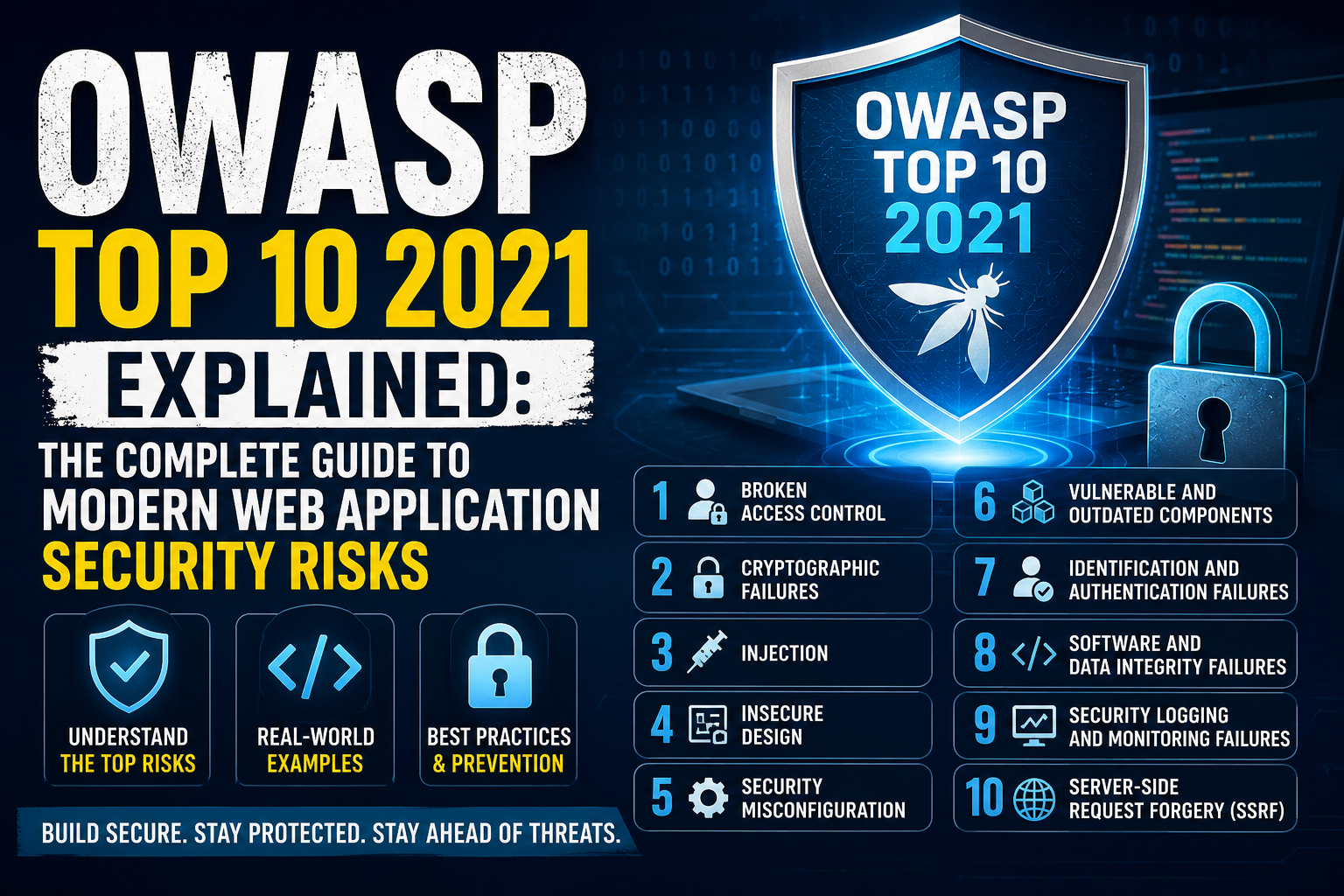
In today’s digital landscape, web applications power nearly every aspect of business. From online banking and e-commerce platforms to healthcare systems and government services, organizations depend on secure applications to protect sensitive data. Unfortunately, cybercriminals continue to discover new ways to exploit vulnerabilities, making application security more important than ever.
This is where the OWASP Top 10 2021 becomes an essential resource. Published by the Open Web Application Security Project (OWASP), this globally recognized document identifies the ten most critical security risks affecting modern web applications. Developers, cybersecurity professionals, DevSecOps engineers, and business leaders rely on it as a practical guide for reducing vulnerabilities and improving security posture.
This comprehensive guide explains each category in the OWASP Top 10 2021, highlights what’s new compared to previous versions, and provides actionable recommendations to secure modern web applications.
What Is the OWASP Top 10?
The OWASP Top 10 is a regularly updated awareness document that ranks the most significant security risks facing web applications worldwide. Rather than focusing on theoretical attacks, it is based on real-world vulnerability data collected from security organizations, vendors, and experts.
Its primary goals include:
- Raising awareness of application security risks
- Helping developers build secure software
- Guiding security testing and code reviews
- Supporting compliance and security training
- Encouraging organizations to adopt secure development practices
Since its first publication in 2003, the OWASP Top 10 has become the industry standard for web application security.
What’s New in OWASP Top 10 2021?
The 2021 edition introduced several major updates to reflect today’s evolving threat landscape.
Some significant changes include:
- Three completely new vulnerability categories
- Several renamed categories
- Updated rankings based on modern attack trends
- Greater emphasis on insecure software design
- Increased attention to supply chain risks
- Better coverage of cloud-native applications and APIs
These updates acknowledge that attackers increasingly target application architecture, third-party components, and development pipelines rather than only exploiting coding mistakes.
The OWASP Top 10 2021 Categories
1. Broken Access Control
Broken Access Control moved to the number one position because it has become the most frequently exploited application vulnerability.
Access control determines what authenticated users are allowed to do. When implemented incorrectly, attackers may gain unauthorized access to sensitive resources.
Common examples include:
- Viewing another user’s profile
- Modifying administrative settings
- Accessing confidential documents
- Privilege escalation
- Directory traversal
Prevention
- Apply the principle of least privilege
- Enforce server-side authorization
- Deny access by default
- Validate permissions for every request
- Regularly test access controls
2. Cryptographic Failures
Previously known as “Sensitive Data Exposure,” this category focuses on improper cryptography that leads to data leaks.
Organizations often store or transmit confidential information without sufficient encryption.
Examples include:
- Weak encryption algorithms
- Plain-text passwords
- Unencrypted databases
- Missing HTTPS
- Poor key management
Prevention
- Use strong encryption standards
- Enable HTTPS everywhere
- Store passwords using modern hashing algorithms
- Rotate encryption keys
- Encrypt sensitive information both in transit and at rest
3. Injection
Injection attacks remain one of the oldest yet most dangerous web security issues.
They occur when untrusted user input is interpreted as commands by an application.
Examples include:
- SQL Injection
- NoSQL Injection
- Command Injection
- LDAP Injection
- OS Command Injection
Prevention
- Use parameterized queries
- Validate all user input
- Avoid dynamic SQL
- Employ ORM frameworks
- Escape special characters where appropriate
4. Insecure Design
One of the newest additions in OWASP Top 10 2021 is Insecure Design.
Unlike coding bugs, insecure design refers to architectural weaknesses introduced during planning and system design.
Examples include:
- Missing rate limiting
- Poor authentication workflows
- Weak business logic
- Inadequate threat modeling
- Lack of security requirements
Prevention
- Conduct threat modeling
- Integrate security into software design
- Perform architecture reviews
- Adopt secure design principles
- Use security patterns
5. Security Misconfiguration
Security misconfiguration continues to be a leading cause of data breaches.
Many attacks succeed simply because applications use default settings or expose unnecessary services.
Common issues include:
- Default passwords
- Open cloud storage
- Unpatched software
- Verbose error messages
- Debug mode enabled in production
Prevention
- Automate configuration management
- Remove unused features
- Harden servers
- Disable unnecessary services
- Regularly audit configurations
6. Vulnerable and Outdated Components
Modern software heavily depends on third-party libraries and frameworks.
If these components contain known vulnerabilities, attackers can exploit them without attacking your code directly.
Examples include:
- Outdated JavaScript libraries
- Vulnerable frameworks
- Unsupported operating systems
- Unpatched plugins
- Legacy middleware
Prevention
- Maintain a software inventory
- Monitor security advisories
- Apply updates promptly
- Remove unused dependencies
- Use Software Composition Analysis (SCA) tools
7. Identification and Authentication Failures
Previously called Broken Authentication, this category includes weaknesses that compromise user identities.
Examples include:
- Weak passwords
- Credential stuffing
- Session fixation
- Missing Multi-Factor Authentication (MFA)
- Predictable session IDs
Prevention
- Require MFA
- Enforce strong password policies
- Use secure session management
- Limit login attempts
- Detect suspicious authentication behavior
8. Software and Data Integrity Failures
This entirely new category reflects modern software supply chain attacks.
Organizations increasingly rely on CI/CD pipelines, package managers, APIs, and cloud services.
Examples include:
- Compromised software updates
- Malicious dependencies
- Unsigned code
- Insecure CI/CD pipelines
- Unverified plugins
Prevention
- Digitally sign software
- Verify package integrity
- Protect CI/CD environments
- Review third-party code
- Monitor supply chain risks
9. Security Logging and Monitoring Failures
Without proper logging, organizations may never detect ongoing cyberattacks.
Attackers often remain inside compromised systems for months because insufficient logs prevent early detection.
Examples include:
- Missing audit logs
- Poor monitoring
- Undetected brute-force attacks
- Inadequate incident response
- Lack of alerting
Prevention
- Centralize logging
- Monitor suspicious events
- Protect log integrity
- Enable real-time alerts
- Conduct regular log reviews
10. Server-Side Request Forgery (SSRF)
SSRF debuted in the 2021 edition due to its increasing prevalence.
In SSRF attacks, an attacker tricks the server into making unauthorized requests to internal systems.
Examples include:
- Accessing internal APIs
- Cloud metadata exploitation
- Internal port scanning
- Firewall bypass
- Remote resource abuse
Prevention
- Validate outgoing requests
- Restrict network access
- Disable unnecessary protocols
- Apply network segmentation
- Use allowlists
Why OWASP Top 10 2021 Matters
Organizations across industries adopt the OWASP Top 10 because it offers practical guidance rather than theoretical concepts.
Its benefits include:
- Better software security
- Reduced risk of data breaches
- Improved developer awareness
- Stronger compliance readiness
- More secure software development lifecycle (SDLC)
Many penetration testing companies also use the OWASP Top 10 as the foundation for security assessments.
Best Practices for Preventing OWASP Top 10 Vulnerabilities
Following security best practices significantly reduces the likelihood of successful attacks.
1. Adopt Secure SDLC
Integrate security into every stage of software development instead of treating it as the final step.
2. Perform Regular Penetration Testing
Ethical hackers can identify vulnerabilities before cybercriminals do.
3. Conduct Code Reviews
Peer reviews often reveal insecure coding patterns.
4. Automate Security Testing
Use tools such as:
- Static Application Security Testing (SAST)
- Dynamic Application Security Testing (DAST)
- Interactive Application Security Testing (IAST)
- Software Composition Analysis (SCA)
5. Keep Dependencies Updated
Automate vulnerability scanning for third-party libraries.
6. Implement Zero Trust Security
Never automatically trust users, devices, or applications.
7. Educate Development Teams
Developer security training remains one of the most effective defenses against application vulnerabilities.
Common Tools Used to Detect OWASP Top 10 Risks
Many organizations rely on security tools to identify vulnerabilities during development.
Popular solutions include:
- Burp Suite
- OWASP ZAP
- SonarQube
- Snyk
- Veracode
- Checkmarx
- GitHub Advanced Security
- Semgrep
- Nessus
- Acunetix
Combining multiple tools provides broader coverage across different stages of the software development lifecycle.
OWASP Top 10 2021 and DevSecOps
Modern software teams increasingly embrace DevSecOps by integrating security into CI/CD pipelines. Instead of performing security checks only before deployment, automated scanning, dependency analysis, and compliance validation occur continuously throughout development.
By aligning DevSecOps practices with the OWASP Top 10 2021, organizations can detect vulnerabilities earlier, reduce remediation costs, and release software with greater confidence.
Future of Web Application Security
Cyber threats continue to evolve alongside technologies such as cloud computing, artificial intelligence, containerization, microservices, and serverless architectures. As attackers adopt increasingly sophisticated techniques, application security must become proactive rather than reactive.
Future editions of the OWASP Top 10 are expected to place even greater emphasis on API security, software supply chains, identity management, AI-assisted attacks, and cloud-native application risks. Organizations that build security into every phase of development will be better prepared to adapt to these emerging challenges.
Conclusion
The OWASP Top 10 2021 remains one of the most valuable resources for understanding modern web application security risks. Covering everything from Broken Access Control and Injection to Software and Data Integrity Failures and Server-Side Request Forgery, it provides a practical roadmap for developers and security professionals alike.
Implementing secure coding practices, performing continuous security testing, keeping dependencies updated, and adopting a DevSecOps mindset can dramatically reduce the risk of cyberattacks. Whether you are building a small web application or managing enterprise-scale systems, using the OWASP Top 10 2021 as part of your security strategy is a proven way to strengthen resilience, protect sensitive data, and build trust with users in an increasingly connected digital world.
1. What is the OWASP Top 10 2021?
It is a globally recognized list of the ten most critical web application security risks published by the Open Web Application Security Project (OWASP).
2. Who should use the OWASP Top 10?
Software developers, security engineers, penetration testers, DevSecOps teams, IT managers, and organizations developing web applications.
3. Why is Broken Access Control ranked first?
Because it is one of the most common and impactful vulnerabilities, allowing attackers to gain unauthorized access to resources and perform actions beyond their intended permissions.
4. Is the OWASP Top 10 only for web applications?
Primarily yes, although many of its security principles also apply to APIs, cloud services, and modern software architectures.
5. How often is the OWASP Top 10 updated?
OWASP updates the list periodically based on industry data, emerging attack techniques, and community research.
6. Can following the OWASP Top 10 eliminate all security risks?
No. It provides an essential foundation for application security, but organizations should complement it with secure development practices, continuous monitoring, threat modeling, and regular security assessments.
Penulis: W.S





Post Comment