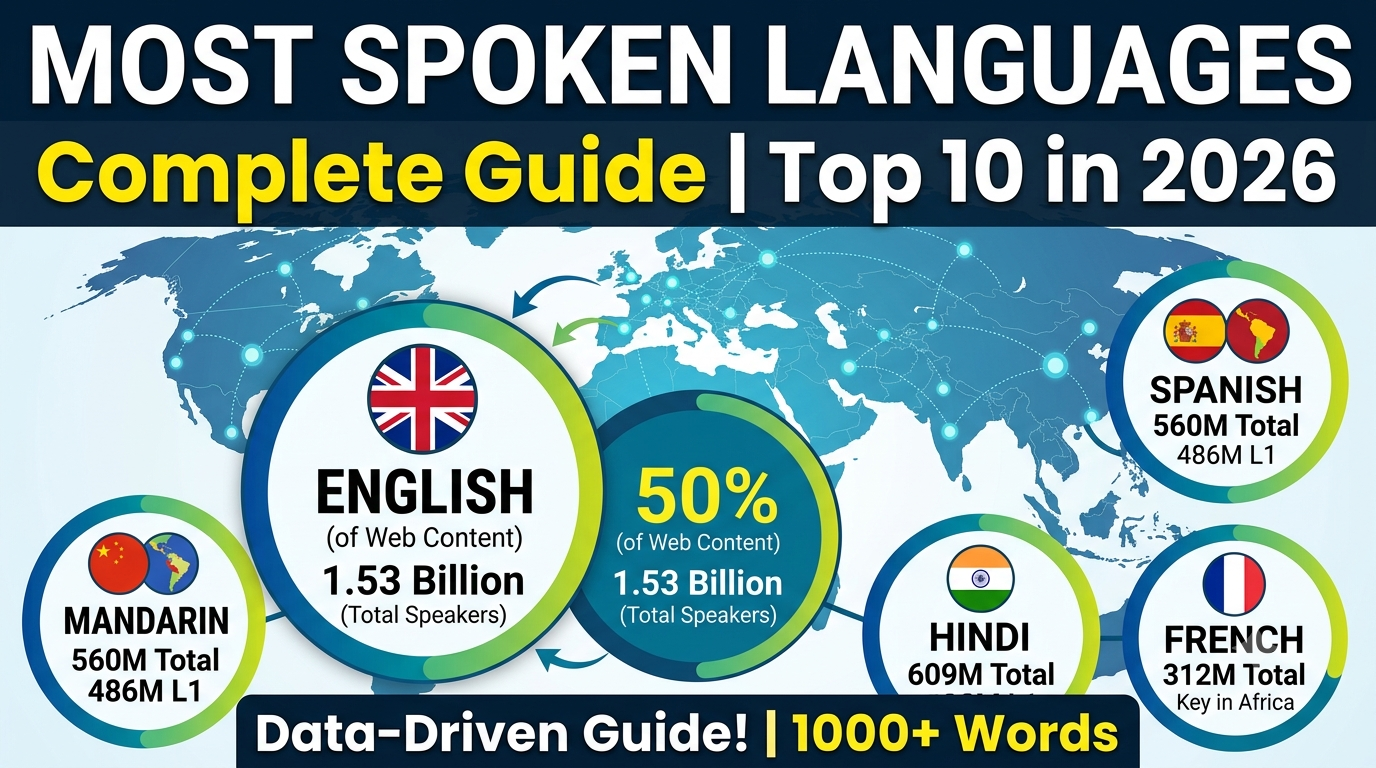
In an increasingly interconnected global economy, language remains the ultimate bridge for culture, trade, diplomacy, and digital communication. Whether you are a business strategist expanding into international markets, a student deciding which foreign language to study next, or a travel enthusiast curious about linguistic demographics, understanding which languages dominate global discourse is essential.
According to data compiled from demographic studies and linguistic research centers like Ethnologue, over 7,100 living languages exist today. However, more than half of the world’s population speaks a combination of just ten major languages.
This complete guide breaks down the most spoken languages in the world, contrasting total speakers (native plus second-language speakers) with native (first-language) speakers, exploring digital language trends, and analyzing future demographic shifts.
Quick Reference: Top 10 Most Spoken Languages in the World
The table below highlights the global linguistic hierarchy based on total speaker estimates:
| Rank | Language | Total Speakers (M) | Native Speakers (L1) (M) | Second-Language (L2) (M) | Main Regions | Language Family |
| 1 | English | ~1,530 | ~390 | ~1,140 | Global (Americas, Europe, Asia, Africa) | Indo-European |
| 2 | Mandarin Chinese | ~1,140 | ~941 | ~199 | East Asia, Southeast Asia | Sino-Tibetan |
| 3 | Hindi | ~609 | ~345 | ~264 | South Asia (India, Nepal) | Indo-European |
| 4 | Spanish | ~560 | ~486 | ~74 | Americas, Europe (Spain) | Indo-European |
| 5 | Standard Arabic | ~335 | ~313 (all dialects) | ~109 | Middle East, North Africa | Afro-Asiatic |
| 6 | French | ~312 | ~79 | ~233 | Europe, Sub-Saharan Africa, North America | Indo-European |
| 7 | Bengali | ~284 | ~234 | ~50 | South Asia (Bangladesh, India) | Indo-European |
| 8 | Portuguese | ~267 | ~232 | ~35 | South America (Brazil), Europe, Africa | Indo-European |
| 9 | Russian | ~253 | ~148 | ~105 | Eastern Europe, Northern/Central Asia | Indo-European |
| 10 | Indonesian | ~252 | ~44 | ~208 | Southeast Asia (Indonesia) | Austronesian |
Note: Data represents aggregated estimates from linguistic catalogs, census projections, and demographic modeling.
Total Speakers vs. Native Speakers: What Is the Difference?
To evaluate language popularity accurately, linguists distinguish between two core categories:
- First Language / Native Speakers (L1): Individuals who acquired the language as their primary mother tongue during early childhood.
- Second Language Speakers (L2): Individuals who learned the language later in life for education, work, trade, or cultural integration.
Why the Distinction Matters
When measuring by native speakers, Mandarin Chinese leads globally with roughly 941 million native speakers, largely due to China’s dense population. Spanish holds second place with over 486 million native speakers, outranking English.
However, when measuring by total speakers, English claims the top spot with over 1.5 billion total speakers. Nearly 75% of English speakers learned it as a second or foreign language, illustrating its status as the world’s premier lingua franca.
Deep Dive: The Top 10 Most Spoken Languages in the World
1. English — The Global Lingua Franca
- Total Speakers: ~1.53 Billion
- Native Speakers: ~390 Million
- Primary Countries: United States, United Kingdom, Canada, Australia, India, Nigeria, New Zealand
English remains the uncontested global language of international commerce, aviation, scientific research, academic publishing, and technology. Originating as a Germanic language in medieval Britain, it spread globally through colonial expansion and, later, the geopolitical and economic influence of the United States.
Because English serves as the official or working language in dozens of international bodies (including the UN, NATO, and the EU), non-native speakers outnumber native speakers by roughly three to one.
2. Mandarin Chinese — The Asian Economic Powerhouse
- Total Speakers: ~1.14 Billion
- Native Speakers: ~941 Million
- Primary Countries: China, Taiwan, Singapore, Malaysia
Mandarin (Putonghua) is a branch of the Sino-Tibetan language family and is the official language of the People’s Republic of China. While spoken Chinese comprises several mutually unintelligible regional dialects (such as Cantonese, Wu, and Min), they share a unified logographic writing system.
Unlike European languages that use phonetic alphabets, Mandarin uses tonal pitch variations to distinguish meaning. With China’s massive domestic market and global trade initiatives, demand for professional Mandarin fluency continues to grow in finance, logistics, and manufacturing.
3. Hindi — South Asia’s Primary Cultural Bridge
- Total Speakers: ~609 Million
- Native Speakers: ~345 Million
- Primary Countries: India, Nepal
Hindi is the primary official language of India’s federal government, written in the Devanagari script. India is one of the most linguistically diverse nations on Earth, housing more than 121 distinct mother tongues. In this environment, Hindi functions as a widespread regional bridge language across the northern and central states.
Spurred by India’s rapid economic expansion, rising digital adoption, and global media exports (such as Bollywood film and music), Hindi’s footprint in business and entertainment continues to broaden.
4. Spanish — The Cross-Continental Giant
- Total Speakers: ~560 Million
- Native Speakers: ~486 Million
- Primary Countries: Mexico, Colombia, Spain, Argentina, United States, Peru
Spanish is the most widely spoken Romance language. Originating on the Iberian Peninsula, Spanish spread across North, Central, and South America during centuries of colonial trade and exploration.
Today, 21 nations maintain Spanish as an official language. Notably, the United States is home to over 40 million native Spanish speakers, making it the second-largest Spanish-speaking community in the world after Mexico. Due to its phonetic structure and widespread exposure in media, Spanish remains one of the most popular languages for non-native learners globally.
5. Standard Arabic — The Multiregional Spiritual & Diplomatic Standard
- Total Speakers: ~335 Million
- Native Speakers: ~313 Million (all dialects combined)
- Primary Countries: Saudi Arabia, Egypt, UAE, Algeria, Morocco, Iraq
Arabic belongs to the Afro-Asiatic language family and is an official language of 26 countries spanning the Middle East and North Africa. Modern Standard Arabic (MSA) serves as the literary standard used in news media, government administration, literature, and formal education, though spoken communication varies across distinct regional dialects (such as Egyptian, Levantine, and Gulf Arabic).
Arabic also holds immense global significance as the liturgical language of Islam, studied by over 1.8 billion Muslims worldwide for religious text analysis and recitation.
6. French — The Rapidly Expanding African & European Language
- Total Speakers: ~312 Million
- Native Speakers: ~79 Million
- Primary Countries: France, Democratic Republic of Congo, Canada, Belgium, Senegal, Ivory Coast
While native speakers in France and Western Europe form the traditional core of French, the language’s rapid contemporary growth is driven by demographic dynamics in Sub-Saharan Africa. Countries like the Democratic Republic of Congo, Ivory Coast, and Senegal use French as a key language for national education, commerce, and public policy.
Demographic projections suggest that by 2050–2100, more than 70% of the world’s French speakers will reside in Africa, potentially pushing French higher in global rankings. French also remains an official working language of major institutions like the United Nations, European Union, and International Olympic Committee.
7. Bengali — South Asia’s Vibrant Literary Language
- Total Speakers: ~284 Million
- Native Speakers: ~234 Million
- Primary Countries: Bangladesh, India (West Bengal, Tripura)
Bengali (or Bangla) is the official national language of Bangladesh and the second most widely spoken language in India. Written in its own distinct Bengali script, it possesses a rich literary history, famously celebrated through Nobel laureate Rabindranath Tagore.
Because of high population density in the Bengal region, Bengali ranks among the top ten most spoken mother tongues on the planet.
8. Portuguese — South America and Lusophone Africa
- Total Speakers: ~267 Million
- Native Speakers: ~232 Million
- Primary Countries: Brazil, Portugal, Angola, Mozambique, Timor-Leste
Portuguese is another Western Romance language that expanded globally from Europe. Today, Brazil accounts for roughly 80% of the world’s Portuguese speakers, making it the dominant linguistic force in South America.
In addition to Brazil and Portugal, Lusophone African nations—such as Angola and Mozambique—are experiencing steady population growth, ensuring Portuguese maintains a strong, multi-continental foundation.
9. Russian — Eurasian Diplomacy & Science
- Total Speakers: ~253 Million
- Native Speakers: ~148 Million
- Primary Countries: Russia, Belarus, Kazakhstan, Kyrgyzstan
Russian is the largest Slavic language and is written using the Cyrillic alphabet. It functions as a primary language for state administration, aerospace engineering, nuclear science, and regional trade across Eastern Europe, Central Asia, and the Caucasus.
Russian is also one of the six official languages of the United Nations and maintains a significant footprint across digital databases and scientific literature.
10. Indonesian (Bahasa Indonesia) — Southeast Asia’s Archipelagic Standard
- Total Speakers: ~252 Million
- Native Speakers: ~44 Million
- Primary Countries: Indonesia, East Timor, Malaysia, Singapore
Indonesian is a standardized form of Malay that serves as the national unifying language across the vast Indonesian archipelago—a country home to over 17,000 islands and more than 700 local languages.
While only a minority speak Indonesian as their home dialect from birth (most speak regional languages like Javanese or Sundanese), nearly the entire population of over 275 million acquires it fluently through education, commerce, and media. This high rate of secondary acquisition makes Indonesian one of the most successful examples of a national bridge language in modern history.
Languages on the Digital Frontier: What Dominates the Web?
There is a noticeable contrast between the languages spoken in daily life and those used across online web content.
               [ Internet Web Content Share ]

  English      ######################################## 49.6%
  Spanish      ##### 6.0%
  German       ##### 6.0%
  Japanese     #### 5.1%
  French       #### 4.5%
  Portuguese   ### 4.1%
  Russian      ### 3.6%
  Chinese      # 1.2%
(Source: W3Techs Web Technology Surveys Analysis)
Key Online Takeaways:
- English Over-Representation: English accounts for nearly 50% of all indexed website content, far exceeding its share of the physical population.
- The Asian Digital Disconnect: Languages like Hindi (609M total speakers) and Mandarin Chinese (1.14B total speakers) represent a smaller percentage of global public web content relative to their population size. This is largely due to regional platform ecosystems (e.g., WeChat, Douyin, and localized apps) operating within closed networks rather than the public indexable web.
Strategic Value: Why Learn a Top Language?
While AI-assisted translation and real-time voice interpretation tools have advanced significantly, human language acquisition offers distinct advantages in international business and career growth:
- Building Cross-Cultural Trust: Direct conversation without an intermediary device establishes interpersonal rapport, empathy, and negotiation leverage during high-stakes business deals.
- Cognitive Health & Agility: Studies show that learning a complex foreign language improves executive function, multitasking ability, and memory retention across all age groups.
- Emerging Market Expansion: Fluency in high-growth languages (such as Spanish, Mandarin, French, or Indonesian) unlocks access to expanding consumer demographics across Latin America, Asia, and Africa.
What is the #1 most spoken language in the world?
When counting total speakers (native plus non-native), English is the most spoken language globally, with over 1.53 billion total speakers.
Which language has the most native (first-language) speakers?
Mandarin Chinese has the highest number of native speakers in the world, with approximately 941 million first-language speakers. Spanish ranks second with roughly 486 million native speakers.
How many total living languages exist today?
According to Ethnologue, there are approximately 7,168 living languages spoken around the world today. However, roughly 43% of these languages are currently classified as endangered due to linguistic shift and urban migration.
Is French really projected to become one of the most spoken languages in the future?
Yes. Demographers project that rapid population growth in French-speaking African nations (such as the Democratic Republic of Congo, Senegal, and Ivory Coast) could significantly increase the global total of French speakers by 2050–2100.
Penulis: W.S







Post Comment