Religion has served as the bedrock of human civilization for millennia. It has shaped moral frameworks, influenced legal systems, inspired architectural marvels, and provided answers to humanity’s most profound questions: Where do we come from? Why are we here? What happens after we die?
Today, out of the more than 4,000 distinct spiritual traditions estimated to exist worldwide, a select group of major faiths accounts for the vast majority of the global population. Over 85% of humanity identifies with a specific religion or spiritual tradition. Understanding these major faiths is not merely an academic exercise—it is essential for navigating our interconnected, multicultural world.
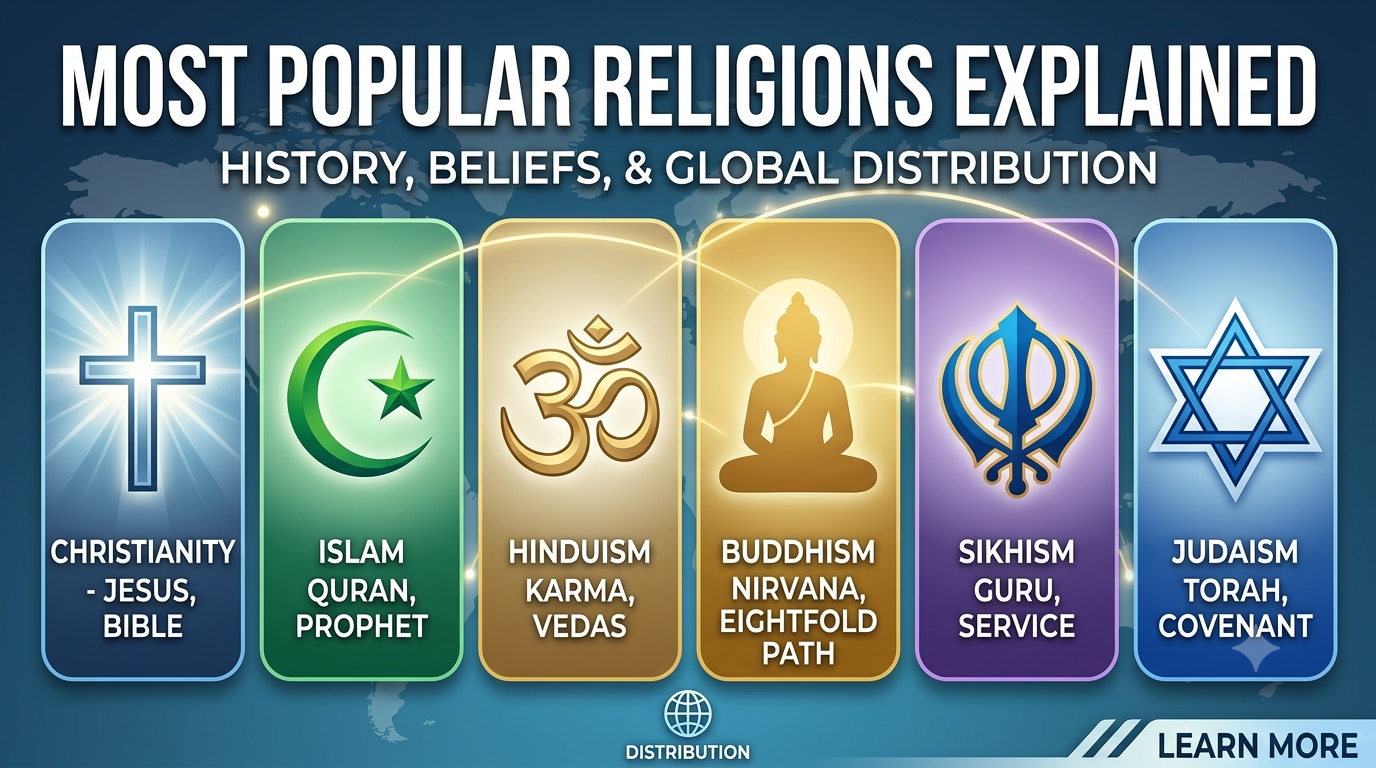
This comprehensive guide breaks down the world’s major religions—Christianity, Islam, Hinduism, Buddhism, Sikhism, and Judaism—exploring their origins, core theological beliefs, major branches, and modern geographic presence.
The Global Religious Landscape at a Glance
Before diving into individual faiths, it helps to look at the global demographic distribution. According to demographic surveys by institutions like the Pew Research Center and World Population Review, world religions generally fall into two broad cultural categories: Abrahamic faiths (tracing roots to the patriarch Abraham) and Dharmic faiths (originating in the Indian subcontinent).
| Religion | Estimated Followers | Percentage of World Population | Primary Geographic Regions |
| Christianity | ~2.4 Billion | ~30% | The Americas, Europe, Sub-Saharan Africa |
| Islam | ~2.0 – 2.1 Billion | ~25 – 26% | Middle East, North Africa, South & Southeast Asia |
| Secular / Unaffiliated | ~1.2 – 1.3 Billion | ~15 – 16% | East Asia, Western Europe, North America |
| Hinduism | ~1.2 Billion | ~15% | South Asia (primarily India and Nepal) |
| Buddhism | ~500 Million | ~6% | East and Southeast Asia |
| Folk / Traditional | ~400 Million | ~5% | Africa, Asia, Indigenous Americas |
| Sikhism | ~30 Million | ~0.4% | India (Punjab), Diaspora in UK, Canada, USA |
| Judaism | ~15 Million | ~0.2% | Israel, United States |
(Data aggregated from Pew Research Center and global demographic research).
1. Christianity: The World’s Largest Religion
With roughly 2.4 billion followers, Christianity remains the largest religion on Earth. It emerged in the 1st century CE as a movement within Judaism in the Roman province of Judea and rapidly expanded into a global movement.
Historical Context & Origins
Christianity is centered on the life, teachings, death, and resurrection of Jesus of Nazareth, whom Christians believe to be the Christ (Messiah) foretold in the Hebrew Scriptures. Starting with a small group of Jewish disciples in Jerusalem, early Christianity spread across the Mediterranean region through the missionary work of apostles like Paul. Despite centuries of persecution by the Roman Empire, it became the empire’s official religion under Emperor Theodosius I in the late 4th century.
Core Beliefs & Sacred Texts
- Sacred Text: The Holy Bible, comprising the Old Testament (Hebrew Scriptures) and the New Testament (gospels, letters, and early church history).
- Monotheism & Trinity: Christians believe in one God who exists as three distinct persons in unity: the Father, the Son (Jesus Christ), and the Holy Spirit.
- Salvation & Resurrection: A central tenet is that humanity is prone to sin, but through the sacrificial death of Jesus on the cross and his resurrection, believers receive forgiveness and eternal life.
- The Golden Rule: Loving God above all else and loving one’s neighbor as oneself form the core ethical directive.
Major Branches
- Roman Catholicism: Led by the Bishop of Rome (the Pope), it represents over half of all Christians globally, emphasizing sacramental tradition and papal authority.
- Protestantism: Emerging from the 16th-century Reformation initiated by figures like Martin Luther, Protestantism emphasizes the authority of Scripture alone (Sola Scriptura) and faith alone (Sola Fide). Major denominations include Baptists, Methodists, Lutherans, and Evangelicals.
- Eastern Orthodoxy: Split from the Western Church during the Great Schism of 1054 CE, Orthodoxy is a family of autocephalous (self-governing) national churches that emphasize ancient liturgical traditions and mystical theology.
Global Distribution
Christianity is geographically widespread. While historically centered in Europe, its center of gravity has shifted significantly to the Global South over the last century. Today, The Americas (North and South) and Sub-Saharan Africa host the largest Christian populations, followed by Europe and parts of Asia-Pacific.
2. Islam: The Fastest-Growing Faith
Practiced by over 2 billion people, Islam is the second-largest religion globally and currently the fastest-growing major faith. The word Islam means “submission” (to the will of God), and a follower of Islam is called a Muslim.
              ┌─────────────────────────────────────────┐
              │           THE FIVE PILLARS OF ISLAM      │
              └────────────────────┬────────────────────┘
                                   │
        ┌──────────────┬───────────┼───────────┬──────────────┐
        ▼              ▼           ▼           ▼              ▼
   1. Shahada      2. Salah     3. Zakat    4. Sawm        5. Hajj
 (Declaration)     (Prayer)    (Alms)      (Fasting)    (Pilgrimage)
Historical Context & Origins
Islam originated in the early 7th century CE in Mecca, an oasis city in the Arabian Peninsula. Muslims believe that God (known in Arabic as Allah) revealed His final guidance to humanity through the Prophet Muhammad via the Archangel Gabriel over a period of 23 years. Muhammad united the tribes of Arabia under monotheism, laying the groundwork for a civilization that quickly expanded across the Middle East, North Africa, and Asia.
Core Beliefs & Sacred Texts
- Sacred Text: The Quran, believed by Muslims to be the literal, unalterable word of God revealed in Arabic. Complementing the Quran are the Hadiths—recordings of the sayings and actions of Prophet Muhammad.
- Tawhid (Absolute Monotheism): The foundational principle that God is One, without partners, physical form, or equal.
- The Five Pillars of Islam:
- Shahada: Declaration of faith (“There is no god but Allah, and Muhammad is His messenger”).
- Salah: Daily ritual prayers performed five times facing Mecca.
- Zakat: Annual obligatory charity giving (typically 2.5% of accumulated wealth) to aid those in need.
- Sawm: Fasting during the holy month of Ramadan from dawn to sunset.
- Hajj: The pilgrimage to the holy city of Mecca, required once in a lifetime for those physically and financially able.
Major Branches
- Sunni Islam: Comprising roughly 85–90% of all Muslims, Sunnis believe that the community rightfully elected Abu Bakr (Muhammad’s close companion) as the first leader (Caliph) after the Prophet’s passing.
- Shia Islam: Comprising roughly 10–15% of Muslims, Shias believe that leadership rightfully belonged to Muhammad’s family, specifically his cousin and son-in-law, Ali ibn Abi Talib, and his designated successors (Imams).
Global Distribution
Contrary to popular perception, the vast majority of Muslims live outside the Middle East. Indonesia holds the world’s largest single Muslim population, followed closely by Pakistan, India, and Bangladesh. Significant populations also span North Africa, the Middle East, Central Asia, and Sub-Saharan Africa.
3. Hinduism: The World’s Oldest Living Tradition
With approximately 1.2 billion followers, Hinduism is the third-largest religion. Unlike Abrahamic faiths, Hinduism has no single founder, no single holy book, and no central governing authority. It is best understood as a vast synthesis of diverse philosophical, spiritual, and cultural traditions.
Historical Context & Origins
Hinduism’s roots date back over 4,000 years to the Indus Valley Civilization and the Vedic culture of ancient India. Over time, dynamic philosophical debates, devotional movements (Bhakti), and epic literature shaped the religion into the vast framework known natively as Sanatana Dharma (“The Eternal Law/Way”).
Core Beliefs & Sacred Texts
- Sacred Texts: A rich library of texts written in Sanskrit, divided into Shruti (“that which is heard”—the Vedas and Upanishads) and Smriti (“that which is remembered”—epics like the Mahabharata, containing the Bhagavad Gita, and the Ramayana).
- Brahman: The ultimate, formless, supreme reality that permeates everything in the universe. While Hindus worship various deities (such as Vishnu, Shiva, and the Goddess Devi), most philosophies view these as different forms or aspects of the one Ultimate Reality.
- Karma & Reincarnation: Karma is the universal law of cause and effect; every action generates an equivalent reaction. This law drives Samsara—the continuous cycle of birth, death, and rebirth.
- Dharma & Moksha: Dharma refers to duty, ethics, and living in harmony with cosmic order. The ultimate spiritual goal is Moksha—liberation from the cycle of rebirth to attain union with Brahman.
Major Traditions
Rather than rigid denominations, Hinduism is organized into four main devotional traditions:
- Vaishnavism: Focuses on the worship of Lord Vishnu and his avatars (such as Rama and Krishna).
- Shaivism: Focuses on Lord Shiva as the supreme deity.
- Shaktism: Worships the Supreme Divine Power in feminine form (Devi, Parvati, Kali, Durga).
- Smartism: Follows an integrative philosophical path that venerates five or six main deities equally.
Global Distribution
Hinduism is geographically concentrated in South Asia. Over 90–95% of the world’s Hindus live in India, with substantial populations in Nepal, Mauritius, and Bali (Indonesia), alongside growing diaspora communities across North America, Europe, and the Persian Gulf.
4. Buddhism: The Path to Enlightenment
Buddhism, practiced by around 500 million people, originated as a reform movement within the cultural context of ancient India and quickly developed into a distinct philosophical and spiritual system.
Historical Context & Origins
Buddhism was founded in the 5th century BCE by Siddhartha Gautama, a prince born in present-day Nepal. Moved by human suffering (aging, sickness, and death), Siddhartha renounced his royal life to seek spiritual truth. After years of intense meditation, he attained supreme enlightenment under a Bodhi tree and became known as the Buddha (“The Awakened One”). He spent the remainder of his life teaching others how to overcome suffering.
Core Beliefs & Sacred Texts
- Sacred Texts: The Pali Canon (Tripitaka), along with Mahayana sutras (such as the Heart Sutra and Lotus Sutra).
- The Four Noble Truths:
- Dukkha: Life involves suffering and dissatisfaction.
- Samudaya: Suffering is caused by craving, attachment, and ignorance.
- Nirodha: Suffering can end by overcoming craving and attachment.
- Magga: The path to the cessation of suffering is the Noble Eightfold Path.
- The Noble Eightfold Path: A practical guide to ethical conduct, mental discipline, and wisdom (Right View, Right Intention, Right Speech, Right Action, Right Livelihood, Right Effort, Right Mindfulness, and Right Concentration).
- Anatta (Non-Self) & Nirvana: Buddhism teaches that there is no permanent, unchanging soul (Anatta). The ultimate goal is Nirvana—a state of peace achieved by extinguishing greed, hatred, and delusion.
       ┌──────────────────────────────────────────────────┐
       │             THE NOBLE EIGHTFOLD PATH             │
       └────────────────────────┬─────────────────────────┘
                                │
        ┌───────────────────────┼───────────────────────┐
        ▼                       ▼                       ▼
     WISDOM                  ETHICS                MEDITATION
 (Right View,            (Right Speech,          (Right Effort,
Right Intention)         Right Action,          Right Mindfulness,
                        Right Livelihood)      Right Concentration)
Major Branches
- Theravada (“School of the Elders”): The oldest surviving branch, Theravada remains closest to early Buddhist monastic practices and is prominent in Southeast Asia (Thailand, Myanmar, Sri Lanka, Cambodia).
- Mahayana (“Great Vehicle”): Emphasizes the path of the Bodhisattva—one who seeks enlightenment not just for themselves, but to help all sentient beings achieve liberation. Popular in East Asia (China, Japan, Korea, Vietnam).
- Vajrayana (“Esoteric / Tibetan Buddhism”): Uses tantric practices, ritual visualizations, and mantras to accelerate the path to enlightenment. Dominant in Tibet, Mongolia, and Bhutan.
Global Distribution
Buddhism is predominantly concentrated in East Asia and Southeast Asia. China holds the largest total number of Buddhists, while countries like Thailand, Cambodia, and Myanmar have the highest percentage of Buddhist residents relative to population.
5. Sikhism: Equality, Service, and Devotion
With roughly 30 million followers, Sikhism is the fifth-largest organized world religion. Despite being younger than many other major faiths, it has grown into a major international spiritual force known for its commitment to social justice and community service.
Historical Context & Origins
Sikhism was founded in the late 15th century CE by Guru Nanak Dev Ji in the Punjab region of South Asia. Guru Nanak rejected the rigid caste hierarchy, ritualism, and religious sectarianism of his day, preaching the message of one universal God and absolute equality for all human beings regardless of gender, class, or creed. He was succeeded by nine human Gurus, culminating in the 10th Guru, Guru Gobind Singh Ji.
Core Beliefs & Sacred Texts
- Sacred Text: The Guru Granth Sahib, the eternal spiritual authority of Sikhism. It is a compilation of hymns and teachings from the Sikh Gurus as well as Hindu and Muslim saints.
- Ik Onkar: The foundational truth that there is only One Universal Creator God.
- Three Core Pillars:
- Naam Japna: Remembering God continually in daily life.
- Kirat Karo: Earning an honest living through hard work.
- Vand Chhako: Sharing one’s wealth and serving those in need.
- Seva & Langar: Unconditional selfless service (Seva) is central. Every Sikh Gurdwara (place of worship) features a Langar—a free community kitchen where every visitor sits on the floor as equals to share a meal, regardless of background.
The Five Ks (Panj Kakar)
Initiated Sikhs (members of the Khalsa) maintain five physical symbols of faith:
- Kesh: Uncut hair (symbolizing acceptance of God’s will).
- Kangha: A small wooden comb (cleanliness and order).
- Kara: An iron bracelet (reminding one of infinite divine connection and moral restraint).
- Kachera: Cotton undergarments (chastity and self-control).
- Kirpan: A ceremonial sword (duty to defend justice and protect the defenseless).
Global Distribution
The historic home of Sikhism is the Punjab region of India. However, a vibrant global diaspora has established significant Sikh communities in Canada, the United Kingdom, the United States, and Australia.
6. Judaism: The Root of the Abrahamic Traditions
Although Judaism has a relatively small global population of roughly 15 million people, its historical and cultural impact on human history is immense. As the oldest monotheistic Abrahamic faith, it provided the theological foundation upon which both Christianity and Islam were built.
Historical Context & Origins
Judaism traces its origin back over 3,500 years to the ancient Near East. According to the Hebrew Bible, God entered into a sacred Covenant with Abraham, promising to make his descendants a great nation. This covenant was renewed through Moses, who led the Israelites out of slavery in Egypt and received the Law (including the Ten Commandments) at Mount Sinai.
Core Beliefs & Sacred Texts
- Sacred Texts: The Tanakh (the Hebrew Bible, consisting of the Torah [Teachings/Law], Nevi’im [Prophets], and Ketuvim [Writings]). The Talmud provides extensive rabbinic commentary on ethics, law, and scripture.
- Monotheism & Covenant: Judaism asserts the absolute oneness of God. The Jewish people understand themselves as bound to God by a covenant to live ethically and follow divine commandments (Mitzvot).
- Action Over Belief: Judaism places heavy emphasis on orthopraxy (correct action and ethical living in this world) rather than strict dogmatic creeds about the afterlife.
- Tikkun Olam: A key spiritual imperative meaning “repairing the world”—working toward justice, peace, and social repair.
Major Movements Today
Modern Judaism reflects various interpretations of how to observe Jewish law (Halakha) in a modern world:
- Orthodox Judaism: Adheres strictly to traditional Jewish law, viewing the Torah as the literal, immutable word of God revealed at Sinai.
- Conservative Judaism: Seeks a middle path, holding that Jewish law is binding but evolves dynamically over time.
- Reform Judaism: Emphasizes the ethical core of Judaism, viewing ritual laws as individual choices and adapting tradition to modern culture.
Global Distribution
Tragically shaped by centuries of exile, diaspora, and the Holocaust, the global Jewish population today is concentrated primarily in two main hubs: Israel (roughly 45–50%) and the United States (roughly 40%), with smaller communities across Europe (UK, France) and Latin America.
Comparative Matrix: Key Features at a Glance
To better synthesize how these major faiths relate to one another, the following table compares their core features side by side:
| Religion | Primary Deity / Ultimate Reality | Concept of Afterlife / Ultimate Goal | Key Spiritual Practices |
| Christianity | Triune God (Father, Son, Holy Spirit) | Heaven / Eternal communion with God | Prayer, Sacraments, Scripture study, Charity |
| Islam | Allah (The One God) | Jannah (Paradise) / Jahannam (Hell) | Five Pillars, Quran recitation, Fasting |
| Hinduism | Brahman (Ultimate Reality manifest in many forms) | Moksha (Liberation from reincarnation) | Yoga, Meditation, Puja (worship), Karma/Dharma |
| Buddhism | Non-theistic (Focus on nature of reality) | Nirvana (Cessation of rebirth and suffering) | Eightfold Path, Mindfulness, Meditation |
| Sikhism | Ik Onkar (One Universal Creator) | Mukti (Union of soul with God) | Naam Simran, Seva (service), Langar |
| Judaism | Yahweh / Adonai (The One God) | Olam Ha-Ba (World to Come) / Focus on life today | Prayer, Torah study, Observing Shabbat & Mitzvot |
Key Takeaways on Global Religious Diversity
As we look toward the future of global demographics, several key trends emerge:
- Changing Demographics: Due to birth rates and youth demographics in regions like Sub-Saharan Africa and South Asia, Islam is projected to grow faster than any other major religion over the coming decades, potentially approaching parity with Christianity by the mid-21st century.
- Growth of the Unaffiliated: Secularism, agnosticism, and spiritual non-affiliation are rising rapidly in Western Europe, North America, and East Asia, making the “unaffiliated” category the third-largest demographic group globally.
- Shared Universal Ethics: Despite distinct theological views, all major religious traditions share a common ethical foundation: promoting compassion, honesty, humility, and the moral duty to help those in need.
Understanding these world religions builds cultural literacy, fosters mutual respect, and helps build bridges in an increasingly interconnected global society.
Penulis: W.S






Post Comment