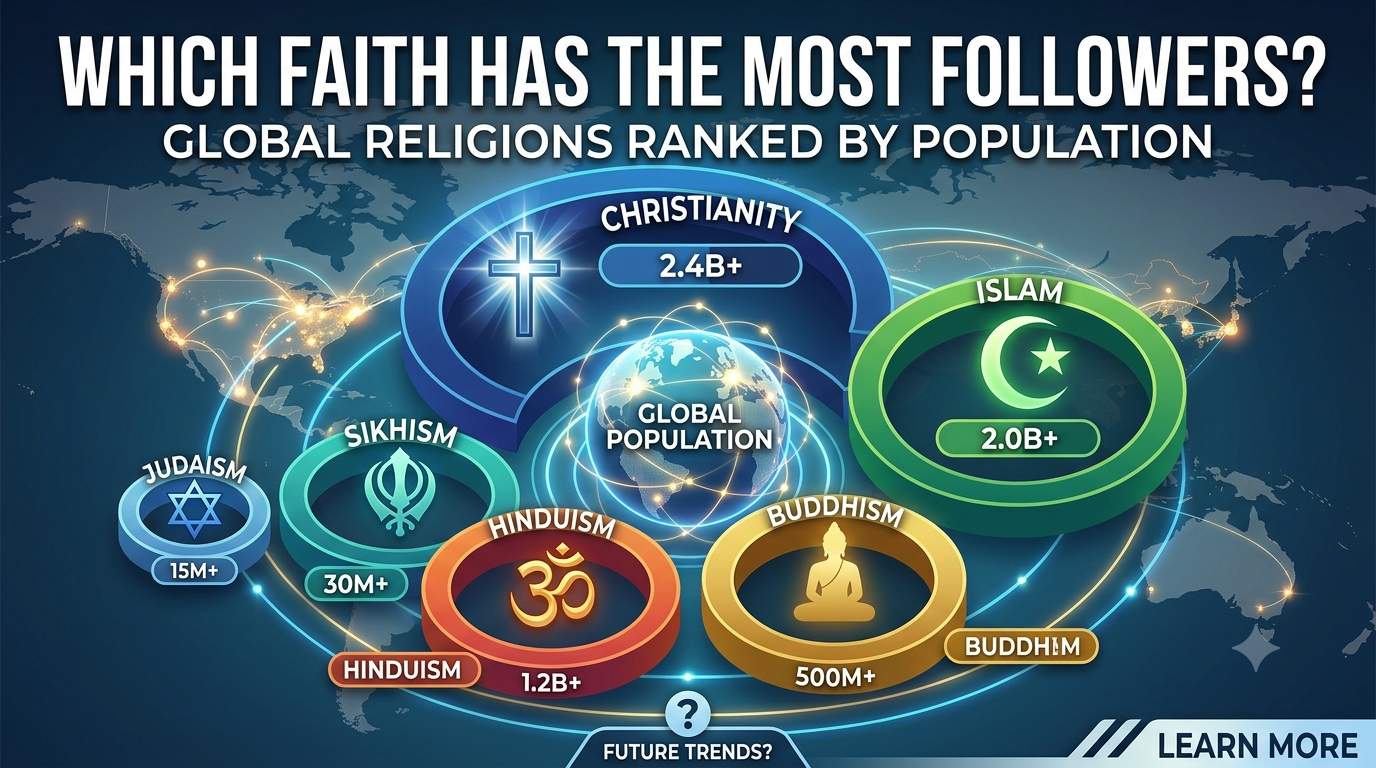
Across human history, religious traditions have served as the foundational pillars of culture, morality, societal structure, and law. Today, out of the thousands of spiritual practices and belief systems existing across the globe, a select group of major faiths accounts for the vast majority of the world’s population.
With the global population exceeding 8 billion people, over 85% of humanity identifies with a specific religious group or spiritual tradition. But which faith has the most followers worldwide? How are these demographics changing as we look toward the future?
This comprehensive guide breaks down the most popular religions by population, examining current rankings, core teachings, demographic concentrations, and global trends.
Global Religious Population at a Glance
According to demographic research compiled by organizations like the Pew Research Center and the World Religion Database, global religious identity can be summarized into several primary categories:
| Religion / Group | Estimated Population | Percentage of World Population | Primary Geographic Concentration |
| Christianity | ~2.4 – 2.6 Billion | ~30% – 32% | The Americas, Europe, Sub-Saharan Africa |
| Islam | ~1.9 – 2.1 Billion | ~25% – 26% | Middle East, North Africa, South & Southeast Asia |
| Secular / Unaffiliated | ~1.2 – 1.3 Billion | ~15% – 16% | East Asia, Western Europe, North America |
| Hinduism | ~1.1 – 1.2 Billion | ~14% – 15% | South Asia (primarily India and Nepal) |
| Buddhism | ~500 Million | ~6% – 7% | East and Southeast Asia |
| Folk / Traditional Religions | ~400 Million | ~5% | Africa, Asia, Indigenous Americas |
| Sikhism | ~30 Million | ~0.4% | India (Punjab), Global Diaspora |
| Judaism | ~15 Million | ~0.2% | Israel, United States |
(Data sources aggregated from Pew Research Center, World Population Review, and statistical databases).
1. Christianity: The World’s Largest Faith (~2.4 to 2.6 Billion)
Christianity remains the world’s largest religion by population, claiming between 30% and 32% of the global human population.
Origins and Foundation
Christianity originated in the 1st century CE in the Roman province of Judea (modern-day Middle East). It is centered on the life, teachings, death, and resurrection of Jesus of Nazareth, whom Christians accept as the Christ (Messiah) and the Son of God.
Core Beliefs and Texts
- Sacred Text: The Holy Bible, divided into the Old Testament (Hebrew Scriptures) and the New Testament.
- Monotheism & Trinity: Belief in one God existing as three distinct persons: the Father, the Son, and the Holy Spirit.
- Salvation: Salvation from sin and the promise of eternal life in heaven are attained through faith in Jesus Christ and divine grace.
Main Branches
- Roman Catholicism: The single largest Christian denomination, representing over 1.2 billion adherents globally, led by the Pope in Vatican City.
- Protestantism: Includes various denominations (such as Baptists, Lutherans, Methodists, and Evangelicals) originating from the 16th-century Reformation.
- Eastern Orthodoxy: Prominent across Eastern Europe, Russia, and the Mediterranean, preserving ancient liturgical traditions.
Global Distribution
While historically concentrated in Europe, Christianity’s center of gravity has shifted heavily to the Global South over the last century. Today, the United States, Brazil, Mexico, Nigeria, and the Philippines hold the world’s largest Christian populations.
2. Islam: The Fastest-Growing Faith (~1.9 to 2.1 Billion)
Ranking second overall, Islam is practiced by roughly 25% to 26% of the global population. Furthermore, due to higher fertility rates and a younger median age relative to other groups, Islam is recognized as the world’s fastest-growing major faith.
           ┌────────────────────────────────────────────────────────┐
           │                  THE FIVE PILLARS OF ISLAM             │
           └───────────────────────────┬────────────────────────────┘
                                       │
     ┌───────────────┬─────────────────┼─────────────────┬───────────────┐
     ▼               ▼                 ▼                 ▼               ▼
  SHAHADA          SALAH             ZAKAT             SAWM            HAJJ
Declaration      Daily Prayer      Almsgiving         Fasting       Pilgrimage
 of Faith      (5 Times Daily)    (Charity Duty)   (Month of Ramadan) to Mecca
Origins and Foundation
Islam was founded in the early 7th century CE in Mecca (Arabian Peninsula) by the Prophet Muhammad. Muslims believe that Muhammad was the final prophet in a long line of divine messengers that includes Abraham, Moses, and Jesus.
Core Beliefs and Practices
- Sacred Text: The Quran, believed to be the literal, unalterable word of God (Allah) revealed in Arabic.
- Tawhid (Monotheism): The absolute oneness of God, without partners or equals.
- The Five Pillars: The essential religious practices governing Muslim life—Faith (Shahada), Prayer (Salah), Alms (Zakat), Fasting (Sawm), and Pilgrimage (Hajj).
Main Branches
- Sunni Islam: Accounts for roughly 85–90% of the worldwide Muslim community.
- Shia Islam: Makes up approximately 10–15% of all Muslims, predominantly in Iran, Iraq, Azerbaijan, and Bahrain.
Global Distribution
Although heavily associated with the Middle East and North Africa, the majority of Muslims live in the Asia-Pacific region. Indonesia holds the largest national Muslim population, followed closely by Pakistan, India, and Bangladesh.
3. Secular, Agnostic, and Religiously Unaffiliated (~1.2 to 1.3 Billion)
While not a unified religion, the religiously unaffiliated—often termed the “nones”—represent the third-largest demographic group globally, accounting for roughly 15% to 16% of humanity.
Group Breakdown
This umbrella category includes:
- Atheists: Individuals who do not believe in the existence of a deity.
- Agnostics: Individuals who believe the existence or non-existence of God is unknown or unknowable.
- Secular / Unaffiliated: Individuals who may believe in a higher power or spiritual forces but do not adhere to organized religion.
Geographic Concentration
The unaffiliated population is concentrated heavily in East Asia (especially China, Japan, and South Korea), Western Europe, and North America. In countries like China, state secularism and cultural traditions lead millions to practice ancestor veneration or local customs without formal affiliation to an organized faith.
4. Hinduism: The Largest Dharmic Faith (~1.1 to 1.2 Billion)
Hinduism is the world’s third-largest single religion (and fourth-largest global category), claiming approximately 15% of the world’s population.
Origins and Foundation
Unlike Abrahamic faiths, Hinduism has no single founder, specific holy scripture, or centralized leadership. Originating in the Indus Valley over 4,000 years ago, it is considered one of the world’s oldest living religions and is natively known as Sanatana Dharma (“The Eternal Law”).
Core Beliefs
- Sacred Texts: The Vedas, Upanishads, and epics such as the Bhagavad Gita and Ramayana.
- Brahman: The underlying ultimate reality or supreme consciousness that takes many formful manifestations (such as Vishnu, Shiva, and Devi).
- Karma & Reincarnation: Moral actions (Karma) govern the cycle of birth, death, and rebirth (Samsara).
- Moksha: The ultimate goal of life—liberation from reincarnation to attain unity with Brahman.
Global Distribution
Hinduism is geographically concentrated. Over 95% of all Hindus globally live in India and Nepal, with notable populations in Mauritius, Bali (Indonesia), and across the Indian diaspora in Western nations.
5. Buddhism (~500 Million)
Buddhism holds the fifth spot overall, with roughly 500 million practitioners globally (representing 6% to 7% of the world’s population).
Origins and Foundation
Founded in northern India during the 5th century BCE by Siddhartha Gautama (the Buddha, or “Awakened One”), Buddhism developed as a spiritual path toward overcoming human suffering.
Core Beliefs
- The Four Noble Truths: The diagnosis of human existence—that suffering exists (Dukkha), stems from craving and attachment, can be brought to an end, and has a defined cure.
- The Noble Eightfold Path: The practical framework for ethical conduct, mental discipline, and wisdom.
- Nirvana: The state of liberation achieved by extinguishing ignorance, greed, and hatred.
Major Branches
- Theravada: Dominant in Southeast Asia (Thailand, Myanmar, Sri Lanka, Cambodia).
- Mahayana: Widespread across East Asia (China, Japan, Korea, Vietnam).
- Vajrayana: Practiced primarily in Tibet, Mongolia, and Bhutan.
6. Folk and Traditional Religions (~400 Million)
Encompassing around 5% of the global population, Folk and Indigenous Religions represent hundreds of localized, traditional belief systems.
- Key Characteristics: These faiths are closely tied to regional cultures, ethnicity, and geography. They often feature animism, ancestor worship, nature worship, and shamanic healing practices.
- Prominent Examples: African Traditional Religions (such as Yoruba or Vodou), Chinese Folk Religion (incorporating Taoism and Confucianism), Shinto in Japan, and Native American spiritualities.
7. Sikhism (~30 Million)
Sikhism is the world’s fifth-largest organized religion, practiced by roughly 30 million people worldwide.
- Origins: Founded in the late 15th century CE by Guru Nanak in the Punjab region of South Asia.
- Core Beliefs: Strict monotheism (Ik Onkar), social equality regardless of caste or gender, honest labor, and selfless service to humanity (Seva).
- Location: The majority of Sikhs live in the Punjab region of India, with thriving diaspora communities in Canada, the United Kingdom, and the United States.
8. Judaism (~15 Million)
While comprising about 0.2% of the global population, Judaism holds monumental historical and theological influence as the root of both Christianity and Islam.
- Origins: Traces back over 3,500 years through a sacred Covenant established between God (Adonai) and the patriarch Abraham.
- Core Beliefs: Monotheism and adherence to the commandments (Mitzvot) set forth in the Torah and expanded upon in the Talmud.
- Location: The vast majority of the global Jewish population is concentrated in Israel and the United States.
Comparative Analysis: The Major Faiths Compared
To see how these traditions compare structurally, review the overview below:
| Religion | Theological Type | Primary Founder / Prophet | Primary Sacred Text | Ultimate Spiritual Goal |
| Christianity | Monotheistic (Trinitarian) | Jesus of Nazareth | The Bible | Eternal salvation with God in Heaven |
| Islam | Strict Monotheism | Prophet Muhammad | The Quran | Entrance to Paradise (Jannah) |
| Hinduism | Monism / Polytheism | None (Evolved tradition) | The Vedas & Epics | Liberation (Moksha) from rebirth |
| Buddhism | Non-theistic | Siddhartha Gautama | The Pali Canon | Enlightenment (Nirvana) |
| Sikhism | Strict Monotheism | Guru Nanak Dev Ji | Guru Granth Sahib | Soul’s union with God |
| Judaism | Strict Monotheism | Abraham / Moses | The Tanakh (Torah) | Living righteously under the Covenant |
What Does the Future Hold? Demographic Projections
Religious demographics are not static; they shift constantly over time based on birth rates, life expectancy, age profiles, and religious switching.
According to long-term demographic models by the Pew Research Center:
- Islam and Christianity Convergence: Due to a young median age and high fertility rates, the global Muslim population is growing at a faster rate than any other major faith. By the second half of the 21st century, Islam and Christianity are projected to become roughly equal in overall size.
- Growing Secularism in the West: The percentage of religiously unaffiliated adults continues to rise steadily across North America and Europe, driven by generational shifts.
- Regional Dominance: Sub-Saharan Africa is projected to host an increasingly central share of the world’s Christian and Muslim populations over coming decades due to strong overall population growth in the region.
Conclusion
When asking which faith has the most followers worldwide, the answer today remains Christianity, closely followed by Islam. Together, these two Abrahamic traditions account for over half of all human beings on Earth.
However, looking beyond raw numbers reveals a rich, highly complex tapestry of human spirituality—from ancient Dharmic paths like Hinduism and Buddhism to non-religious frameworks and indigenous traditions. Understanding these numbers and belief systems is essential for navigating an increasingly interconnected world.
Penulis: W.S





Post Comment