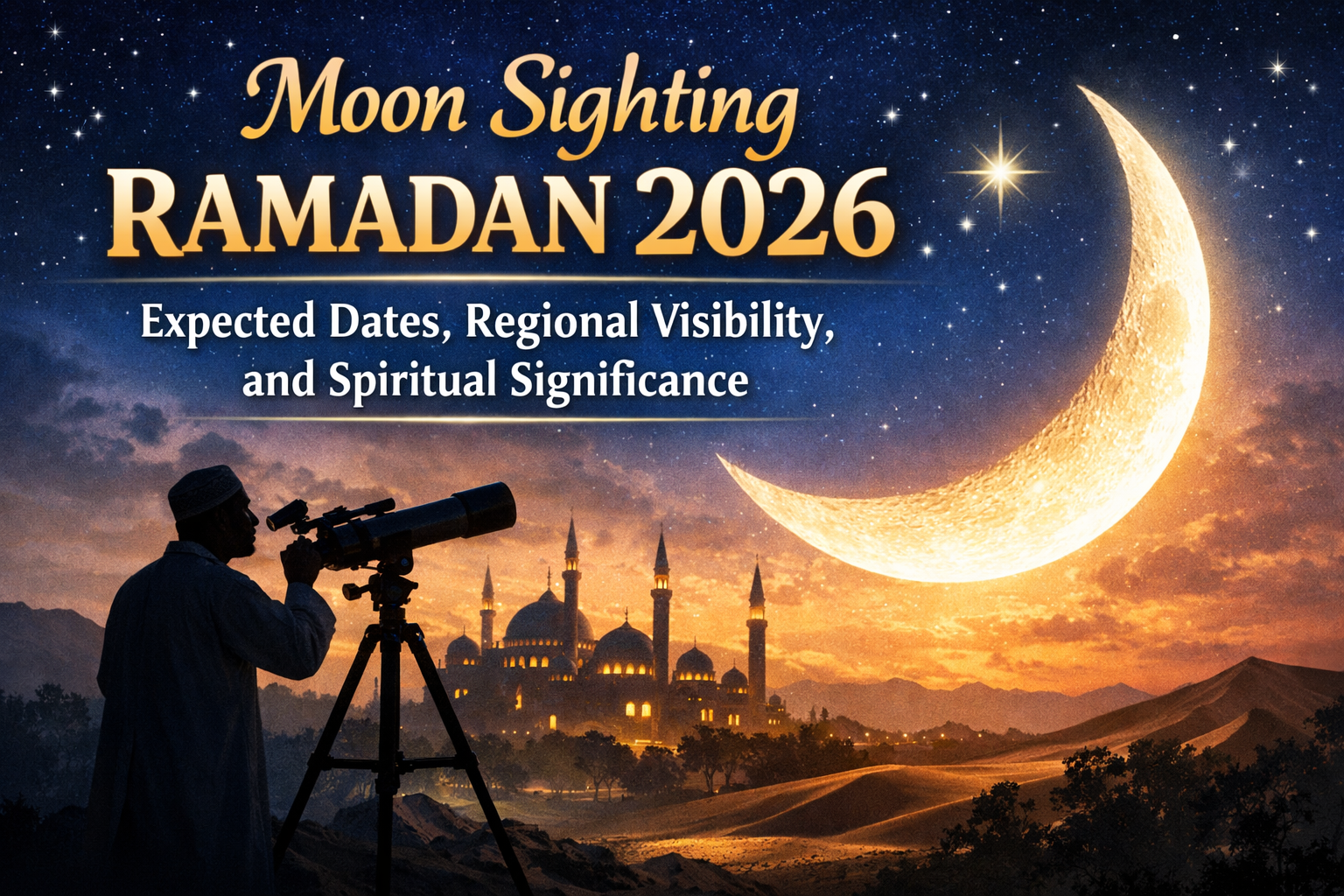
The arrival of the holy month of Ramadan is one of the most anticipated moments for over two billion Muslims worldwide. As we approach the year 2026 (Hijri year 1447), the global community is already looking toward the skies. The moon sighting for Ramadan 2026 is not just a scientific observation; it is a spiritual tradition that bridges the gap between ancient ritual and modern astronomy.
In this comprehensive guide, we explore the predicted dates for the Ramadan 2026 moon sighting, how the Hilal (crescent moon) is determined, and why this event remains the heartbeat of Islamic practice.
1. When is the Ramadan 2026 Moon Sighting?
Based on astronomical calculations, the Ramadan 2026 moon sighting is expected to take place on two primary dates, depending on your geographic location: February 17 and February 18, 2026.
The Two-Day Global Window
Because the Islamic calendar is lunar, the start of a new month depends on the physical sighting of the crescent moon after sunset on the 29th day of the preceding month (Sha’ban).
- Scenario A (February 18 Start): If the moon is sighted on the evening of February 17, fasting begins at dawn on Wednesday, February 18.
- Scenario B (February 19 Start): If the moon is not visible on February 17, Sha’ban completes 30 days, and Ramadan officially begins on Thursday, February 19.
2. Regional Predictions: Who Will See the Moon First?
The visibility of the moon is influenced by the “birth” of the new moon (conjunction) and the observer’s position on Earth. For Ramadan 1447 AH, here is the regional breakdown:
Saudi Arabia and the Middle East
Saudi Arabia often serves as a primary reference for many Muslim communities. In 2026, the conjunction is expected to occur on February 17. Most astronomical models suggest that while the moon will be born, its visibility in the Middle East on the 17th may be extremely difficult without optical aid. However, official committees in Saudi Arabia, the UAE, and Qatar will convene on the evening of February 17, 2026, to make the formal announcement.
Indonesia, Malaysia, and South Asia
For countries like Indonesia, India, and Pakistan, the moon is typically sighted a day later than in the Middle East due to their eastern longitudinal positions. It is highly probable that these regions will look for the moon on February 18, leading to a start date of February 19, 2026.
North America and Europe
In the West, many organizations (such as the Fiqh Council of North America) rely on pre-calculated astronomical data. They are likely to announce February 18 as the first day of fasting, provided the moon reaches the required criteria for visibility somewhere on the globe.
3. The Science of the “Hilal”: How Moon Sighting Works
The moon sighting for Ramadan 2026 isn’t just about looking up. Astronomers use several criteria to determine if the Hilal is “sightable”:
- Moon Age: The time elapsed since the new moon conjunction. Usually, the moon needs to be at least 15–24 hours old to be visible.
- Lag Time: The difference between sunset and moonset. The longer the moon stays in the sky after the sun sets, the easier it is to see.
- Elongation: The angular distance between the sun and the moon. A greater elongation makes the crescent thicker and brighter.
4. Why the Moon Sighting Tradition Matters
In an era of high-precision apps and atomic clocks, why do Muslims still insist on physical moon sighting?
A Direct Command
The practice is rooted in the Hadith of Prophet Muhammad (PBUH): “Fast when you see it [the crescent] and break your fast when you see it.” This creates a direct, lived connection between the believer and the natural world created by Allah.
Unity and Community
The night of the moon sighting (often called Chand Raat in South Asia) is a time of communal excitement. Families gather on rooftops or at local mosques, eyes turned westward. This shared experience fosters a sense of global Ummah, as Muslims across continents await the same celestial signal.
5. Preparing for Ramadan 2026
Since the moon sighting for Ramadan 2026 is expected around mid-February, it is wise to begin spiritual and physical preparations early.
- Adjust Your Schedule: If the start date is February 18 or 19, ensure your work or school commitments allow for the change in sleep patterns (for Suhoor and Taraweeh prayers).
- The “Practice” Fasts: Many choose to fast during the month of Sha’ban to acclimate the body.
- Mental Readiness: Use the time leading up to the moon sighting to set goals for Quran recitation, charity (Zakat), and self-reflection.
6. Key Dates for Your Calendar (Estimated)
| Event | Estimated Date (Western) | Hijri Date |
| Moon Sighting Night | Feb 17 / 18, 2026 | 29 Sha’ban 1447 |
| First Day of Ramadan | Feb 18 / 19, 2026 | 1 Ramadan 1447 |
| Laylat al-Qadr | March 10–18, 2026 | Last 10 Nights |
| Eid al-Fitr Moon Sighting | March 19, 2026 | 29 Ramadan 1447 |
| Eid al-Fitr | March 20, 2026 | 1 Shawwal 1447 |
7. Frequently Asked Questions (FAQs)
Can we use a telescope for the Ramadan 2026 moon sighting?
Yes, many contemporary scholars allow the use of telescopes and binoculars to assist in the sighting. However, the final testimony usually requires the moon to be visible to the human eye or through equipment that mimics human sight.
Why is there often a difference in dates between countries?
This is due to geographic “visibility curves.” The moon may be visible in the Southern Hemisphere or the Americas while remaining below the horizon in Asia. Some follow local sightings (Ikhtilaf al-Matali), while others follow a global announcement.
What happens if it is cloudy on February 17, 2026?
Islamic law is practical. If the sky is obscured by clouds or smog, the current month (Sha’ban) is automatically extended to 30 days. Ramadan then begins the following day without the need for a sighting.
Conclusion: Averting Our Eyes to the Heavens
The moon sighting for Ramadan 2026 represents a beautiful intersection of faith and the cosmos. Whether you rely on the latest astronomical apps or stand on a balcony waiting for that silver sliver to appear, the sentiment is the same: it is a call to slow down, reflect, and enter a month of divine mercy.
As we count down the days to February 2026, let the moon be a reminder of our place in the universe—part of a vast, orderly creation that begins and ends each chapter with the simple grace of a New Moon.





Post Comment