
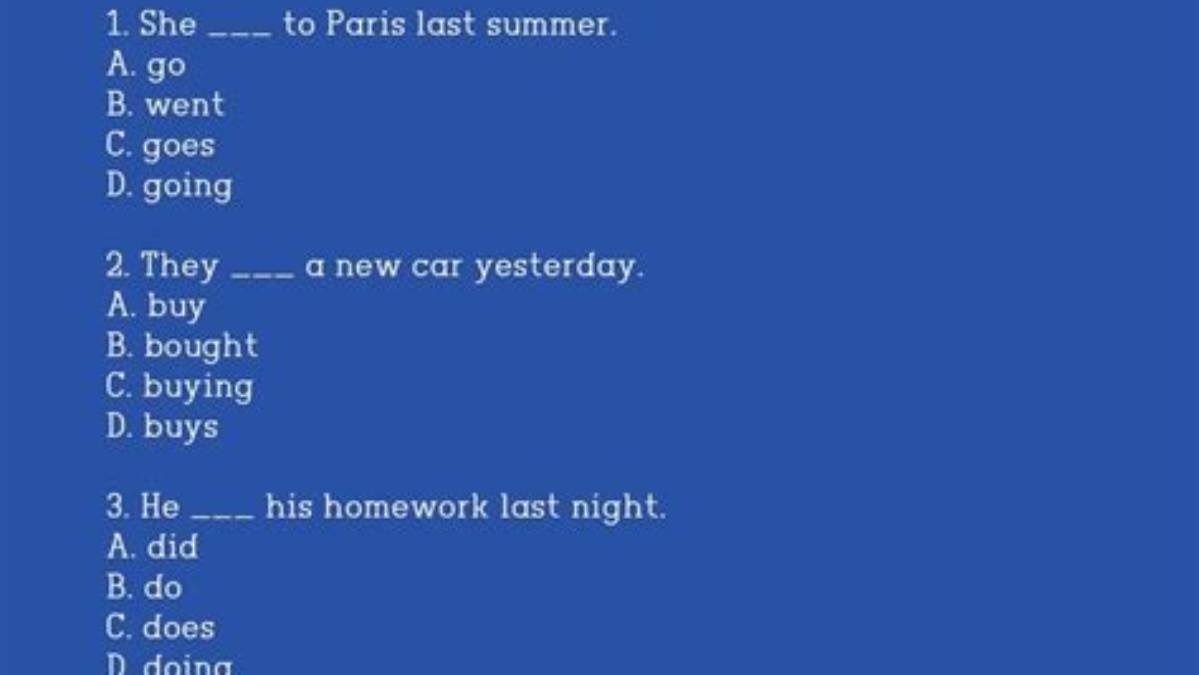
Belajar contoh soal simple past tense dan pembahasan adalah cara paling efektif untuk menguasai materi bentuk lampau dalam bahasa Inggris. Simple past tense digunakan untuk menyatakan kejadian yang sudah terjadi dan sudah selesai di masa lalu, misalnya kejadian kemarin, minggu lalu, atau tahun lalu. Materi ini biasanya diajarkan di kelas 10 dan menjadi dasar penting sebelum mempelajari tenses lainnya.
Artikel ini dirancang khusus untuk pemula yang ingin berlatih secara bertahap. Kamu akan menemukan ringkasan materi terlebih dahulu, kemudian latihan soal pilihan ganda dan esai singkat yang dilengkapi pembahasan langkah demi langkah. Dengan berlatih secara rutin, kamu akan lebih percaya diri saat mengerjakan soal di ulangan maupun ujian.
Pengertian Simple Past Tense
Simple past tense adalah bentuk kata kerja yang digunakan untuk menyatakan aktivitas atau keadaan yang terjadi di masa lalu dan tidak ada hubungannya dengan masa sekarang. Waktu kejadiannya biasanya sudah jelas, misalnya yesterday, last week, two days ago, atau in 2020.
Contoh sederhananya adalah kalimat I watched a movie last night, yang berarti saya menonton film semalam. Kegiatan menonton sudah selesai sebelum kalimat itu diucapkan, sehingga kata kerjanya berbentuk lampau.
Rumus dan Pola Kalimat
Untuk kalimat verbal, pola dasarnya tergantung pada jenis kata kerjanya, yaitu kata kerja beraturan (regular) dan tidak beraturan (irregular). Kata kerja beraturan ditambah akhiran -ed, sedangkan kata kerja tidak beraturan berubah bentuknya secara total dan harus dihafal.
Berikut pola kalimat pada simple past tense:
- Kalimat positif: S + V2 (contoh: She visited her grandmother yesterday)
- Kalimat negatif: S + did not/didn’t + V1 (contoh: They did not go to school last Monday)
- Kalimat tanya: Did + S + V1? (contoh: Did you finish your homework?)
- Kalimat nominal (kata benda/sifat): S + was/were + komplement (contoh: We were tired after the trip)
Catatan penting: setelah did atau did not, kata kerja selalu kembali ke bentuk pertama (V1), bukan bentuk lampau. Kesalahan umum pemula adalah menulis Did you went? yang seharusnya Did you go?
Penggunaan Was dan Were
Untuk kalimat nominal, gunakan was untuk subjek tunggal (I, he, she, it) dan were untuk subjek jamak (we, you, they). Misalnya, He was happy yesterday dan They were at the library yesterday.
Bentuk negatifnya menjadi was not atau wasn’t, serta were not atau weren’t. Untuk kalimat tanya, was atau were diletakkan di awal, seperti Were you sick last night?
Kata Kerja Beraturan dan Tidak Beraturan
Kata kerja beraturan mengikuti aturan penambahan -ed, misalnya play menjadi played, dan study menjadi studied (huruf y berubah menjadi i sebelum -ed). Beberapa kata kerja yang berakhiran konsonan tunggal setelah vokal tunggal mengalami penggandaan konsonan, seperti stop menjadi stopped.
Kata kerja tidak beraturan tidak mengikuti aturan tertentu dan harus dihafalkan. Beberapa yang paling sering muncul dalam soal antara lain:
| V1 (Bentuk Dasar) | V2 (Bentuk Lampau) | Arti |
|---|---|---|
| go | went | pergi |
| eat | ate | makan |
| see | saw | melihat |
| buy | bought | membeli |
| take | took | mengambil |
| write | wrote | menulis |
| sleep | slept | tidur |
| give | gave | memberi |
Keterangan Waktu yang Umum Digunakan
Soal simple past tense sering kali bisa dijawab dengan menemukan keterangan waktu. Kata-kata berikut adalah petunjuk bahwa kalimat berbentuk lampau:
- yesterday (kemarin)
- last night, last week, last month, last year
- two days ago, a week ago, a long time ago
- this morning (jika sudah lewat)
- in 2010, in 1998 dan tahun-tahun yang sudah berlalu
Kalimat tanpa keterangan waktu pun bisa berbentuk lampau jika konteksnya jelas, misalnya dalam sebuah cerita atau narasi. Oleh karena itu, selalu perhatikan kalimat sebelum dan sesudahnya.
Cara Menggunakan Latihan Soal Ini
Sebelum mulai berlatih, kerjakan dulu ringkasan konsep di atas sampai kamu paham. Kemudian, kerjakan soal satu per satu tanpa melihat pembahasannya terlebih dahulu. Setelah selesai, cocokkan jawabanmu dan pelajari penjelasan langkah demi langkah untuk setiap nomor.
Tips belajar yang bisa kamu terapkan:
- Kenali dulu keterangan waktunya untuk menentukan apakah kalimat memang lampau.
- Cek apakah kalimat verbal (pakai kata kerja) atau nominal (pakai was/were).
- Ingat aturan emas: setelah did, kata kerja kembali ke bentuk dasar.
- Hafal kata kerja tidak beraturan secara bertahap, mulai dari yang paling sering muncul.
- Ulangi soal yang salah setelah beberapa hari untuk memastikan kamu benar-benar paham.
Latihan di bawah ini disusun dari soal mudah hingga soal yang lebih menantang. Jika kamu kesulitan pada nomor tertentu, kembali lagi ke bagian rumus dan tabel kata kerja tidak beraturan di atas. Semangat belajar!
Contoh Soal dan Pembahasan
-
Choose the correct form of the verb to complete the sentence: ‘She ___ a letter to her friend yesterday.’
- write
- writes
- wrote
- written
Lihat jawaban dan pembahasan
Jawaban: C. wrote
Step 1: The time signal ‘yesterday’ shows that the sentence is in simple past tense. Step 2: The verb ‘write’ is an irregular verb. Step 3: The past form (V2) of ‘write’ is ‘wrote’, so the correct answer is ‘wrote’.
-
Change this sentence into simple past tense: ‘They play football in the park.’
- They play football in the park yesterday.
- They played football in the park yesterday.
- They are playing football in the park yesterday.
- They plays football in the park yesterday.
Lihat jawaban dan pembahasan
Jawaban: B. They played football in the park yesterday.
Step 1: The sentence is verbal with the regular verb ‘play’. Step 2: In simple past tense, regular verbs take the suffix -ed. Step 3: ‘play’ becomes ‘played’, so the correct sentence is ‘They played football in the park yesterday.’
-
Which sentence uses the correct negative form of simple past tense?
- She didn’t went to the market.
- She didn’t go to the market.
- She not go to the market.
- She doesn’t go to the market.
Lihat jawaban dan pembahasan
Jawaban: B. She didn’t go to the market.
Step 1: Negative verbal sentences in simple past use ‘did not/didn’t + V1’. Step 2: After ‘didn’t’, the verb must return to its base form (V1), so ‘went’ is wrong. Step 3: Therefore, ‘She didn’t go to the market.’ is the correct answer.
-
Fill in the blank: ‘I ___ very tired after the trip last week.’
- am
- is
- was
- were
Lihat jawaban dan pembahasan
Jawaban: C. was
Step 1: The sentence has no main verb, so it is a nominal sentence using was/were. Step 2: The subject ‘I’ always pairs with ‘was’. Step 3: The time signal ‘last week’ confirms past tense, so the answer is ‘was’.
-
Complete the dialogue: ‘A: ___ you finish your homework last night? B: Yes, I did.’
- Do
- Did
- Are
- Was
Lihat jawaban dan pembahasan
Jawaban: B. Did
Step 1: The answer ‘Yes, I did’ indicates the question uses ‘did’. Step 2: The time signal ‘last night’ confirms simple past tense. Step 3: Questions in simple past use ‘Did + subject + V1’, so the correct word is ‘Did’.
-
Choose the sentence that contains an irregular verb in simple past tense.
- He walked to school this morning.
- She visited her aunt last Sunday.
- We bought a new bag at the market.
- They studied English two days ago.
Lihat jawaban dan pembahasan
Jawaban: C. We bought a new bag at the market.
Step 1: Analyze each verb: ‘walked’, ‘visited’, and ‘studied’ are formed with -ed, so they are regular verbs. Step 2: ‘Bought’ is the past form of ‘buy’, which changes completely and does not follow any pattern. Step 3: Therefore, option C is the sentence with an irregular verb.
-
Make a correct negative sentence from: ‘He got up early this morning.’
- He didn’t got up early this morning.
- He not got up early this morning.
- He didn’t get up early this morning.
- He wasn’t get up early this morning.
Lihat jawaban dan pembahasan
Jawaban: C. He didn’t get up early this morning.
Step 1: The sentence is verbal with the irregular verb ‘got up’. Step 2: Negative simple past uses ‘didn’t + V1’. Step 3: ‘got up’ must return to its base form ‘get up’, so the correct sentence is ‘He didn’t get up early this morning.’
-
Fill in the blank: ‘When I was a child, I ___ to the beach every holiday.’ (verb: go)
- gone
- go
- went
- goes
Lihat jawaban dan pembahasan
Jawaban: C. went
Step 1: The clause ‘When I was a child’ shows a finished past period. Step 2: The verb ‘go’ is irregular and its past form (V2) is ‘went’. Step 3: ‘Gone’ is the past participle (V3), not V2, so the correct answer is ‘went’.
-
Identify the mistake and choose the corrected sentence: ‘Did she saw the rainbow after the rain? ‘
- Did she see the rainbow after the rain?
- Did she seen the rainbow after the rain?
- Does she saw the rainbow after the rain?
- Did she saw it the rainbow after the rain?
Lihat jawaban dan pembahasan
Jawaban: A. Did she see the rainbow after the rain?
Step 1: The question uses ‘did’, which already marks the past tense. Step 2: After ‘did’, the main verb must be in base form (V1), not V2. Step 3: ‘saw’ must change to ‘see’, so the corrected sentence is ‘Did she see the rainbow after the rain?’
-
Rearrange the following words into a correct simple past tense question: ‘did – your – visit – when – you – grandmother – ?’
- When did you visit your grandmother?
- When you did visit your grandmother?
- When did you visited your grandmother?
- When you visit did your grandmother?
Lihat jawaban dan pembahasan
Jawaban: A. When did you visit your grandmother?
Step 1: A simple past question follows the pattern: Question word + did + subject + V1 + object. Step 2: Place ‘When’ first, then ‘did’, the subject ‘you’, the base verb ‘visit’, and the object ‘your grandmother’. Step 3: The result is ‘When did you visit your grandmother?’, and the verb ‘visit’ stays in base form because ‘did’ already shows the past.
Pertanyaan yang Sering Diajukan
Apa itu simple past tense?
Simple past tense adalah bentuk kata kerja untuk menyatakan kejadian yang sudah terjadi dan selesai di masa lalu, misalnya kejadian kemarin atau tahun lalu. Pola dasarnya menggunakan bentuk kedua kata kerja (V2) atau was/were untuk kalimat nominal.
Apa bedanya regular dan irregular verb dalam simple past tense?
Regular verb membentuk kata lampau dengan menambahkan akhiran -ed, seperti play menjadi played. Irregular verb berubah bentuknya secara tidak teratur, seperti go menjadi went, sehingga harus dihafalkan.
Kapan menggunakan did dan kapan menggunakan was/were?
Did digunakan untuk kalimat verbal, yaitu kalimat yang memiliki kata kerja, baik dalam bentuk negatif maupun tanya. Was/were digunakan untuk kalimat nominal, yaitu kalimat tanpa kata kerja yang memakai kata benda, sifat, atau keterangan.
Mengapa setelah did kata kerja tidak boleh berbentuk lampau?
Karena penanda lampau sudah ditunjukkan oleh kata did, sehingga kata kerja utama kembali ke bentuk dasar (V1). Contoh yang benar adalah Did you eat? bukan Did you ate?
Bagaimana cara cepat menghafal kata kerja tidak beraturan?
Hafalkan sedikit demi sedikit setiap hari, mulai dari kata kerja yang paling sering digunakan seperti go, eat, see, dan buy. Latih dengan membuat kalimat sendiri agar bentuk kata tersebut lebih mudah diingat.
Baca Juga
- Mengenal Contoh Soal Kebebasan Berpendapat dan Cara Menjawabnya dengan Tepat
- Kuasi Pythagoras: Soal Kelas Dijamin Paham!
- Contoh Soal Poligon Luar Lengkap dengan Pembahasan Mudah Dipahami