
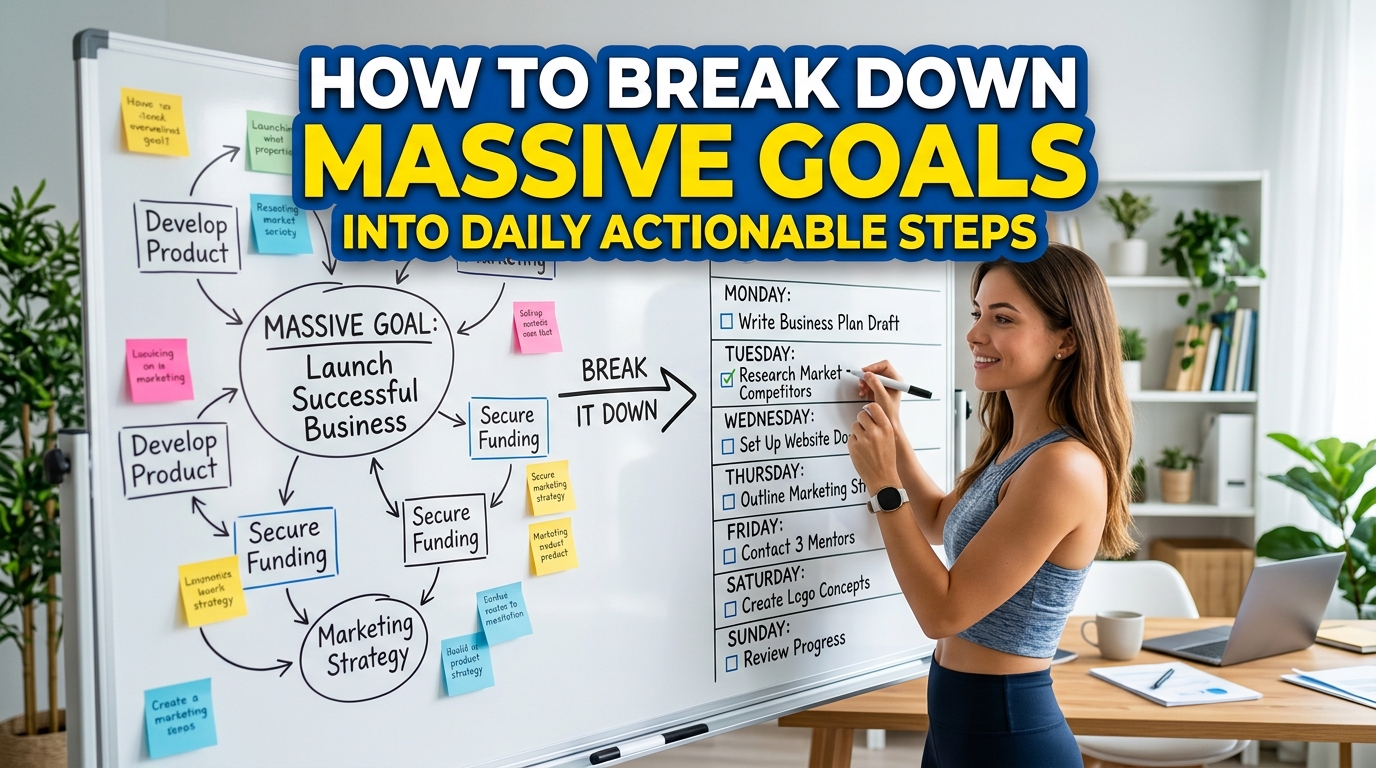
Big goals can be exciting, but they can also feel overwhelming. Whether you want to improve your fitness, learn a new skill, build a career, complete an important project, or develop better habits, looking at the entire goal at once can make it difficult to know where to begin.
The solution is to break massive goals into smaller, daily actionable steps. Instead of focusing only on the final destination, you create a practical system that tells you what to do today, tomorrow, and throughout the week.
This approach can make large goals feel more manageable while helping you build consistency and momentum.
Why Massive Goals Feel Overwhelming
Large goals often involve many different tasks. When everything appears connected and equally important, it can be difficult to identify the first step.
For example, “learn a new language” is a worthwhile goal, but it does not tell you exactly what to do today. Should you study vocabulary, practice speaking, watch videos, or learn grammar?
Breaking the goal down transforms a broad objective into specific actions.
Instead of asking, “How will I accomplish everything?” ask, “What is the next useful step I can take?”
This simple change in perspective can make a major goal feel more approachable.
Start With a Clear Definition of Success
Before breaking down your goal, define what you actually want to accomplish.
A goal should be clear enough that you can recognize when you have made meaningful progress.
For example, instead of saying “I want to improve my writing,” you could define the goal as completing a certain type of writing project or developing a consistent writing habit.
The clearer your destination, the easier it becomes to identify the steps needed to reach it.
Divide the Goal Into Major Milestones
Once your main goal is clear, divide it into several larger milestones.
Milestones represent important stages between where you are now and where you want to be.
For example, if your goal is to create a website, milestones might include:
- Define the website’s purpose.
- Plan the structure.
- Create the necessary content.
- Build the website.
- Test the website.
- Publish and improve it.
Each milestone is much easier to understand than the entire project.
Turn Milestones Into Smaller Tasks
The next step is to break each milestone into individual tasks.
A useful task should describe an action rather than an abstract intention.
For example, “work on the website” is vague. A more actionable task might be “write the homepage introduction.”
Similarly, instead of “study programming,” you could create tasks such as reviewing one concept, completing a small exercise, or practicing a particular skill.
The more specific the task, the easier it is to begin.
Focus on Daily Actionable Steps
After identifying smaller tasks, determine which ones you can realistically complete each day.
Daily actions should be small enough to fit into your schedule.
You do not necessarily need to spend several hours working toward a goal every day. Even a focused period of effort can contribute to long-term progress when repeated consistently.
For example, your daily actions could include:
- Reading a few pages of a useful book
- Practicing a specific skill
- Writing a short section of a project
- Reviewing notes
- Organizing research
- Completing one small task
The objective is to create forward movement without making your routine impossible to maintain.
Use the “Next Action” Principle
When a project feels complicated, ask yourself:
“What is the next physical or practical action I can take?”
This question prevents you from getting stuck thinking about the entire project.
If you want to start a research project, the next action might be opening a document and listing potential topics.
If you want to improve your fitness routine, the next action might be scheduling an activity.
The next action should be something you can actually do rather than something abstract.
Prioritize Your Daily Tasks
Not every task has the same level of importance. Once you have a list of possible actions, identify which ones have the greatest impact on your goal.
You can divide tasks into three categories:
- High priority: Tasks that directly move the goal forward.
- Medium priority: Useful tasks that support progress.
- Low priority: Tasks that can wait if necessary.
This approach prevents you from spending too much time on activities that feel productive but have little impact.
Set a Small Number of Daily Priorities
A long daily to-do list can become overwhelming. Instead of trying to complete dozens of tasks, select a small number of important actions.
For example, you might choose three meaningful priorities for the day.
This gives you a clear focus and makes it easier to recognize what needs to be completed first.
If you finish your priorities early, you can always move on to additional tasks.
Create a Realistic Schedule
A daily action plan works best when it fits your actual life.
Consider your school, work, family responsibilities, hobbies, and other commitments when deciding when to work on your goals.
Choose times when you are most likely to have the necessary energy and attention.
A realistic schedule is usually more sustainable than an ambitious schedule that leaves you exhausted.
Use Time Blocks
Time blocking can help turn intentions into actual actions.
Instead of simply writing “study” on your to-do list, assign a specific period for studying.
For example, you might reserve a particular part of your afternoon for working on your project.
The exact schedule depends on your lifestyle. The important idea is to give important tasks a defined place in your day.
Track Your Progress
Tracking progress makes large goals easier to understand.
You can use a notebook, calendar, spreadsheet, task-management application, or simple checklist.
Record completed tasks and milestones so you can see how much progress you have made.
Tracking also helps identify patterns. You may discover that you work more effectively at certain times or that some tasks consistently take longer than expected.
Use this information to improve your plan.
Build Consistency With Small Wins
Small accomplishments can create momentum.
Completing one task may seem insignificant when compared with a massive goal, but repeated small actions can produce substantial progress over time.
For example, writing a small amount each day can eventually contribute to a complete project. Regular practice can gradually improve a skill.
The key is to focus on repetition rather than waiting for perfect conditions.
Expect Setbacks
No plan works perfectly every day. Unexpected responsibilities, low energy, distractions, and other challenges can interrupt your routine.
A missed day does not mean your goal has failed.
Instead of abandoning your plan, identify the next available opportunity to continue.
You can also create backup actions. If you cannot complete your full task, consider whether a smaller version is possible.
Flexibility helps protect long-term consistency.
Review Your Plan Regularly
Your original plan may change as you learn more about your goal.
Set aside time to review your progress and ask:
- What have I completed?
- What is working well?
- Which tasks are taking too long?
- What should I prioritize next?
- Do I need to change my schedule?
Regular reviews allow you to adapt instead of continuing with an ineffective plan.
Avoid Multitasking Too Much
Trying to work on multiple major tasks simultaneously can reduce your focus.
Whenever possible, concentrate on one meaningful action at a time.
Complete a task, then move to the next priority.
Focused work can make even a short period of time more productive.
Use the One-Day-at-a-Time Approach
Massive goals can create pressure because the final result may seem far away.
Instead of constantly thinking about the entire journey, concentrate on today’s actions.
Ask yourself:
“What can I do today that will make tomorrow easier?”
This mindset shifts your attention from worrying about the size of the goal to taking practical action.
Final Thoughts
Learning how to break down massive goals into daily actionable steps can transform overwhelming ambitions into manageable routines.
Start by defining your desired outcome, divide it into milestones, and turn those milestones into specific tasks. Then choose a small number of daily priorities and schedule them realistically.
Remember that meaningful progress does not always come from dramatic actions. Small, consistent steps can accumulate over time and move you significantly closer to your objective.
You do not have to accomplish everything today. You only need to identify the next useful action and take it.
penulis: Shofiya M.P