
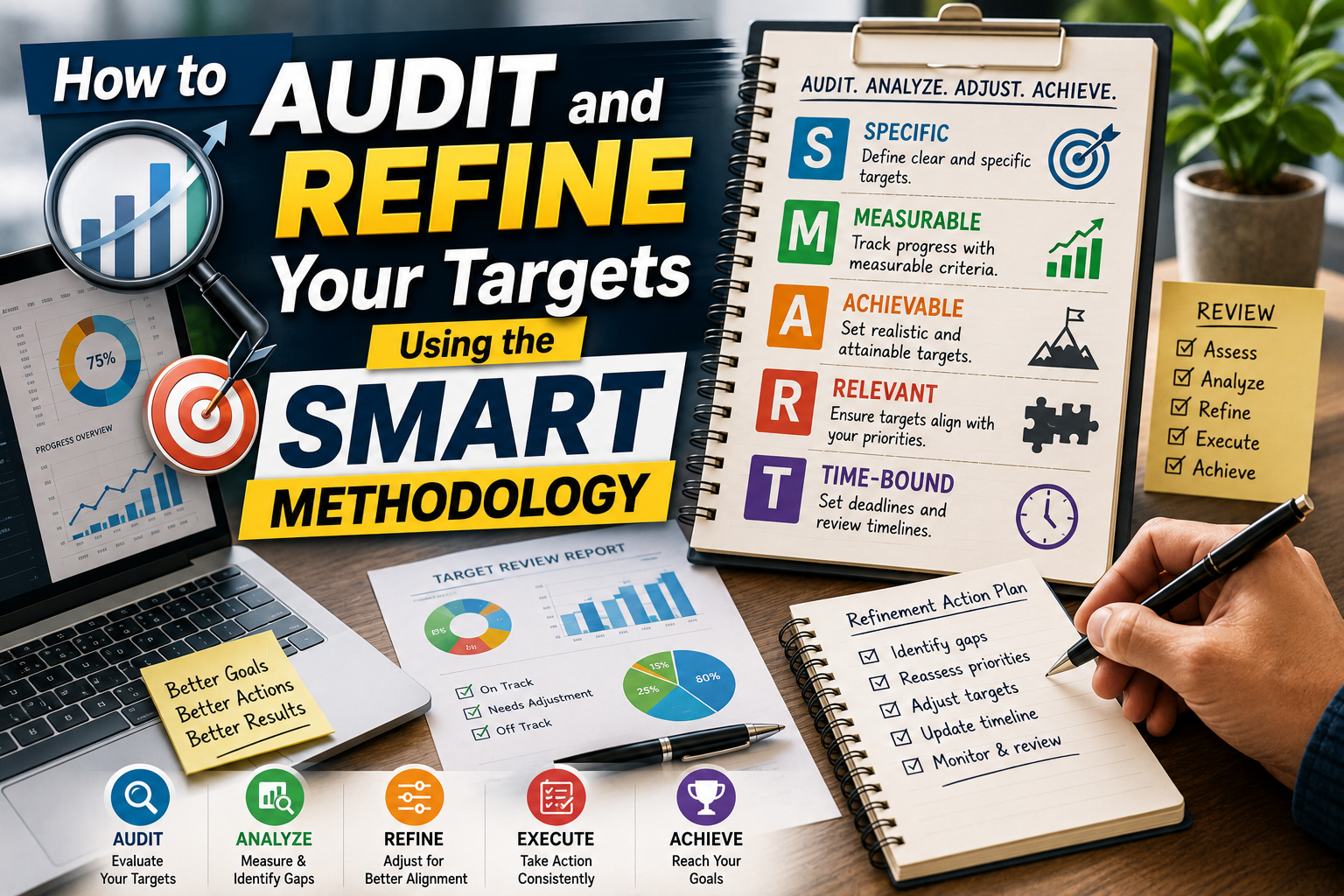
Setting goals is standard practice for any ambitious organization or professional. However, setting targets and actually achieving them are two vastly different challenges. Many teams fall into the trap of establishing vague objectives during annual planning sessions, only to realize months later that little to no progress has been made.
If your goals feel unaligned, overly optimistic, or impossible to measure, it is time for a strategic reset. Auditing and refining your targets using the SMART methodology—ensuring goals are Specific, Measurable, Achievable, Relevant, and Time-bound—provides a structured framework to transform weak objectives into actionable, high-impact outcomes.
What Is a Goal Audit and Why Does It Matter?
A goal audit is the systematic review of your current performance targets, key performance indicators (KPIs), and long-term strategic objectives. Rather than waiting for an annual review to evaluate success, auditing allows you to catch misalignment early, reallocate resources, and eliminate dead-end projects.
The Pitfalls of Unrefined Targets
-
Ambiguity: Targets like “increase brand awareness” lack clear direction.
-
Misalignment: Team-level activities fail to support company-wide strategy.
-
Burnout: Setting unrealistic targets demotivates employees.
-
Lack of Accountability: Without concrete metrics, tracking ownership becomes impossible.
Auditing your targets ensures that every resource spent directly contributes to organizational growth.
Deconstructing the SMART Methodology
The SMART criteria serve as the gold standard for goal refinement. To audit existing targets effectively, you must understand each element of the framework:
| Element | Focus Area | Key Question to Ask |
| Specific | Clarity & Detail | What exactly do we need to accomplish, and who is involved? |
| Measurable | Quantifiable Metrics | How will we track progress and verify completion? |
| Achievable | Realism & Capability | Do we have the skills, budget, and tools to reach this target? |
| Relevant | Strategic Alignment | Does this goal directly support our core business objectives? |
| Time-bound | Deadlines & Milestones | What is the explicit target date for completion? |
Step-by-Step Guide: How to Audit Your Current Targets
Auditing targets requires an honest evaluation of past performance and current capabilities. Follow these four steps to conduct a thorough audit.
+---------------------+      +---------------------+      +---------------------+      +---------------------+
| 1. Inventory Goals  | ---> | 2. Analyze Data     | ---> | 3. Test Alignment   | ---> | 4. Identify Gaps    |
| Collect all KPIs    |      | Evaluate past performance | Strategy vs. Execution | Resource & skill limits |
+---------------------+      +---------------------+      +---------------------+      +---------------------+
1. Inventory Every Active Target
Gather every goal currently assigned across departments, teams, and individual roles. Consolidate them into a single centralized matrix or tracking dashboard.
2. Analyze Historical Performance Data
Review past output. Have targets been consistently missed or achieved too easily?
-
Consistently missed targets signal unrealistic expectations, resource constraints, or poor strategy.
-
Target goals hit effortlessly suggest that the bar was set too low, underutilizing team capacity.
3. Test Strategic Alignment
Evaluate whether achieving these targets still matters. Business environments change quickly; a goal defined six months ago may no longer align with current market conditions or organizational priorities.
4. Identify Resource Gaps
Assess whether your team possesses the necessary headcount, budget, technology, and training to deliver on current expectations.
How to Refine Targets Using SMART Principles
Once your audit is complete, apply the SMART methodology to refashion weak, vague objectives into sharp, operational targets.
WEAK GOAL:
"We need to get more organic traffic to our blog."

                 │
                 ▼  Apply SMART Criteria

REFINED SMART GOAL:
"Increase organic blog traffic by 25% over the next six months
by publishing 12 SEO-optimized articles per month."
1. Make the Target Specific
Vague targets create confusion. Specify the who, what, where, and why.
-
Unrefined: “Improve customer support.”
-
Refined: “Reduce average ticket resolution time for first-tier support inquiries.”
2. Make the Target Measurable
Establish baseline metrics and definitive targets. Incorporate key performance indicators (KPIs) to track ongoing health.
-
Unrefined: “Increase sales this quarter.”
-
Refined: “Increase monthly recurring revenue (MRR) by 15%.”
3. Ensure the Target is Achievable
Unrealistic goals destroy morale. Balance ambition with operational reality by looking at capacity, budget, and historical trajectory.
-
Unrefined: “Double market share in two weeks.”
-
Refined: “Expand market share by 3% over the next four quarters through targeted ad campaigns.”
4. Ensure the Target is Relevant
A goal must serve a broader purpose. If achieving a metric does not move the needle for overall organizational success, drop it or redefine it.
-
Unrefined: “Go viral on TikTok.”
-
Refined: “Generate 500 qualified sales leads monthly via short-form video content on TikTok.”
5. Attach Time-Bound Deadlines
Without strict deadlines, targets slip down the priority list. Divide long-term goals into quarterly and monthly milestones.
-
Unrefined: “Launch the updated website soon.”
-
Refined: “Launch the updated website by October 31st, with design approval completed by September 15th.”
Real-World Case Studies: Transforming Weak Goals into SMART Targets
To visualize this transformation, consider these comparative examples across different business functions:
Example 1: Human Resources & Operations
Unrefined Target: “We need to hire more developers fast because engineering is behind schedule.”
Audit Findings: The goal lacks defined metrics, a realistic timeline, and clear specifications regarding skill requirements.
Refined SMART Target: “Recruit and onboard three senior full-stack developers within the next 90 days to eliminate the engineering sprint backlog by Q4.”
Example 2: Digital Marketing
Unrefined Target: “Get more email subscribers.”
Audit Findings: The goal provides no baseline, no deadline, and no tactical direction.
Refined SMART Target: “Grow the newsletter email subscriber list by 20% (from 10,000 to 12,000) by the end of Q3 by introducing a gated industry whitepaper.”
Best Practices for Maintaining Target Hygiene
Auditing and refining goals is not a one-time exercise. Maintain long-term target accuracy by embedding these habits into your management structure:
-
Schedule Quarterly Audits: Review targets every 90 days to adjust for market shifts, internal resource changes, and emerging opportunities.
-
Document Assumptions: Whenever a new target is established, record the underlying assumptions (e.g., market growth rate, ad spend budget). If those assumptions change, revise the target immediately.
-
Focus on Lead Indicators: Track leading metrics (daily sales calls made) alongside lagging metrics (total revenue generated) to address performance gaps proactively.
-
Limit Total Focus Areas: Avoid setting too many goals simultaneously. Focus on three to five core SMART targets per team to prevent dilution of effort.
Conclusion
Auditing and refining your targets with the SMART methodology bridges the gap between vision and execution. By taking the time to evaluate performance metrics, eliminate strategic misalignment, and apply rigorous standards to every objective, you empower your team to focus on work that truly drives results.
Take time today to audit your active targets, apply the SMART criteria, and convert vague aspirations into clear, measurable pathways to growth.
Penulis: W.S