
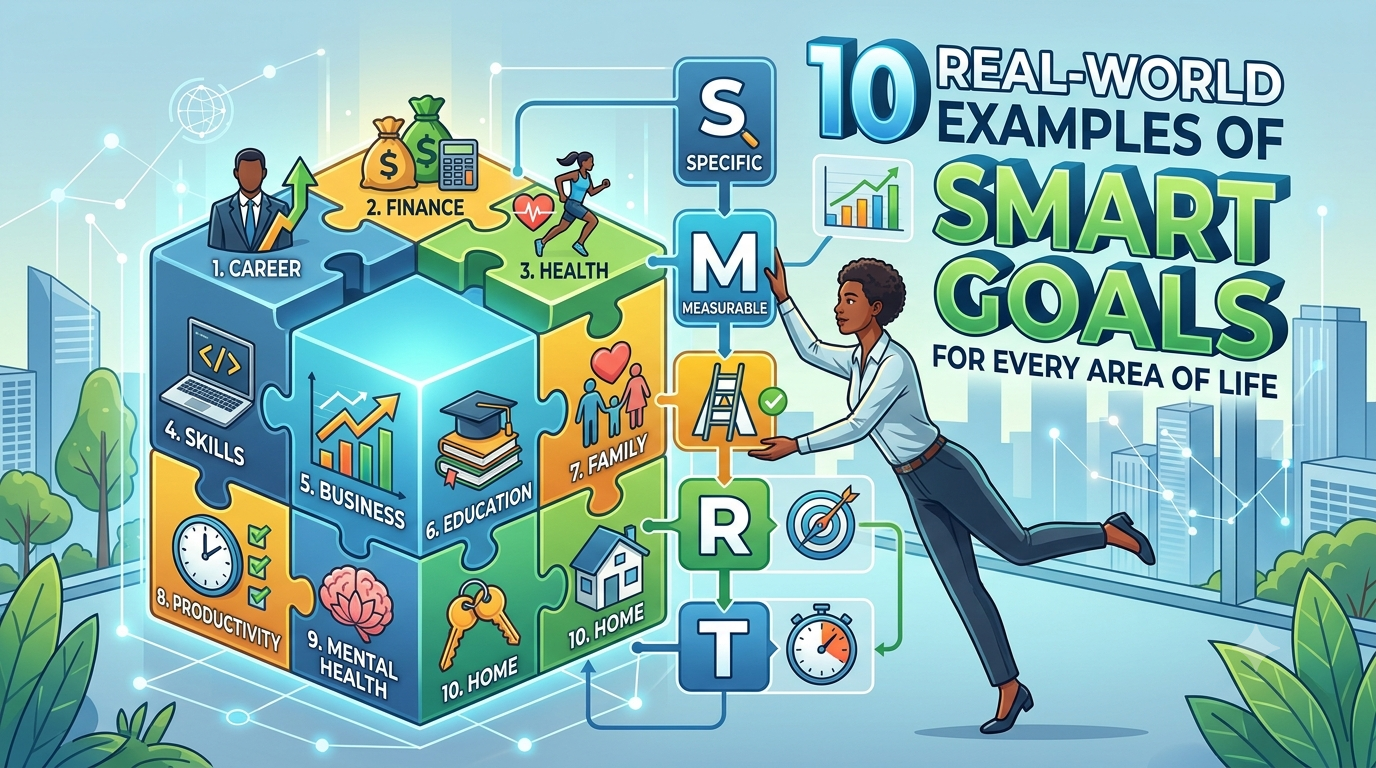
Setting goals is one of the most reliable ways to achieve personal and professional success. However, vague ambitions like “I want to get fit,” “I want to save money,” or “I want to read more” rarely lead to actionable results. Without structure, clear metrics, and deadlines, even the most passionate intentions tend to fade away under the weight of daily routines.
This is where the SMART goal framework becomes essential. By transforming abstract desires into structured, actionable targets, you can create a clear roadmap for progress.
Below, we explore what makes a goal SMART and walk through 10 detailed, real-world examples covering career growth, personal finance, health and fitness, skill development, and personal relationships.
What Is a SMART Goal?
The SMART acronym stands for five core criteria that turn general aspirations into achievable targets:
    ┌─────────────────────────────────────────────────────────────┐
    │                         S. M. A. R. T.                      │
    └─────────────────────────────────────────────────────────────┘
          │           │            │            │            │
     ┌────┴─────┐ ┌───┴──────┐ ┌───┴──────┐ ┌───┴──────┐ ┌───┴────────┐
     │ Specific │ │Measurable│ │Achievable│ │ Relevant │ │ Time-bound │
     └──────────┘ └──────────┘ └──────────┘ └──────────┘ └────────────┘
-
Specific: Clearly defines what you intend to accomplish, leaving no room for ambiguity.
-
Measurable: Includes concrete criteria or key performance indicators (KPIs) to track progress.
-
Achievable: Ensures the objective is realistic based on your current resources, time, and constraints.
-
Relevant: Aligns with your broader life values, long-term vision, or current strategic priorities.
-
Time-bound: Sets a clear deadline or timeline to instill urgency and focus.
Traditional Goals vs. SMART Goals
To see the value of this system, consider how traditional goals compare directly to SMART goals:
10 Real-World Examples of SMART Goals
1. Career Advancement: Securing a Senior Promotion
-
Vague Goal: “I want to advance in my career.”
-
SMART Goal: “I will obtain a promotion to Senior Marketing Specialist within 9 months by leading 3 major client campaigns, increasing client ROI by 15%, and completing an advanced analytics certification.”
-
Breakdown:
-
Specific: Target position (Senior Marketing Specialist) and actionable path (lead campaigns, deliver ROI, complete certification).
-
Measurable: 3 campaigns, 15% ROI increase, 1 certification.
-
Achievable: Builds directly upon current marketing skills and available resources.
-
Relevant: Directly supports career progression and income growth.
-
Time-bound: Target completion within 9 months.
-
2. Personal Finance: Building an Emergency Savings Fund
-
Vague Goal: “I need to build an emergency fund.”
-
SMART Goal: “I will save $3,600 over the next 12 months for an emergency fund by setting up an automatic transfer of $300 from every monthly paycheck into a high-yield savings account.”
 Monthly Income
       │
       ▼
 ┌───────────┐     Auto-Transfer ($300/mo)     ┌──────────────────────┐
 │ Checking  │ ──────────────────────────────► │ High-Yield Savings   │
 │ Account   │                                 │ Target: $3,600 / yr  │
 └───────────┘                                 └──────────────────────┘
-
Breakdown:
-
Specific: Save $3,600 using automated transfers to a designated savings account.
-
Measurable: Tracked by a $300 monthly deposit toward a total of $3,600.
-
Achievable: Fits comfortably within a balanced monthly household budget.
-
Relevant: Enhances overall financial security and reduces personal stress.
-
Time-bound: 12-month completion window.
-
3. Health & Fitness: Running a 10K Race
-
Vague Goal: “I want to get into running.”
-
SMART Goal: “I will train for and finish a 10K road race in under 60 minutes in 16 weeks by following a 4-day-a-week running program and tracking progress via a GPS watch.”
-
Breakdown:
-
Specific: Complete a 10K race with a time target of under 60 minutes.
-
Measurable: 4 training runs per week; final race time evaluated against the 60-minute mark.
-
Achievable: Gradually builds distance and speed over a realistic 16-week cycle.
-
Relevant: Improves cardiovascular endurance and daily stamina.
-
Time-bound: Fixed 16-week deadline tied to an official race date.
-
4. Skill Acquisition: Learning a New Programming Language
-
Vague Goal: “I want to learn how to code.”
-
SMART Goal: “I will learn Python programming by spending 45 minutes daily on an online coding platform, completing 10 practical mini-projects, and building a fully functional web scraper within 6 months.”
-
Breakdown:
-
Specific: Master Python by completing a structured curriculum, mini-projects, and a final web scraper project.
-
Measurable: 45 minutes per day, 10 mini-projects, 1 capstone project.
-
Achievable: A daily 45-minute commitment is manageable alongside a full-time job or study schedule.
-
Relevant: Opens up new technical capabilities for data analysis and career growth.
-
Time-bound: 6 months.
-
5. Business & Entrepreneurship: Increasing Monthly Revenue
-
Vague Goal: “I want my small business to make more sales.”
-
SMART Goal: “I will increase monthly recurring revenue (MRR) by 20% over the next quarter by launching a referral program and running two targeted social media ad campaigns.”
 Baseline MRR
      │
      ├──► Implement Customer Referral Program
      ├──► Execute Target Social Media Ads
      │
      ▼
 Target MRR (+20% Growth in 90 Days)
-
Breakdown:
-
Specific: Increase MRR using customer referrals and paid targeted social advertising.
-
Measurable: A precise 20% increase in revenue metrics.
-
Achievable: Leverages existing customer satisfaction and proven acquisition channels.
-
Relevant: Drives core business sustainability and expansion.
-
Time-bound: Must be completed over the next quarter (90 days).
-
6. Education & Learning: Reading 12 Books in a Year
-
Vague Goal: “I need to read more non-fiction books.”
-
SMART Goal: “I will read 12 non-fiction books over the next 12 months by reading 20 pages every night before sleeping.”
-
Breakdown:
-
Specific: Read 12 non-fiction books within a year using a daily night routine.
-
Measurable: 20 pages per day, equating to roughly 1 book per month (assuming an average of 250-300 pages per book).
-
Achievable: Reading 20 pages takes approximately 20–30 minutes daily.
-
Relevant: Broadens knowledge and personal perspectives consistently.
-
Time-bound: 12 months (or 1 book every 30 days).
-
7. Relationships & Social Life: Prioritizing Quality Family Time
-
Vague Goal: “I want to spend more time with my family.”
-
SMART Goal: “I will schedule and host a distraction-free weekly family game night every Friday evening for the next 6 months to improve family connection.”
-
Breakdown:
-
Specific: Host a dedicated, device-free family game night on Friday evenings.
-
Measurable: 1 occurrence per week; total of 24 family sessions over 6 months.
-
Achievable: Requires blocking out only 2 hours every Friday night.
-
Relevant: Strengthens personal relationships and family bonds.
-
Time-bound: Consistent weekly execution over a 6-month period.
-
8. Productivity & Mindfulness: Reducing Daily Screen Time
-
Vague Goal: “I spend too much time on my phone.”
-
SMART Goal: “I will reduce my daily personal smartphone screen time from 4 hours to under 2 hours per day over the next 30 days by using app usage limits and keeping my phone in another room during work hours.”
-
Breakdown:
-
Specific: Reduce screen time by setting device limits and physically altering phone placement.
-
Measurable: Track screen time daily through phone analytics, moving from 4 hours to under 2 hours.
-
Achievable: A gradual step-down using system tools makes the target manageable.
-
Relevant: Reclaims focused hours for deeper productivity and mental clarity.
-
Time-bound: Target achieved within a 30-day window.
-
9. Mental Health: Establishing a Daily Meditation Practice
-
Vague Goal: “I want to reduce stress through mindfulness.”
-
SMART Goal: “I will practice mindfulness meditation for 10 minutes every morning immediately after waking up for the next 60 days using a guided meditation app.”
-
Breakdown:
-
Specific: Perform guided morning meditation for 10 minutes using a mobile app.
-
Measurable: 10 minutes per day, tracked via the app’s daily streak counter.
-
Achievable: 10 minutes requires minimal time adjustment in the morning routine.
-
Relevant: Helps reduce daily stress, improving emotional stability and focus.
-
Time-bound: Target duration of 60 consecutive days.
-
10. Home & Lifestyle: Organizing the Living Space
-
Vague Goal: “I need to declutter my house.”
-
SMART Goal: “I will declutter and organize all 5 rooms in my home over the next 5 weeks by focusing on one room every Saturday morning for 3 hours.”
 Week 1: Living Room  ──►  3 Hours (Saturday)
 Week 2: Kitchen      ──►  3 Hours (Saturday)
 Week 3: Master Bed   ──►  3 Hours (Saturday)
 Week 4: Home Office  ──►  3 Hours (Saturday)
 Week 5: Garage/Storage ─► 3 Hours (Saturday)
-
Breakdown:
-
Specific: Declutter and organize all 5 main rooms in the home.
-
Measurable: Complete 1 room per week over 5 weeks (15 total hours of focused effort).
-
Achievable: Breaking a large household task into single-room weekly chunks prevents overwhelm.
-
Relevant: Creates a clean, comfortable, and functional living environment.
-
Time-bound: 5 weeks total.
-
How to Successfully Stick to Your SMART Goals
Defining SMART goals is the critical first step, but continuous execution is what produces results. Here are three practical techniques to help you maintain momentum:
1. Break Big Targets into Weekly Sprints
Large deadlines can feel distant, leading to procrastination. Convert your long-term SMART metrics into weekly action steps. For instance, if your goal is to save $3,600 in a year, focus purely on hitting your weekly savings target of ~$70.
2. Set Up Visual Progress Tracking
Whether you use a digital dashboard, a mobile habit tracker, or a simple paper spreadsheet on your wall, visual tracking creates immediate feedback loops. Seeing a growing streak reinforces positive behavioral patterns.
3. Schedule Regular Goal Audits
Life circumstances change, and goals should adapt accordingly. Set aside 15 minutes at the end of every month to review your progress:
-
Are you on track with your metrics?
-
Were your initial timeframes realistic?
-
Does the goal still align with your priorities?
Conclusion
Transforming abstract desires into SMART goals removes uncertainty and gives you a structured path to follow. By making your goals Specific, Measurable, Achievable, Relevant, and Time-bound, you shift your focus from simply wishing for outcomes to actively building them across every area of your life. Choose one area today, apply the SMART model, and track your progress toward meaningful success.
Penulis: W.S