
Whether you are aiming to advance your career, launch a new venture, improve your personal health, or optimize team performance, setting goals is the universal starting point for success. However, there is a vast difference between simply having an ambition and creating an actionable framework that guarantees results.
Many people set broad, unanchored goals such as “I want to earn more money” or “I want to get fit.” While these express positive intentions, they lack the clarity, structure, and accountability required to drive daily action. Within weeks, most of these well-meaning desires dissolve into everyday noise.
Enter the SMART model—one of the most widely adopted and effective frameworks for strategic goal setting in the world.
Originally introduced by George T. Doran in 1981, the SMART acronym provides a powerful, step-by-step checklist to transform vague aspirations into precise, trackable, and achievable objectives. In this comprehensive guide, we will break down exactly what SMART stands for, analyze each component in detail, explore real-world examples, and share actionable strategies to help you implement it effectively.
The SMART Acronym Defined
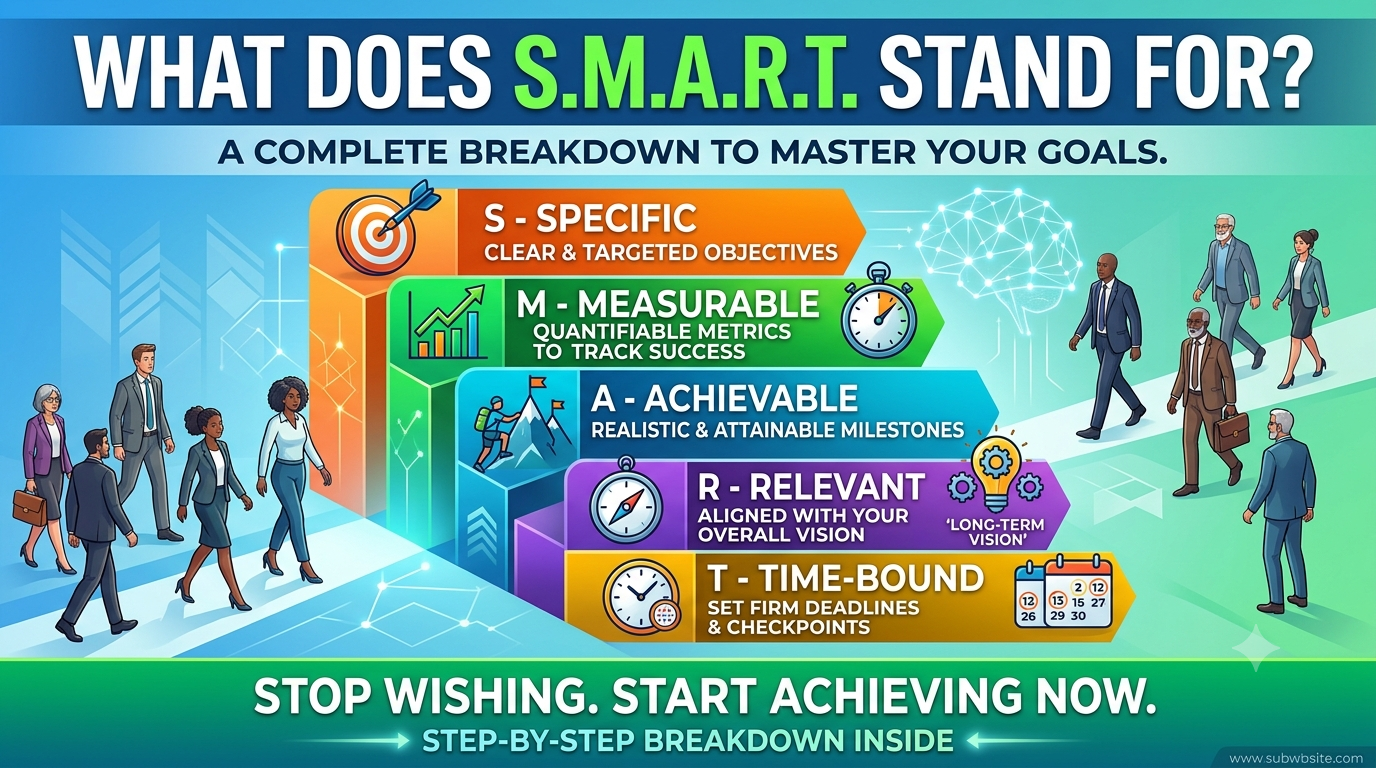
At its core, SMART is an acronym that establishes clear parameters for defining and executing goals.
┌─────────────────────────────────────────────────────────────────┐
│                    THE S.M.A.R.T. BREAKDOWN                     │
├─────────────────────────────────────────────────────────────────┤
│  S ─── SPECIFIC       │ What exactly do you want to accomplish? │
│  M ─── MEASURABLE     │ How will you track progress and success?│
│  A ─── ACHIEVABLE     │ Is this goal realistic and attainable?  │
│  R ─── RELEVANT       │ Does this align with your overall vision?│
│  T ─── TIME-BOUND     │ What is your target deadline?           │
└─────────────────────────────────────────────────────────────────┘
When all five elements are present, a goal shifts from a passive wish to an operational roadmap. Let us examine each letter in detail.
1. S – Specific (Focus and Clarity)
The first element of the framework requires absolute clarity. A goal that is too broad or ambiguous makes it difficult for your brain to determine what specific actions to take next. Specificity eliminates confusion and focuses your mental energy on a clear target.
To make a goal specific, you must address the 5 “W” Questions:
-
What do I want to accomplish precisely?
-
Why is this goal important?
-
Who is involved or responsible?
-
Where will the action take place?
-
Which resources or constraints apply?
Broad vs. Specific Comparison:
-
Vague: “I want to grow my online business.”
-
Specific: “I want to increase our e-commerce platform’s monthly organic search traffic by publishing high-quality blog content targeting secondary keywords.”
By clearly defining the what and how, you eliminate daily guesswork and establish immediate direction.
2. M – Measurable (Tracking and Quantification)
If you cannot measure your goal, you cannot evaluate progress or determine when you have successfully reached the finish line. Measurable criteria provide objective proof of development and keep you motivated throughout the journey.
To make a goal measurable, define key metrics, numbers, and concrete indicators by answering:
-
How much or how many?
-
What is my key baseline metric right now?
-
What quantitative target signals completion?
-
How often will I review my performance indicators?
[ Current Baseline ] ──> [ Quantifiable Metric ] ──> [ Target Outcome ]
  5,000 Visitors/Mo       +2,000 New Visitors       7,000 Visitors/Mo
Broad vs. Measurable Comparison:
-
Vague: “I want to get better at social media marketing.”
-
Measurable: “I want to grow our corporate LinkedIn audience from 2,000 to 5,000 followers while maintaining an average post engagement rate of 4%.”
Quantifiable targets give you an objective standard against which to measure success, removing emotional bias from performance evaluations.
3. A – Achievable (Realism and Feasibility)
While ambitious targets are inspiring, setting goals that are completely out of reach sets you up for inevitable frustration, burnout, and failure. An Achievable (or Attainable) goal strikes the perfect balance between stretching your current capabilities and remaining realistic given your existing resources.
When assessing whether a goal is achievable, consider:
-
Skillset & Knowledge: Do you or your team possess the necessary expertise, or can it be acquired in time?
-
Resource Allocation: Do you have the necessary financial budget, tools, and software?
-
Time Constraints: Does your existing workload permit the hours required to execute this plan?
| Goal Category | Unrealistic Goal | Achievable SMART Goal |
| Fitness | Run a 26-mile marathon next weekend with zero prior training. | Train for 16 weeks to complete a local 10K run under 60 minutes. |
| Sales | Increase company revenue by 500% in 30 days without budget. | Scale monthly revenue by 15% over the next quarter using targeted email campaigns. |
| Skill Acquisition | Become a fluent software engineer in 7 days. | Complete an introductory Python course and build one basic web application in 90 days. |
An achievable goal respects your real-world limits while challenging you to grow steadily.
4. R – Relevant (Strategic Alignment)
Not every good idea is worth pursuing right now. The Relevant component ensures that your individual goal aligns with your overarching personal values, career trajectory, or company-wide strategic objectives.
Pursuing goals that lack relevance wastes valuable time and creates friction with higher-priority initiatives.
To determine if a goal is relevant, ask yourself:
-
Does this goal align with my multi-year vision or main business objectives?
-
Is this the right time to launch this initiative?
-
Does this effort provide a high return on investment (ROI) for my energy and resources?
-
Am I pursuing this because it genuinely matters, or because of external pressure?
If a goal does not directly contribute to your long-term vision, it is simply a distraction disguised as productivity.
5. T – Time-Bound (Deadlines and Urgency)
Parkinson’s Law states that work expands to fill the time allotted for its completion. Without a firm, non-negotiable deadline, goals lack urgency. They get pushed to the bottom of your daily priorities by immediate fires and routine tasks.
A Time-Bound goal establishes a clear completion date alongside interim milestones.
Key Elements of Time-Bound Structure:
-
Target Deadline: Set a clear target date (e.g., “by June 30th”).
-
Interim Checkpoints: Establish monthly or weekly review benchmarks to monitor momentum.
-
Execution Cadence: Define recurring daily or weekly commitments (e.g., “dedicate 45 minutes every weekday morning”).
Broad vs. Time-Bound Comparison:
-
Vague: “I will write a book someday.”
-
Time-Bound: “I will complete a 50,000-word initial draft of my manuscript within 90 days by writing 600 words every morning before 9:00 AM, concluding on November 30th.”
A firm timeline turns passive intention into active daily execution.
SMART Goal Examples Across Various Domains
To illustrate how all five components merge into a single, cohesive statement, examine these practical examples tailored for different scenarios:
Example 1: Professional & Career Advancement
-
Weak Goal: “I want to get a promotion.”
-
SMART Goal: “To earn a promotion to Senior Project Manager by Q4, I will complete the PMP certification exam by July 15th and successfully lead two cross-functional client projects with a satisfaction rating of 90% or higher over the next six months.”
-
S: Targeted role (Senior Project Manager) via specific requirements.
-
M: PMP certification completion and a 90% client satisfaction score.
-
A: Realistic steps given current experience as a mid-level manager.
-
R: Directly aligns with career advancement goals.
-
T: Complete by Q4, with a July 15th exam milestone.
-
Example 2: Financial Management
-
Weak Goal: “I need to save more money.”
-
SMART Goal: “I will build a $6,000 emergency fund within 12 months by setting up an automated transfer of $500 from my primary checking account to a high-yield savings account on the 1st of every month.”
-
S: Build a dedicated $6,000 emergency fund.
-
M: $500 monthly transfer totaling $6,000.
-
A: $500 per month fits within the current household monthly budget.
-
R: Strengthens overall financial security and reduces personal stress.
-
T: Fully funded in 12 months.
-
Example 3: Small Business Growth
-
Weak Goal: “We need to increase client conversion.”
-
SMART Goal: “Our sales team will increase lead-to-client conversion rate from 8% to 12% by the end of Q3 by implementing a new CRM follow-up sequence and conducting weekly sales training sessions starting April 1st.”
-
S: Boost sales conversion rates using specific software and training.
-
M: Increase from 8% to 12%.
-
A: A 4% gain is attainable based on historical team performance.
-
R: Directly drives company revenue growth.
-
T: Target completion by the end of Q3.
-
Best Practices to Successfully Execute SMART Goals
Writing down a SMART goal is an important first step, but continuous execution is what turns targets into results. Use these strategies to maximize your execution rate:
[ Define SMART Goal ] ──> [ Deconstruct into Action Steps ] ──> [ Schedule Weekly Reviews ] ──> [ Achieve Success ]
-
Document and Place Goals in Plain Sight: Write your SMART goals down and keep them visible on your desk, digital dashboard, or workspace wall. Out of sight means out of mind.
-
Deconstruct Goals into Micro-Actions: Break down a quarterly SMART goal into monthly targets, weekly milestones, and daily tasks. Focus your daily energy solely on executing today’s action item.
-
Conduct Weekly Accountability Reviews: Schedule 15 minutes every Sunday or Monday morning to evaluate your metrics, assess roadblocks, and adjust your weekly schedule accordingly.
-
Build a Supporting Environment: Modify your workspace and daily habits to reduce friction for target behaviors while increasing friction for distractions.
Final Words: Turning Ambition into Achievable Milestones
Understanding what SMART stands for—Specific, Measurable, Achievable, Relevant, and Time-Bound—provides you with a battle-tested framework for consistent personal and professional execution.
By removing ambiguity, defining clear metrics, setting realistic expectations, ensuring strategic alignment, and enforcing tight deadlines, you eliminate decision fatigue and build continuous momentum. Stop relying on luck or unorganized willpower. Take your core ambitions today, run them through the SMART framework, and create a clear roadmap toward your success.
Penulis: W.S