
Setting goals is one of the most effective ways to turn aspirations into reality. However, many people struggle to achieve what they set out to do—not because they lack motivation, but because their goals are vague, unrealistic, or poorly structured.
Statements like “I want to grow my business,” “I want to get fit,” or “I want to save money” express positive intentions, but they lack a clear framework for action. Without concrete boundaries and a roadmap, these desires often fade into everyday distractions.
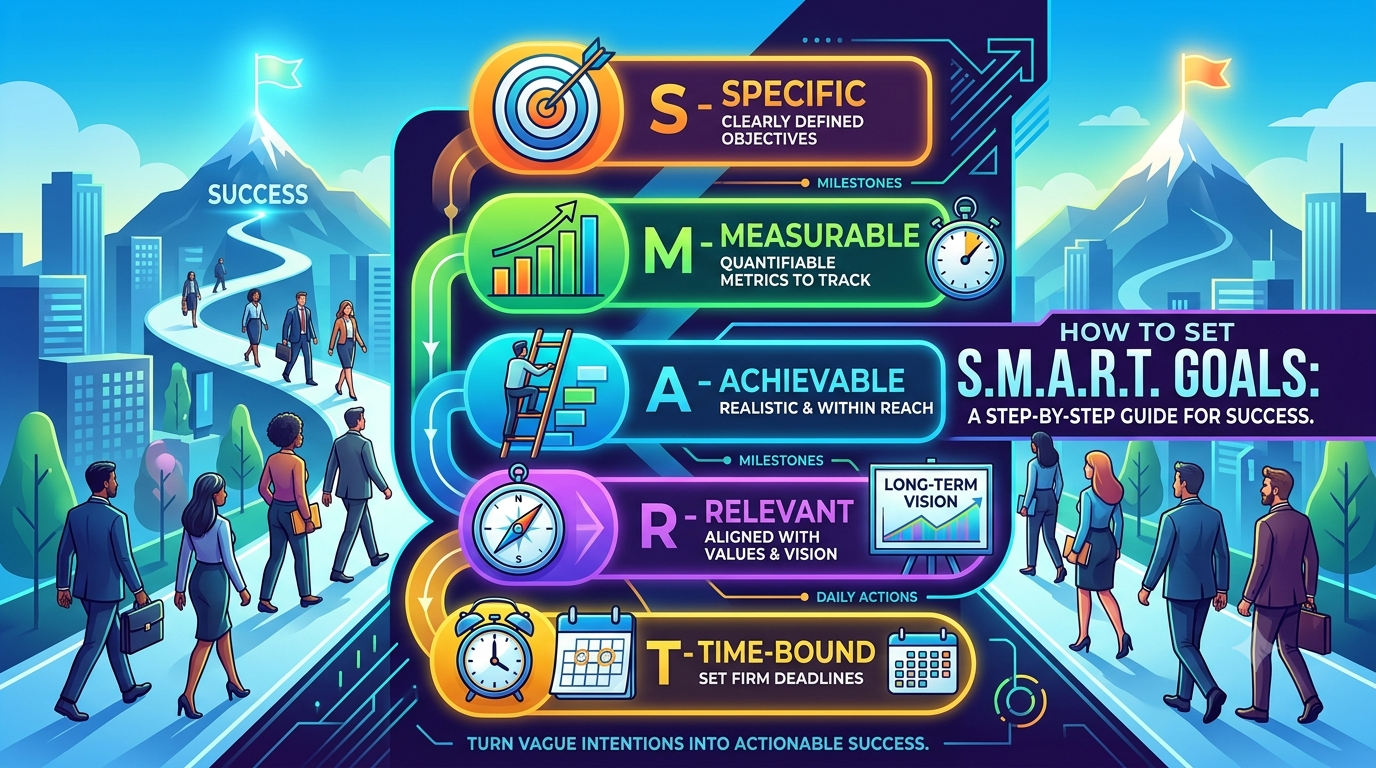
This is where the SMART goal-setting framework becomes essential. By transforming broad ambitions into Specific, Measurable, Achievable, Relevant, and Time-bound objectives, you create a strategic blueprint designed for consistent progress and measurable success.
What Does SMART Stand For?
The SMART framework was created to eliminate ambiguity and establish clear accountability. Each letter of the acronym represents a critical component of a high-impact goal:
┌─────────────────────────────────────────────────────────────┐
│                    THE S.M.A.R.T. FRAMEWORK                  │
├─────────────────────────────────────────────────────────────┤
│  S ─── SPECIFIC     │ Clear, well-defined, and unambiguous │
│  M ─── MEASURABLE   │ Quantifiable criteria to track progress│
│  A ─── ACHIEVABLE   │ Realistic and within reach            │
│  R ─── RELEVANT     │ Aligned with long-term vision & values │
│  T ─── TIME-BOUND   │ Set with a firm target deadline       │
└─────────────────────────────────────────────────────────────┘
When all five elements are integrated into your planning, your probability of achieving your objective increases dramatically.
Step 1: Make It Specific (S)
A goal that is too broad makes it difficult to determine where to start or what actions to take daily. Specificity provides clarity, reducing the cognitive load required to make decisions.
To make a goal specific, answer the core 5 “W” questions:
-
What do I want to accomplish precisely?
-
Why is this goal important to me?
-
Who needs to be involved (if applicable)?
-
Where will this take place?
-
Which resources or constraints apply?
Example Comparison:
-
Vague Goal: “I want to improve my writing skills.”
-
Specific Goal: “I want to write and publish a weekly 1,000-word industry article on LinkedIn to establish thought leadership in digital marketing.”
Notice how the specific version instantly dictates the required daily and weekly actions.
Step 2: Make It Measurable (M)
If you cannot measure your goal, you cannot track your progress or know when you have successfully reached the finish line. Measurable goals rely on concrete metrics, numbers, and key performance indicators (KPIs).
To ensure your goal is measurable, ask yourself:
-
How much?
-
How many?
-
How will I know when the goal is accomplished?
[ Broad Ambition ] ──> [ Define Key Metric ] ──> [ Track Weekly Milestones ]
  "Increase Sales"       "Reach $50k Revenue"       "Secure $12.5k per Week"
Having quantifiable benchmarks allows you to monitor progress continuously, celebrate incremental wins, and adjust your strategy if you fall behind schedule.
Step 3: Make It Achievable (A)
While ambition is valuable, setting goals that are wildly unrealistic leads to frustration, burnout, and early abandonment. An achievable goal pushes your limits while remaining rooted in reality.
To evaluate whether a goal is achievable, assess:
-
Current Resources: Do you have the necessary time, skills, tools, and financial capacity?
-
Historical Performance: Have you accomplished similar milestones in the past?
-
Feasibility: Can this be accomplished under your current personal and professional commitments?
An achievable goal strikes a balance between stretching your capabilities and maintaining sustainable execution.
Step 4: Make It Relevant (R)
Not all opportunities are worth pursuing. A goal can be specific, measurable, achievable, and time-bound, but if it does not align with your broader vision, values, or overarching business strategy, it remains a distraction.
Relevance ensures that your time and energy are invested in pursuits that truly matter.
Before locking in a goal, ask:
-
Does this goal align with my long-term personal or professional objectives?
-
Is this the right time to pursue this target?
-
Am I pursuing this because I genuinely value it, or due to external pressure?
If a goal does not move you closer to your multi-year vision, discard it or table it for later.
Step 5: Make It Time-Bound (T)
Parkinson’s Law states that work expands to fill the time allotted for its completion. Without a firm deadline, goals lack urgency, making them vulnerable to endless procrastination.
A time-bound goal establishes a target completion date along with interim checkpoints.
Setting Time-Bound Parameters:
-
Target Deadline: “By December 31st…”
-
Milestones: “By the end of Month 1, complete research; by Month 2, complete the first draft…”
-
Daily/Weekly Cadence: “Dedicate 45 minutes every morning at 7:30 AM…”
Establishing a timeline creates a healthy sense of urgency, driving daily execution over passive delay.
Transforming Vague Intentions into SMART Goals: Practical Examples
To understand how these five components fit together, let us convert common vague intentions into actionable SMART goals across different areas of life.
Example 1: Professional Development
-
Vague Intention: “I need to improve my public speaking.”
-
SMART Goal: “To land a promotion to Senior Manager by Q4, I will enroll in an advanced presentation course and deliver three 15-minute presentations to my internal department over the next six months.”
-
S: Specific target (deliver internal presentations for promotion).
-
M: Measurable (three 15-minute presentations).
-
A: Achievable (accessible internal audience over six months).
-
R: Relevant (supports career advancement to Senior Manager).
-
T: Time-bound (six-month timeframe, target by Q4).
-
Example 2: Financial Growth
-
Vague Intention: “I want to save more money.”
-
SMART Goal: “I will build a $6,000 emergency fund by automatically transferring $500 from my paycheck into a high-yield savings account on the 1st of every month for the next 12 months.”
-
S: Specific target (build a $6,000 emergency fund via automatic transfers).
-
M: Measurable ($500 per month; total $6,000).
-
A: Achievable ($500 fits within existing monthly net budget).
-
R: Relevant (provides financial security and peace of mind).
-
T: Time-bound (12-month duration).
-
Best Practices to Ensure Your SMART Goals Succeed
Creating a well-structured SMART goal is half the battle; executing it consistently is the rest. Use these strategies to keep your momentum strong:
1. Write Them Down
Research indicates that physically writing down your goals significantly increases the likelihood of achieving them. Keep your written SMART goals visible—on your desk, as a phone wallpaper, or inside your workspace planner.
2. Break Goals into Actionable Micro-Steps
A six-month SMART goal can still feel overwhelming if viewed as one single task. Deconstruct your objective into monthly milestones, weekly targets, and daily action items.
[ Annual Goal ] ──> [ Monthly Target ] ──> [ Weekly Milestone ] ──> [ Daily Action ]
3. Establish a Weekly Review Routine
Schedule 15 minutes every week to review your metrics:
-
Which milestones did I achieve this week?
-
Where did I encounter friction or delay?
-
What adjustments are necessary for the coming week?
Regular reviews keep your goals top-of-mind and prevent drift.
Final Thoughts: Turn Vision into Reality
The SMART framework transforms vague aspirations into an organized, actionable roadmap for success. By demanding specificity, establishing measurable metrics, maintaining realistic boundaries, ensuring long-term relevance, and setting firm deadlines, you remove guesswork from your daily execution.
Stop relying on wishful thinking or short-lived motivation. Choose one major area of your life or business today, apply the SMART framework, and begin taking deliberate steps toward your target.
Penulis: W.S