
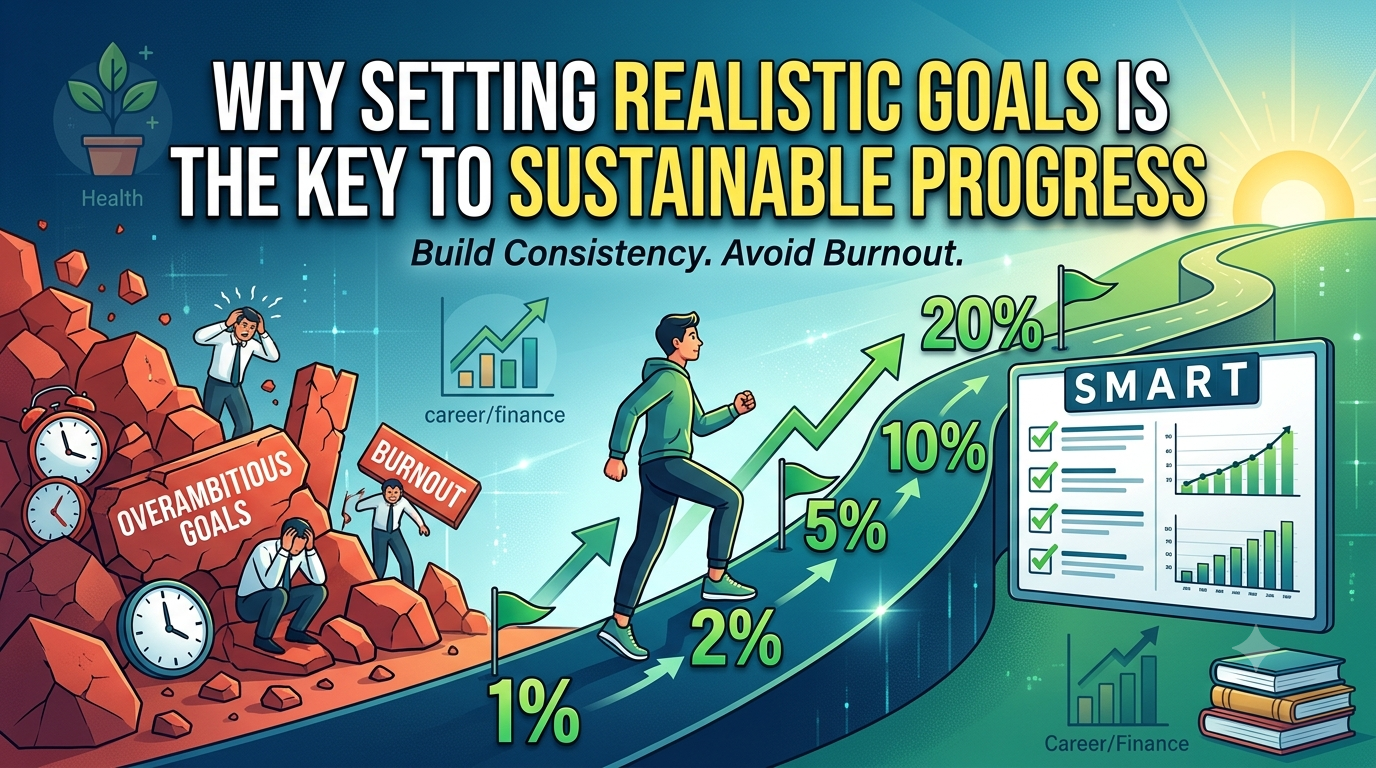
In a culture obsessed with rapid transformation, overnight success, and radical lifestyle overhauls, the advice to “dream big” often morphs into “expect everything immediately.” Social media feeds are flooded with 30-day body transformations, 90-day millionaire blueprints, and aggressive daily routines that promise total reinvention in record time. While high ambitions are not inherently bad, setting unrealistic, hyper-aggressive goals often backfires, leading directly to burnout, chronic frustration, and eventual abandonment of our original ambitions.
True, lasting change rarely happens through grand, heroic bursts of effort. Instead, it is built on the quieter, less glamorous foundation of sustainable progress. At the heart of sustainable progress lies a critical, frequently overlooked strategy: setting realistic goals.
Understanding the psychological mechanics of goal-setting, the hidden dangers of overambition, and practical frameworks for establishing attainable targets can transform ambitious visions into real-world achievements.
The Psychology Behind Goal Setting: Why Unrealistic Goals Fail
To understand why realistic goals work, it helps to examine why unrealistic ones consistently fail. Human psychology and neuroscience play huge roles in how we respond to targets, expectations, and perceived failure.
Unrealistic Expectations ➔ Early Missteps ➔ Perceived Failure ➔ Dopamine Crash ➔ Abandonment
1. The Trap of the “Planning Fallacy”
Psychologists Daniel Kahneman and Amos Tversky coined the term planning fallacy to describe our natural tendency to underestimate the time, effort, and resources required to complete a future task, while overestimating the benefits. When setting goals, we almost always imagine a best-case scenario where we have limitless energy, zero distractions, perfect health, and flawless discipline. When real life inevitably intervenes—bringing unexpected delays, fatigue, or personal emergencies—our rigid, inflated goals crumble, leaving us feeling defeated.
2. The Dopamine and Motivation Loop
Dopamine is the neurotransmitter responsible for motivation, reward anticipation, and focus. When you set a goal and make visible progress toward it, your brain releases dopamine, reinforcing the behavior and giving you the psychological energy to keep going.
However, when a goal is so impossibly steep that you consistently fail to hit your milestones, your brain registers this gap as a repeated threat or failure. Instead of a helpful dopamine loop, you trigger stress, self-doubt, and motivation fatigue. Over time, your brain begins to associate the goal itself with discomfort, prompting you to abandon it altogether.
3. The False-Hope Syndrome
Unrealistic goals often stem from what researchers call False-Hope Syndrome. This occurs when people make commitments to change based on unrealistic expectations regarding the speed, amount, and ease of the transformation, as well as the degree to which that change will improve their lives. When the progress turns out to be slower and harder than expected, self-blame sets in, followed by a complete surrender to old habits.
The Core Benefits of Setting Realistic Goals
Setting realistic goals is not about settling for mediocrity or limiting your potential; it is about creating a functional, highly effective operational strategy. Here is how realistic goal-setting actively fuels sustainable success:
| Benefit | Impact on Performance | Long-Term Outcome |
| Maintains Momentum | Keeps motivation high through small, consistent wins | Eliminates the “start-and-stop” cycle |
| Prevents Burnout | Allocates energy efficiently over long periods | Ensures physical and mental longevity |
| Builds True Self-Efficacy | Proves to yourself that you keep your promises | Increases confidence for larger future goals |
| Fosters Adaptability | Allows room for life’s unpredictable disruptions | Prevents minor setbacks from becoming total failures |
1. Building Momentum Through Small Wins
Progress is self-reinforcing. When you set manageable targets—such as reading 10 pages a day instead of a book a week, or exercising for 20 minutes three times a week instead of two hours every day—you create opportunities for frequent, daily victories. These small wins build emotional and psychological momentum. Over a year, reading 10 pages a day adds up to over 3,600 pages, or roughly 12 to 15 books. Consistency always beats sporadic intensity.
2. Protecting Mental Health and Energy Capital
Burnout occurs when the demands placed upon you exceed your available resources over a prolonged period. When you attempt to execute a lifestyle overhaul that demands 100% of your energy every day, you run on emotional overdraft. Realistic goals respect your physical, cognitive, and emotional limits. They leave room for rest, social connections, and recovery, ensuring that your pursuit of growth does not destroy your overall well-being.
3. Cultivating Genuine Self-Efficacy
Psychologist Albert Bandura defined self-efficacy as an individual’s belief in their capacity to execute behaviors necessary to produce specific performance attainments. You do not build self-efficacy by repeating positive affirmations; you build it by producing evidence. Every time you set a realistic target and achieve it, you stack concrete evidence that you are reliable and capable. This internal trust becomes the backbone of long-term self-discipline.
Realistic vs. Unrealistic Goals: Practical Examples
To see how subtle adjustments in framing can drastically alter your trajectory, consider these comparisons across common life domains:
Fitness and Health
-
Unrealistic Goal: “I will go to the gym for 90 minutes every morning at 5:00 AM, six days a week, and cut out all carbs and sugar completely starting tomorrow.”
-
Realistic Alternative: “I will attend three 45-minute workout sessions per week and add one serving of vegetables to my lunch and dinner daily.”
-
Why it works: The alternative respects your current baseline habits, allowing room for gradual adaptation without triggering systemic shock or schedule chaos.
Financial Growth
-
Unrealistic Goal: “I will save 60% of my income this month and eliminate all non-essential spending entirely.”
-
Realistic Alternative: “I will automate a 10% transfer of my monthly income into a high-yield savings account and review my subscriptions to cut $50 in recurring monthly costs.”
-
Why it works: It automates success and introduces pain-free efficiency rather than relying strictly on fragile, temporary willpower.
Professional and Career Development
-
Unrealistic Goal: “I will double my business revenue and publish four blog posts a week while learning two new programming languages this quarter.”
-
Realistic Alternative: “I will publish one high-quality, SEO-optimized blog post per week and dedicate two focused hours every Tuesday and Thursday to learning a new skill.”
-
Why it works: It respects time constraints, focuses on process over output, and avoids cognitive overload.
Practical Strategies for Setting and Achieving Realistic Goals
Transitioning from overambitious daydreaming to grounded, actionable planning requires a deliberate framework. Here are proven methodologies to establish targets that actually stick.
1. Apply the SMART Framework (With a Twist)
The SMART criteria remain a gold standard for practical planning. Ensure your goals meet these standards:
-
Specific: Clearly define what success looks like.
-
Measurable: Use numbers, metrics, or clear indicators.
-
Achievable: Verify that the goal is realistically within your current capacity.
-
Relevant: Align the target with your overarching long-term vision.
-
Time-Bound: Set a flexible, reasonable deadline.
Pro Tip: Focus heavily on the Achievable component. Ask yourself: “On my worst, lowest-energy day, can I still complete at least a scaled-down version of this goal?” If the answer is no, lower the threshold.
2. Optimize for Process, Not Just Outcomes
Outcome goals (e.g., “Write a 300-page book”) describe what you want to achieve, but they offer zero guidance on daily execution. Process goals (e.g., “Write 250 words every morning before checking email”) focus entirely on the input you control directly.
When you shift your definition of success from the distant outcome to the daily input, you remove anxiety and make sustained effort far more manageable.
3. Implement “Habit Stacking” and Environment Design
Instead of trying to summon willpower out of thin air, leverage existing habits. James Clear, author of Atomic Habits, popularizes the practice of habit stacking: pairing a new, realistic goal with an established daily routine.
-
Formula: “After I [Current Habit], I will [New Small Goal].”
-
Example: “After I pour my morning coffee, I will write down three priority tasks for the day.”
Additionally, adjust your immediate environment to reduce friction for good habits and increase friction for bad ones. If your goal is to drink more water, place a filled bottle directly on your desk every evening for the next morning.
4. Build in “Buffer Zones” and Minimum Baselines
Life is non-linear and unpredictable. Rigid goals invite failure because they do not account for disruption. Create flexibility by setting range-based targets and baseline minimums:
-
Range Goals: Instead of “I will run 5 miles every day,” aim for “I will run 2 to 4 miles, 3 to 4 times a week.”
-
Minimum Baselines: Define an absolute minimum acceptable effort for days when everything goes wrong. If your standard workout is 45 minutes, your minimum baseline might be 10 minutes of light stretching or bodyweight squats. Maintaining the habit loop—even at 10% capacity—is infinitely better than breaking it completely.
How Realistic Goals Lead to Long-Term, Compound Success
The fundamental secret of setting realistic goals is an appreciation for the mechanics of compounding. In finance, compound interest turns modest, regular investments into substantial fortunes over time. The exact same mechanism applies to human performance, knowledge, health, and personal development.
1% Better Every Day ➔ (1.01)^365 ➔ 37.78x Improvement per Year
When you set an unrealistic goal, you are demanding a 500% jump in performance overnight. You might maintain that intensity for three days, a week, or even a month, but the eventual drop-off brings you right back to square one.
Conversely, a realistic goal targets a modest 1% improvement that you can actually sustain daily or weekly. Improving by just 1% every day leaves you nearly 38 times better off at the end of a year. The math of consistency will always triumph over the temporary excitement of extreme effort.
Overcoming the Fear of “Not Doing Enough”
One of the biggest hurdles to setting realistic goals is the internal fear that small goals are insignificant, slow, or unimpressive. We worry that if we aren’t suffering or pushing ourselves to absolute exhaustion, we aren’t trying hard enough.
It is crucial to reframe your perspective on progress:
-
Slower progress is permanent progress. Fast changes achieved through extreme measures usually revert just as quickly once the extreme protocol ends.
-
Quiet consistency commands respect. True discipline is not demonstrated by loud, unsustainable over-exertion once every six months. It is proven by showing up quietly, dependably, and effectively every single week.
-
Rest is part of the strategy. Highly successful individuals do not work themselves to collapse; they balance focused execution with deliberate recovery to ensure their career or creative output lasts for decades.
Final Thoughts: Embrace the Power of the Long Game
Setting realistic goals is not an act of surrender; it is a masterclass in strategic execution. By honoring your real-world constraints, understanding your brain’s psychological reward systems, and prioritizing sustainable consistency over short-lived intensity, you set yourself up for lasting transformation.
Stop measuring your worth by the magnitude of your daily resolutions, and start measuring your success by your ability to keep small, consistent promises to yourself. Drop the impossible standards, embrace modest, steady progress, and play the long game. You will be amazed at how far realistic steps can ultimately take you.
Are you working on a specific personal or professional goal right now that you would like to refine into a more realistic, actionable framework?
Penulis: W.S