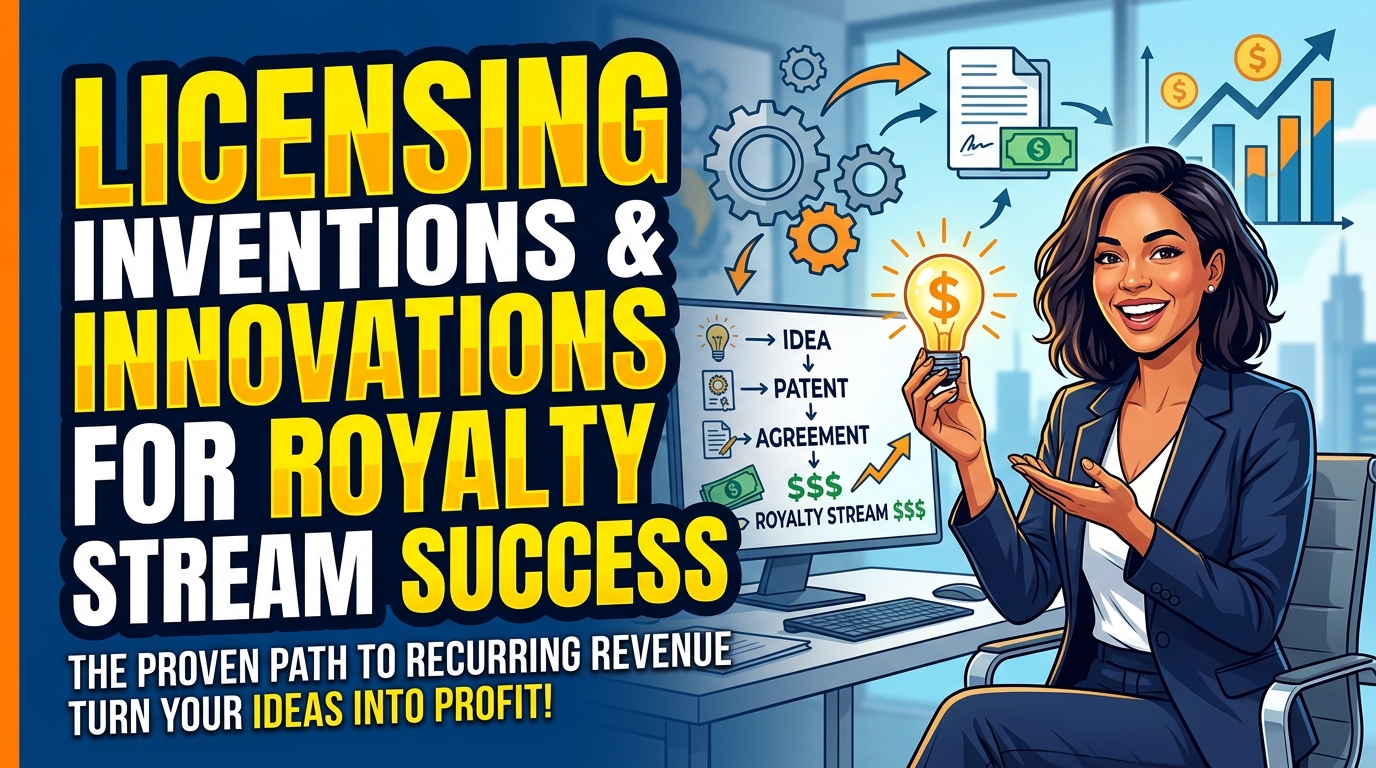
Turning an invention into a profitable business does not always require manufacturing products, building a warehouse, or managing a large sales team. For inventors and innovators, licensing inventions and innovations can provide an alternative path to commercialization. Instead of producing and selling a product independently, an inventor can grant another company permission to use intellectual property in exchange for payments, often including royalties.
A successful licensing strategy can create a recurring royalty stream while allowing the inventor to benefit from a company’s existing manufacturing, distribution, marketing, and sales infrastructure. However, licensing is not automatic income. It requires preparation, intellectual property protection, market research, negotiation, and careful contract management.
This article explores how inventors can approach licensing opportunities and build a sustainable royalty-based business model.
What Is Invention Licensing?
Invention licensing is a business arrangement in which an intellectual property owner gives another party permission to use specified intellectual property under agreed terms.
The intellectual property could involve a patent, trademark, copyright, design, technology, or other legally protectable asset, depending on the agreement and applicable law.
In return, the licensee may provide compensation to the inventor. This compensation can take several forms, including an upfront payment, milestone payments, royalties, or a combination of these arrangements.
The license agreement should clearly define what rights are being granted, how the intellectual property can be used, the geographic territory covered, the duration of the agreement, and the financial terms.
Why Licensing Can Create Royalty Income
One of the main attractions of licensing is that the inventor does not necessarily need to operate the entire commercial business.
A company that already has manufacturing facilities, distribution networks, sales representatives, and established customers may be able to bring an invention to market more efficiently.
The inventor can then potentially receive royalties based on qualifying sales or another agreed calculation.
For example, if a company licenses a patented product and pays the inventor a percentage of qualifying net sales, successful commercialization can create ongoing royalty payments.
However, royalties depend on the contract and the licensee’s actual performance. There is no guarantee that an invention will generate substantial sales.
Protect Intellectual Property First
Before approaching potential licensees, inventors should understand how their intellectual property can be protected.
For inventions that may qualify for patent protection, obtaining appropriate legal advice can be important. Publicly disclosing an invention before taking appropriate steps may affect intellectual property rights in some jurisdictions.
Other assets may require different forms of protection. A brand name may involve trademark considerations, while original written or visual material may involve copyright.
Inventors should maintain organized records of development, prototypes, research, and ownership.
Working with a qualified intellectual property professional can help determine which protections are appropriate for a particular invention and market.
Validate the Market
A clever invention is not automatically a commercially successful invention.
Potential licensees want to know whether customers actually need the product and whether there is a realistic market opportunity.
Market validation can involve researching competing products, customer needs, pricing, industry trends, and potential distribution channels.
Inventors should be able to explain the problem their innovation solves and why customers may choose it over existing alternatives.
Evidence of market demand can make an invention more attractive to potential business partners.
Develop a Strong Value Proposition
Before presenting an invention to companies, create a clear explanation of its commercial value.
A strong value proposition should answer several questions:
- What problem does the invention solve?
- Who is the target customer?
- What makes the innovation different?
- How could it improve an existing product or process?
- Why might customers pay for it?
- What commercial opportunity could it create?
Companies are generally interested in solutions that can contribute to their business objectives.
An inventor should therefore present the invention from a commercial perspective rather than focusing exclusively on its technical features.
Prepare a Professional Licensing Presentation
A professional presentation can make a significant difference when approaching potential licensees.
The presentation should be concise, visually clear, and focused on important information.
Depending on the situation, it may include product images, diagrams, prototype demonstrations, market research, competitive comparisons, intellectual property information, and potential applications.
Avoid revealing sensitive technical details unnecessarily before appropriate confidentiality arrangements are established.
The objective of an initial presentation is to generate interest and encourage further discussion.
Identify Potential Licensees
Finding the right company is often more important than contacting the largest number of businesses.
Potential licensees should ideally have a strong connection to the invention’s target market.
For example, a company that already manufactures and distributes similar products may have the infrastructure required to commercialize a new innovation.
Research potential partners by examining their product portfolios, distribution networks, target customers, financial position, and history of introducing new products.
A good licensee should have both the ability and motivation to commercialize the invention.
Understand Exclusive and Non-Exclusive Licensing
Licensing agreements can take different forms.
An exclusive license may give one company specific rights to use the intellectual property within a defined market, territory, or product category.
A non-exclusive license allows the intellectual property owner to grant similar rights to multiple companies, subject to the terms of each agreement.
Exclusivity can make a deal more attractive to a licensee, but it may also limit the inventor’s ability to work with other companies.
The right structure depends on the invention, market, territory, and commercial strategy.
Negotiate Royalty Terms Carefully
Royalty rates are only one part of a licensing agreement.
Inventors should also consider the definition of sales used to calculate royalties, payment schedules, minimum performance requirements, reporting obligations, audit rights, territories, and contract duration.
A seemingly attractive royalty percentage may be less valuable if the calculation is based on a narrow definition of revenue or if the licensee has limited sales obligations.
Professional legal and financial advice can be valuable during negotiations, particularly when significant intellectual property or long-term rights are involved.
Consider Minimum Performance Requirements
A licensing agreement should ideally provide incentives for the licensee to actively commercialize the invention.
Without appropriate performance requirements, an exclusive license could potentially prevent the inventor from working with another company even if the licensee does little with the product.
Agreements may include minimum sales targets, commercialization deadlines, minimum royalty payments, or other performance conditions.
The exact provisions should be negotiated carefully and tailored to the industry and product.
Track Royalty Payments
Once an invention is licensed, financial monitoring becomes important.
License agreements should specify how often the licensee provides royalty reports and payments.
Inventors should keep organized records of statements, invoices, correspondence, and contractual obligations.
Depending on the agreement, the intellectual property owner may have audit rights that allow verification of reported sales.
Accurate recordkeeping can help identify discrepancies and support professional management of the royalty stream.
Continue Improving the Innovation
Licensing an invention does not necessarily mean development ends.
Markets change, customer expectations evolve, and competitors introduce new products.
Depending on the agreement, inventors may continue developing improvements, variations, or related innovations.
New developments can potentially create additional licensing opportunities.
However, inventors should carefully understand ownership and improvement clauses in existing agreements before developing related intellectual property.
Diversify Royalty Opportunities
Relying entirely on one licensing agreement can create concentration risk.
If a licensee stops selling the product, terminates the agreement, or experiences financial difficulties, royalty income may decline.
Where contract terms permit, inventors can explore additional licensing opportunities across different applications, industries, or territories.
Diversification can create a broader intellectual property portfolio and reduce dependence on a single commercial partner.
Avoid Common Licensing Mistakes
Several mistakes can make licensing less effective.
One common problem is approaching companies before adequately protecting intellectual property. Another is failing to research whether customers actually want the product.
Inventors may also underestimate the importance of contract details.
Giving away broad rights without appropriate compensation, performance requirements, or termination provisions can create long-term difficulties.
It is also important to be cautious about companies that make unrealistic promises or request significant fees without providing clear value.
Professional due diligence can help reduce unnecessary risks.
Conclusion
Licensing inventions and innovations for royalty stream success can provide a practical commercialization strategy for inventors who do not want to build an entire manufacturing and distribution operation themselves.
The process begins with protecting intellectual property, validating market demand, identifying suitable licensees, and preparing a compelling commercial presentation.
A carefully negotiated licensing agreement can define royalty payments, territories, exclusivity, performance expectations, reporting requirements, and other important rights.
However, licensing is not guaranteed passive income. The success of a royalty stream depends on customer demand, licensee performance, contract quality, and effective intellectual property management.
By approaching licensing strategically and seeking qualified professional advice when needed, inventors can increase their ability to turn innovative ideas into commercial opportunities and potentially build sustainable royalty-based income over the long term.
Penulis: Shofiya M.P








Post Comment