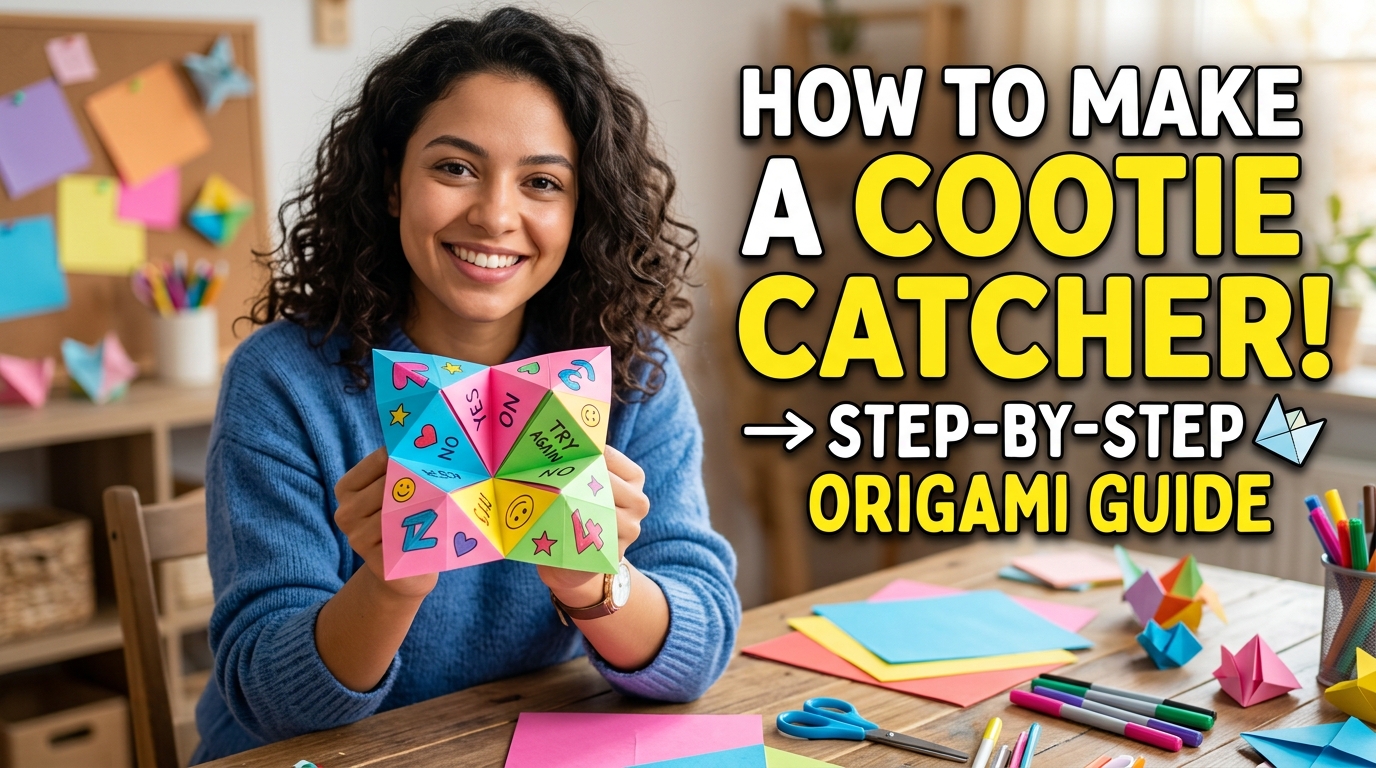
Making a cootie catcher is a fun and simple paper-folding activity that combines creativity, origami, and a little bit of playful guessing. Also known as a paper fortune teller, this classic craft can be made with just one square sheet of paper and a few minutes of your time. It is an easy project for kids, students, families, or anyone who wants to enjoy a screen-free activity.
In this step-by-step guide, you will learn how to make a cootie catcher from scratch, how to fold it correctly, and how to add numbers, colors, questions, or fun predictions to make it more interesting.
What Is a Cootie Catcher?
A cootie catcher is a folded paper toy that opens and closes using your fingers. Players choose colors and numbers, then open different sections of the paper to reveal hidden messages or predictions.
Although it is often called a fortune teller, a cootie catcher is mainly a fun paper game. You can customize it with jokes, challenges, questions, positive messages, or silly predictions.
The best part is that you do not need special origami paper. A regular sheet of square paper works perfectly.
Materials You Need
Before starting your origami project, prepare these simple materials:
- One square sheet of paper
- A pencil or pen
- Colored pencils or markers
- A ruler, optional
- Scissors, only if you need to turn rectangular paper into a square
For the easiest results, use lightweight paper that is easy to fold. You can choose plain white paper and decorate it yourself, or use colorful paper for a more creative look.
Step 1: Start With a Square Piece of Paper
The first step in making a cootie catcher is preparing a perfect square.
If you already have square paper, place it flat on your table. If you only have standard rectangular paper, you can make a square by folding one corner diagonally toward the opposite edge and removing the extra strip.
Make sure the paper lies flat before beginning the folds. Clean and accurate creases will make the finished cootie catcher easier to open and close.
Step 2: Fold the Paper Diagonally
Place the square paper in front of you.
Fold one corner across to the opposite corner so that the two edges line up. Press firmly along the fold to create a diagonal crease.
Open the paper again and repeat the process with the other two corners.
When you unfold the paper, you should see two diagonal creases crossing in the center. These creases will help you find the middle of the paper during the next steps.
Step 3: Fold All Four Corners Toward the Center
Lay the paper flat with the colored or decorated side facing down if you are using double-sided paper.
Take one corner and fold it toward the center of the square. The tip of the corner should meet approximately at the center point where the diagonal creases intersect.
Press the fold firmly.
Repeat this process with all four corners. When finished, the paper should look like a smaller square made from four folded triangular sections.
This is one of the most important steps, so take your time and make sure the folds are neat.
Step 4: Turn the Paper Over
Once all four corners have been folded toward the center, carefully turn the entire paper over.
You should now see a square with four sections. The original folded corners will be underneath.
Again, accurate folds are important because they determine how easily your cootie catcher will move.
Step 5: Fold the New Corners Toward the Center
Now you will repeat a similar folding process.
Take each of the four corners and fold them toward the center of the square. Press down firmly after each fold.
When all four corners are folded inward, you will have an even smaller square.
At this point, the basic structure of your paper fortune teller is almost complete.
Step 6: Make the Finger Pockets
Turn the paper over if necessary so that the folded flaps are facing you.
Carefully fold the square in half vertically, then open it. Fold it in half horizontally and open it again.
These creases make it easier to shape the four finger pockets.
Place your thumbs and index fingers underneath the four sections. Gently push the folds inward so the paper begins to form a four-part structure.
Do not force the paper. If the folds are too stiff, run your fingers along the creases again.
Step 7: Add Colors and Numbers
Now comes the creative part.
On the four outer sections, write four different colors. For example, you could use:
- Red
- Blue
- Green
- Yellow
You can also draw simple patterns or symbols instead of writing color names.
Next, open the cootie catcher slightly and write numbers on the smaller sections. You can use numbers from 1 to 8, or choose your own sequence.
Try using different numbers on each section to make the game more unpredictable.
Step 8: Add Fun Messages
Finally, write a short message underneath each numbered flap.
These messages can be funny, positive, or related to a game. For example, you could write:
- “You will have a great day!”
- “Tell a funny joke.”
- “Try your best at something new.”
- “Choose another number.”
- “Your next surprise is coming soon.”
- “Make someone smile today.”
You can also create themed cootie catchers about school, friendship, trivia, animals, or hobbies.
How to Play With a Cootie Catcher
Playing with a cootie catcher is easy.
First, ask another person to choose one of the four colors. Spell the selected color while moving the cootie catcher back and forth with your fingers.
Next, ask the player to choose one of the visible numbers. Open and close the cootie catcher that many times.
Finally, let the player choose another number. Open the corresponding flap to reveal the hidden message.
The game can be repeated as many times as you want. Because you create the messages yourself, you can change the game whenever you make a new cootie catcher.
Tips for Making a Better Cootie Catcher
If you want your paper fortune teller to look neat and work smoothly, keep these tips in mind.
Use square paper. A balanced square makes folding much easier.
Make sharp creases. Press each fold firmly with your finger.
Avoid very thick paper. Lightweight paper is easier to manipulate.
Decorate before the final folds. Adding designs early can make decorating easier.
Keep the messages short. Short messages fit better under the small flaps.
Be creative. There are no strict rules about what your cootie catcher has to contain.
Fun Cootie Catcher Ideas
Once you know the basic folding technique, you can create many different versions.
For a classroom activity, make a quiz cootie catcher with questions and answers. For a party, create one with funny challenges. You could also make a positive-message version with encouraging statements.
Another idea is a learning cootie catcher. Write vocabulary words, math problems, science facts, or history questions inside. This turns a simple origami craft into an interactive study activity.
You can also create seasonal versions for birthdays, holidays, school events, or family gatherings.
Common Mistakes to Avoid
One common mistake is starting with paper that is not square. Uneven paper can make the final folds difficult.
Another mistake is failing to align the corners with the center. Even small differences can make the finished cootie catcher uneven.
Finally, avoid pressing too hard when opening the finished toy. The paper can become damaged if the folds are forced.
If something looks wrong, gently unfold the section and check your previous creases.
Conclusion
Learning how to make a cootie catcher is a simple origami project that requires very few materials. With one square sheet of paper, some careful folds, and a little creativity, you can make a fun paper fortune teller in just a few minutes.
The basic process involves creating diagonal creases, folding the corners toward the center, forming the finger pockets, and decorating the sections with colors, numbers, and messages.
Once you understand the folding technique, experiment with different themes and designs. Whether you use it for a game, classroom activity, creative project, or simply for fun, a homemade cootie catcher is an easy craft that can keep you entertained and encourage creativity.
Penulis: Shofiya M.P







Post Comment