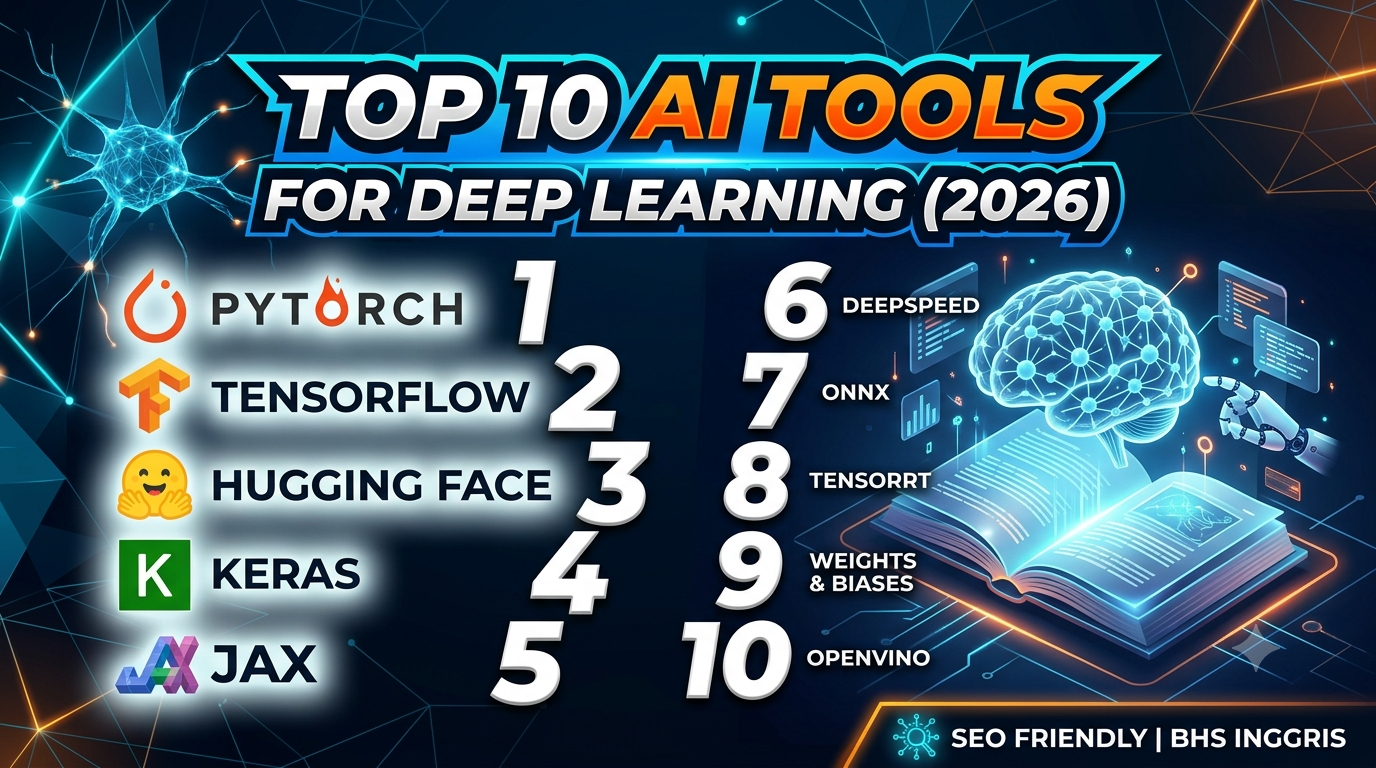
The landscape of Artificial Intelligence (AI) and Machine Learning (ML) continues to evolve at a breakneck pace. Deep learning—the subset of machine learning based on artificial neural networks—drives today’s most advanced breakthroughs, from Large Language Models (LLMs) and computer vision systems to real-time generative media.
Building, training, and deploying deep neural networks requires massive computational resources and complex mathematical operations. Choosing the right software ecosystem can mean the difference between seamless model iteration and endless engineering friction.
Whether you are an AI researcher, a software engineer, or an enterprise technology lead, this guide breaks down the top 10 AI tools for deep learning, highlighting their unique capabilities, ideal use cases, and key advantages.
Quick Comparison: Top Deep Learning Tools
| Tool / Framework | Developed By / Maintainer | Primary Strength & Focus | Target Audience |
| PyTorch | Meta Platforms / Linux Foundation | Dynamic computation, rapid research, LLM architecture | Researchers, AI Engineers |
| TensorFlow | Scalable end-to-end production pipelines & enterprise AI | MLOps Engineers, Enterprise Teams | |
| Keras | François Chollet / Google | High-level API, rapid prototyping, beginner friendliness | Beginners, Data Scientists |
| Hugging Face | Hugging Face Inc. | Pre-trained model library, NLP, vision, and fine-tuning | NLP Practitioners, LLM Developers |
| JAX | Google Research | High-performance numerical computing & auto-diff | Researchers, Scientific Computing Specialists |
| DeepSpeed | Microsoft | Distributed training optimization & GPU memory reduction | Large Model Trainers, Infrastructure Engineers |
| ONNX | Microsoft, Meta, & Partners | Model interoperability & framework-agnostic export | Production Deployment Teams |
| NVIDIA TensorRT / NGC | NVIDIA | GPU-accelerated inference optimization & containerization | Systems Engineers, Performance Optimizers |
| Weights & Biases (W&B) | Weights & Biases | Experiment tracking, model registry, and MLOps visualization | Data Science Teams, ML Managers |
| OpenVINO | Intel | CPU & edge device inference acceleration | Embedded Systems Developers, Edge AI Teams |
1. PyTorch
Best For: Academic research, rapid model prototyping, and Large Language Model (LLM) development.
Developed originally by Meta AI and now maintained under the Linux Foundation umbrella, PyTorch has become the primary choice for deep learning researchers and AI practitioners globally. Its defining feature is its dynamic computation graph (eager execution), which allows developers to modify neural network behavior on the fly during runtime.
Key Features
-
Pythonic Interface: Integrates natively with Python structures, making code intuitive to read, write, and debug.
-
TorchScript: Converts PyTorch models into flexible C++ runtimes for production deployment without requiring Python dependencies.
-
Rich Ecosystem: Underpins major AI libraries, including Hugging Face Transformers, PyTorch Lightning, and torchvision.
-
Pros: Highly intuitive, fast debugging, dominant in academic papers and modern generative AI research.
-
Cons: Production deployment historically required more effort compared to static graph alternatives.
2. TensorFlow
Best For: Enterprise-grade AI infrastructure, robust production pipelines, and cross-platform deployment.
Created by Google, TensorFlow remains an industry giant for building end-to-end machine learning systems. While PyTorch leads in research, TensorFlow shines in large-scale commercial deployments. Through tools like TensorFlow Serving, TensorFlow Lite, and TensorFlow.js, engineers can deploy models across cloud servers, mobile devices, web browsers, and edge hardware.
Key Features
-
Comprehensive MLOps Ecosystem: Provides robust tooling for dataset preparation (TFDS), model evaluation, and monitoring (TFX).
-
Cross-Platform Deployment: TensorFlow Lite enables deep learning on iOS, Android, and IoT microcontrollers.
-
TensorBoard: Industry-standard visualization suite for monitoring training metrics, loss curves, and network graphs.
-
Pros: Unmatched enterprise scalability, comprehensive production ecosystem, and strong cross-device support.
-
Cons: Steeper learning curve than higher-level frameworks; legacy codebases can feel verbose.
3. Keras
Best For: Fast prototyping, entry-level deep learning, and clean neural network design.
Keras is an elegant, high-level deep learning API designed to minimize human cognitive overhead. With the release of Keras 3, the framework operates seamlessly on top of multiple backends, including PyTorch, TensorFlow, and JAX. This allows developers to write model code once and run it on whichever compute backend fits their needs.
Key Features
-
Multi-Backend Architecture: Switch effortlessly between TensorFlow, PyTorch, or JAX execution engines.
-
Modular Design: Layers, losses, optimizers, and activation functions are self-contained modules that easily plug together.
-
User-Centric Error Handling: Delivers actionable, clear error messages that accelerate troubleshooting.
-
Pros: Exceptionally beginner-friendly, clean syntax, backend flexibility.
-
Cons: Highly customized, low-level tensor manipulation can require stepping down into underlying frameworks.
4. Hugging Face Transformers
Best For: NLP, multimodal AI, pre-trained model access, and LLM fine-tuning.
Hugging Face has transformed how developers work with deep learning by creating an open-source hub for state-of-the-art pre-trained models. The transformers library provides standardized APIs to download, fine-tune, and deploy models spanning Natural Language Processing (BERT, Llama), Computer Vision (ViT), and Audio processing (Whisper).
Key Features
-
Model Hub: Instant access to over hundreds of thousands of open-source models, datasets, and interactive demos.
-
PEFT & QLoRA Integration: Built-in support for Parameter-Efficient Fine-Tuning and quantization, allowing giant models to be trained on consumer hardware.
-
Framework Agnostic: Seamlessly bridges PyTorch, TensorFlow, and JAX workflows.
-
Pros: Eliminates the need to train massive models from scratch; massive community support.
-
Cons: High-level abstractions can occasionally mask underlying model mechanics during deep custom development.
5. JAX
Best For: High-performance scientific computing, functional transformation, and cutting-edge AI research.
Developed by Google Research, JAX is a specialized tool designed for high-performance numerical computing and automated differentiation. Combining an updated version of NumPy with the XLA (Accelerated Linear Algebra) compiler, JAX enables automatic vectorization, parallelization, and GPU/TPU compilation directly from standard Python code.
Key Features
-
Composable Program Transformations: Offers
grad(automatic differentiation),jit(just-in-time compilation),vmap(vectorization), andpmap(parallel execution). -
Pure Functional Paradigm: Encourages functional programming patterns, leading to deterministic and easily parallelizable neural networks.
-
TPU Optimization: Built from the ground up to maximize execution speed on Google Tensor Processing Units.
-
Pros: Extremely fast execution speed; highly flexible for non-traditional neural network architectures.
-
Cons: Functional state management requires a paradigm shift for developers accustomed to object-oriented frameworks.
6. DeepSpeed
Best For: Distributed deep learning, memory-efficient training, and scaling models with billions of parameters.
Created by Microsoft, DeepSpeed is an open-source deep learning optimization library built on top of PyTorch. It tackles one of the biggest challenges in modern AI: training massive models that exceed GPU memory limits. Through its proprietary ZeRO (Zero Redundancy Optimizer) technology, DeepSpeed partitions optimizer states, gradients, and model parameters across available hardware nodes.
Key Features
-
ZeRO Memory Optimization: Enables training models with tens or hundreds of billions of parameters without running out of VRAM.
-
Extreme Scale Training: Efficiently scales across thousands of GPUs with high compute throughput.
-
Integrated Offloading: Offloads memory-intensive tasks to host CPU or NVMe storage when GPU memory is saturated.
-
Pros: Drastically reduces GPU hardware costs for training foundation models.
-
Cons: Requires advanced infrastructure knowledge and distributed system debugging skills.
7. ONNX (Open Neural Network Exchange)
Best For: Cross-framework compatibility and model portability.
ONNX is an open format designed to represent deep learning models across different framework boundaries. Co-developed by Microsoft, Meta, and industry partners, ONNX allows developers to train a model in PyTorch or TensorFlow and export it into a unified, standardized graph format. This format can then be executed using the high-performance ONNX Runtime engine across diverse hardware targets.
Key Features
-
Framework Interoperability: Train in one ecosystem (e.g., PyTorch) and run inference in another (e.g., C++ environment).
-
ONNX Runtime: Highly optimized inference engine supporting CPU, GPU, and specialized AI accelerators.
-
Graph Optimization: Applies node fusion, constant folding, and quantization to speed up inference speeds.
-
Pros: Prevents vendor lock-in; optimizes deployment speeds across heterogeneous hardware ecosystems.
-
Cons: Complex custom layers or unconventional operators may require manual converter mapping.
8. NVIDIA TensorRT & NGC
Best For: Ultra-low latency GPU inference, model quantization, and hardware-level acceleration.
NVIDIA TensorRT is an SDK built specifically for high-performance deep learning inference on NVIDIA GPUs. Working alongside the NVIDIA GPU Cloud (NGC) catalog—which offers pre-optimized AI containers and pretrained models—TensorRT takes trained neural networks and optimizes them directly for target GPU architectures.
Key Features
-
Precision Calibration: Converts FP32 models to lower-precision INT8 or FP16 representations without significant accuracy degradation.
-
Kernel Auto-Tuning: Selects optimal algorithms and block sizes based on the specific target GPU architecture.
-
Dynamic Tensor Memory: Reuses memory allocations efficiently to minimize allocation overhead during real-time inference.
-
Pros: Maximizes throughput and delivers the lowest possible inference latency on NVIDIA hardware.
-
Cons: Hardware-locked to NVIDIA GPUs; steep learning curve for optimization setup.
9. Weights & Biases (W&B)
Best For: MLOps, experiment tracking, hyperparameter tuning, and collaborative model evaluation.
While frameworks handle computation, managing deep learning experiments requires robust tracking software. Weights & Biases has become the standard platform for tracking hyperparameters, training loss metrics, dataset versions, and model artifacts in real time.
Key Features
-
Automated Dashboarding: Logs training runs, loss graphs, gradient distributions, and system metrics with minimal code integration.
-
Hyperparameter Sweeps: Automates hyperparameter search (Bayesian, grid, random) across distributed clusters.
-
Model Registry: Provides version control for datasets and trained model weights to ensure operational reproducibility.
-
Pros: Seamless integration with PyTorch, TensorFlow, Keras, and Hugging Face; excellent team collaboration tools.
-
Cons: SaaS offering can become costly at high enterprise volume (though free community tiers exist).
10. OpenVINO
Best For: Optimizing and deploying deep learning models on Intel CPUs, integrated GPUs, and edge platforms.
Developed by Intel, the OpenVINO (Open Visual Inference and Neural Network Optimization) toolkit focuses on accelerating deep learning inference across Intel hardware. It converts models trained in frameworks like PyTorch or TensorFlow into an intermediate representation (IR), maximizing execution speed on standard enterprise servers and edge hardware without requiring dedicated discrete GPUs.
Key Features
-
Broad Framework Support: Imports models directly from TensorFlow, PyTorch, ONNX, and Caffe.
-
Hardware Heterogeneity: Automatically routes workload layers across available Intel CPUs, GPUs, and VPUs.
-
Model Quantization: Provides Post-Training Optimization Tools (POT) to convert precision with minimal loss of accuracy.
-
Pros: Drastically cuts inference hardware costs by leveraging existing CPU/integrated GPU infrastructure.
-
Cons: Specifically tailored for Intel architecture optimization.
How to Choose the Right Deep Learning Tool
Selecting the right framework depends heavily on your team’s objectives, hardware constraints, and technical background:
-
For Research & Experimentation: Choose PyTorch. Its dynamic nature and vibrant community make it the default standard for cutting-edge work.
-
For Production & Scale: Choose TensorFlow or ONNX. Both offer battle-tested ecosystems for enterprise serving across diverse software environments.
-
For NLP & LLMs: Choose Hugging Face paired with PyTorch and DeepSpeed. This stack simplifies downloading, fine-tuning, and distributing massive language models.
-
For High-Speed Mathematical Research: Choose JAX. Its functional approach and JIT compilation deliver unmatched raw speed on TPUs and GPUs.
-
For Edge & Embedded Systems: Choose OpenVINO (for Intel) or TensorRT (for NVIDIA).
Which deep learning framework is easiest for beginners?
Keras is widely considered the most accessible framework due to its clean syntax and human-centric design. Modern PyTorch is also highly readable and beginner-friendly.
Is PyTorch better than TensorFlow?
Neither is universally “better.” PyTorch currently dominates academic research, open-source LLMs, and dynamic model design. TensorFlow excels in legacy enterprise pipelines, mobile/embedded deployment (TF Lite), and structured end-to-end MLOps.
What is the difference between Machine Learning and Deep Learning?
Machine learning encompasses general algorithms that learn patterns from structured data (e.g., decision trees, linear regression). Deep learning is a specialized subfield that uses multi-layered artificial neural networks to automatically extract features from complex, unstructured data like images, audio, and raw text.
Conclusion
The deep learning toolkit landscape is richer and more versatile than ever before. Rather than relying on a single tool, modern AI engineering pipelines often combine several: training in PyTorch or JAX, optimizing with DeepSpeed or TensorRT, tracking metrics with Weights & Biases, and serving models globally via ONNX or TensorFlow Serving. Understanding how these tools complement each other is key to building resilient, scalable AI solutions.
Penulis: W.S








Post Comment