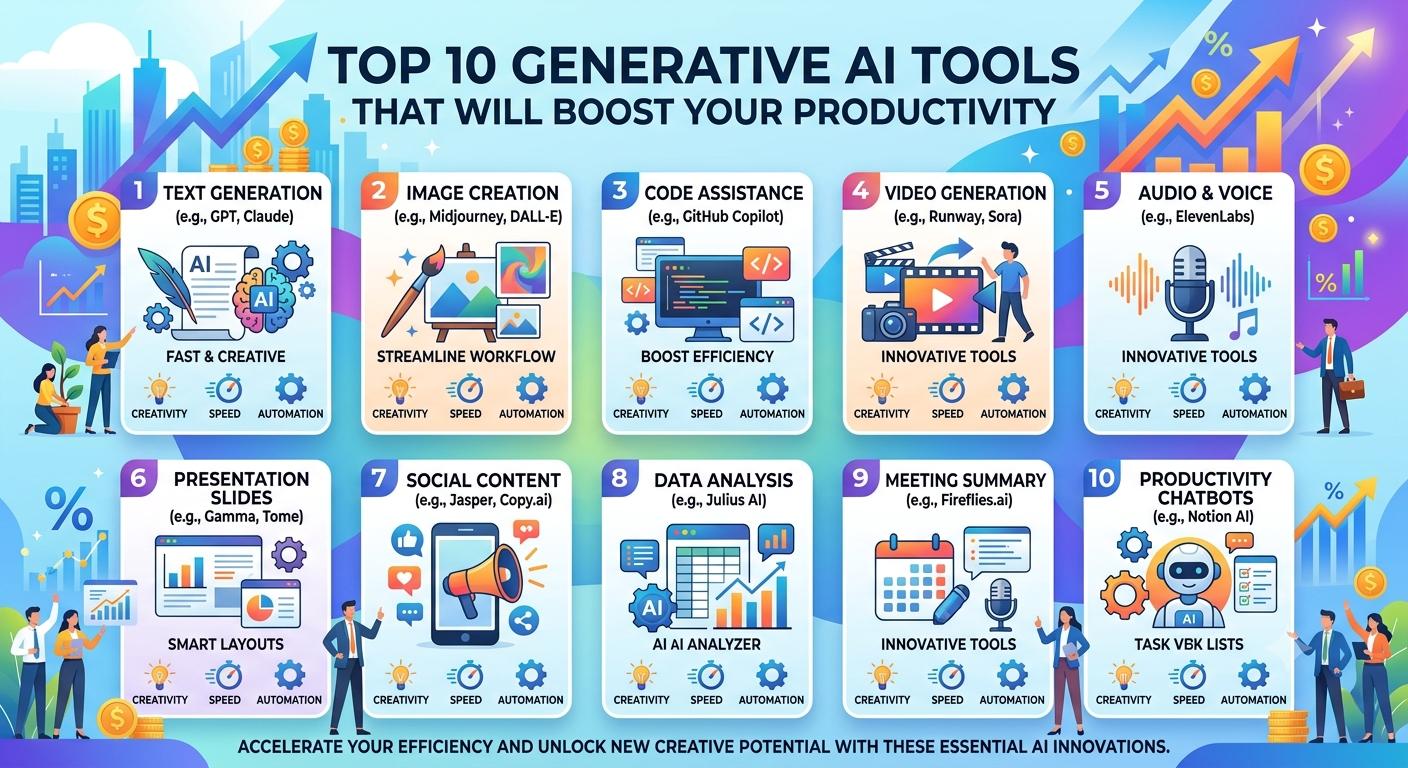
The modern workplace has undergone a dramatic transformation, with generative artificial intelligence shifting from a futuristic novelty into an indispensable daily asset. According to global workplace studies, knowledge workers leveraging AI tools experience significant efficiency surges, saving hours every week on tasks ranging from content creation and deep research to calendar management and administrative overhead.
Choosing the right applications can feel overwhelming given the sheer volume of options available. To help you navigate this landscape, here is an in-depth look at the top 10 generative AI tools designed to drastically supercharge your productivity across different workflows.
1. ChatGPT
- Best For: All-around general assistance, brainstorming, and multi-modal problem solving.
- Core Strengths: As one of the most versatile platforms available, OpenAI’s ChatGPT handles everything from text drafting and coding to data analysis and image creation in a single interface. Features like custom projects, memory retention across conversations, and advanced analytical models make it a powerful starting point for any digital workflow. Whether you need to draft an email response, outline a project proposal, or debug code, it reduces the friction of starting from a blank page.
2. Claude
- Best For: Long-form writing, nuanced reasoning, and heavy document analysis.
- Core Strengths: Developed by Anthropic, Claude is widely praised for its large context window and meticulous prose style. It excels at parsing dense, multi-page reports, legal contracts, or entire codebases in a single session. Furthermore, its interactive workspace features (such as Artifacts) allow users to view, edit, and iterate on code, web snippets, or documents live alongside the conversation without losing context.
3. Perplexity AI
- Best For: Conversational research and fact-checking with transparent citations.
- Core Strengths: Perplexity functions as an AI-powered answer engine rather than a traditional link directory. When you ask a question, it scans the live web and synthesizes an answer complete with inline citations for every claim. This eliminates the tedious “open ten tabs and scroll” cycle of traditional web searches, making it a go-to tool for students, journalists, and market researchers who value accuracy and speed.
4. Microsoft 365 Copilot
- Best For: Enterprise environments and office suite automation.
- Core Strengths: For professionals entrenched in the corporate ecosystem, Copilot integrates directly into Word, Excel, PowerPoint, Outlook, and Teams. It can summarize endless email chains, pull key action items from a Microsoft Teams meeting, draft slide decks from a simple text prompt, and analyze complex spreadsheet data. By embedding AI directly into daily office apps, Copilot minimizes app-switching and accelerates administrative tasks.
5. Notion AI
- Best For: Knowledge management, note-taking, and workspace organization.
- Core Strengths: Notion AI builds intelligence directly into your workspace notes, databases, and project wikis. It can automatically summarize meeting notes, rewrite paragraphs into different professional tones, brainstorm project tasks, and answer questions based entirely on your team’s internal documentation. It serves as a central brain for organizing personal projects or company-wide knowledge bases.
6. NotebookLM
- Best For: Synthesizing personal source materials and study notes.
- Core Strengths: Google’s NotebookLM flips the standard AI paradigm: instead of searching the open web, it answers questions and generates insights strictly from the documents you upload. If you feed it lecture notes, research papers, or financial statements, it creates accurate study guides, briefing docs, and citations pointing directly to your source passages. Its standout audio-overview feature even converts your uploaded documents into an engaging podcast-style discussion.
7. Motion
- Best For: AI-driven calendar management and dynamic task scheduling.
- Core Strengths: Motion acts as an intelligent executive assistant for your time. Instead of manually blocking out hours on a calendar, you input your tasks, project deadlines, and meeting preferences, and Motion automatically reorganizes your schedule on the fly. If an unexpected meeting pops up or a task runs long, the AI recalculates your day in real-time to ensure you hit your deadlines without burning out.
8. Gamma
- Best For: Rapid creation of polished presentations, docs, and web pages.
- Core Strengths: If you dread staring at blank presentation slides, Gamma is a game-changer. By inputting a simple text prompt or an outline, Gamma generates a visually striking, professionally structured presentation, complete with layouts, color schemes, and AI-generated images, in seconds. You can then refine the output conversationally, drastically cutting down the hours typically spent formatting decks.
9. Fireflies.ai
- Best For: Automated meeting transcription, recording, and action tracking.
- Core Strengths: Fireflies joins your virtual meetings (across Zoom, Google Meet, and Microsoft Teams) to record, transcribe, and summarize discussions automatically. It captures speaker breakdowns, timestamps, and key action items so you can focus entirely on the conversation rather than frantically typing notes. Afterward, you can query the meeting transcript like a chat document to find specific decisions or assigned tasks.
10. Cursor
- Best For: AI-native software development and coding assistance.
- Core Strengths: Cursor is a code editor built from the ground up to integrate artificial intelligence seamlessly into the development process. Unlike simple code completion plugins, Cursor understands your entire codebase, allowing you to execute multi-file edits, debug errors through natural language chat, and run autonomous coding agents. It serves as a massive productivity multiplier for modern engineers and developers.
Best Practices for Integrating AI Into Your Workflow
Maximizing the value of these generative tools requires a strategic approach rather than adopting every app on the market:
- Identify Your Bottlenecks: Pinpoint the tasks that drain your time the most—whether that is drafting emails, writing code, or researching topics—and adopt one or two specialized tools to solve those exact friction points.
- Maintain Human Oversight: While AI dramatically accelerates productivity, models can occasionally hallucinate facts or produce generic outputs. Always review, edit, and fact-check critical work before publishing or sending it.
- Iterate Your Prompts: Treat AI like a collaborative junior partner. Providing clear context, constraints, and examples in your prompts yields significantly better results on the first try.
Conclusion
The integration of generative AI into daily workflows is no longer optional for those aiming to stay competitive in a fast-paced economy. By strategically implementing tools like ChatGPT for general tasks, Perplexity for research, Copilot for office workflows, and Motion for time management, you can reclaim hours of your week, reduce administrative fatigue, and focus your energy on high-impact, creative problem solving.
WRITER : INDAH PATMA SARI





Post Comment