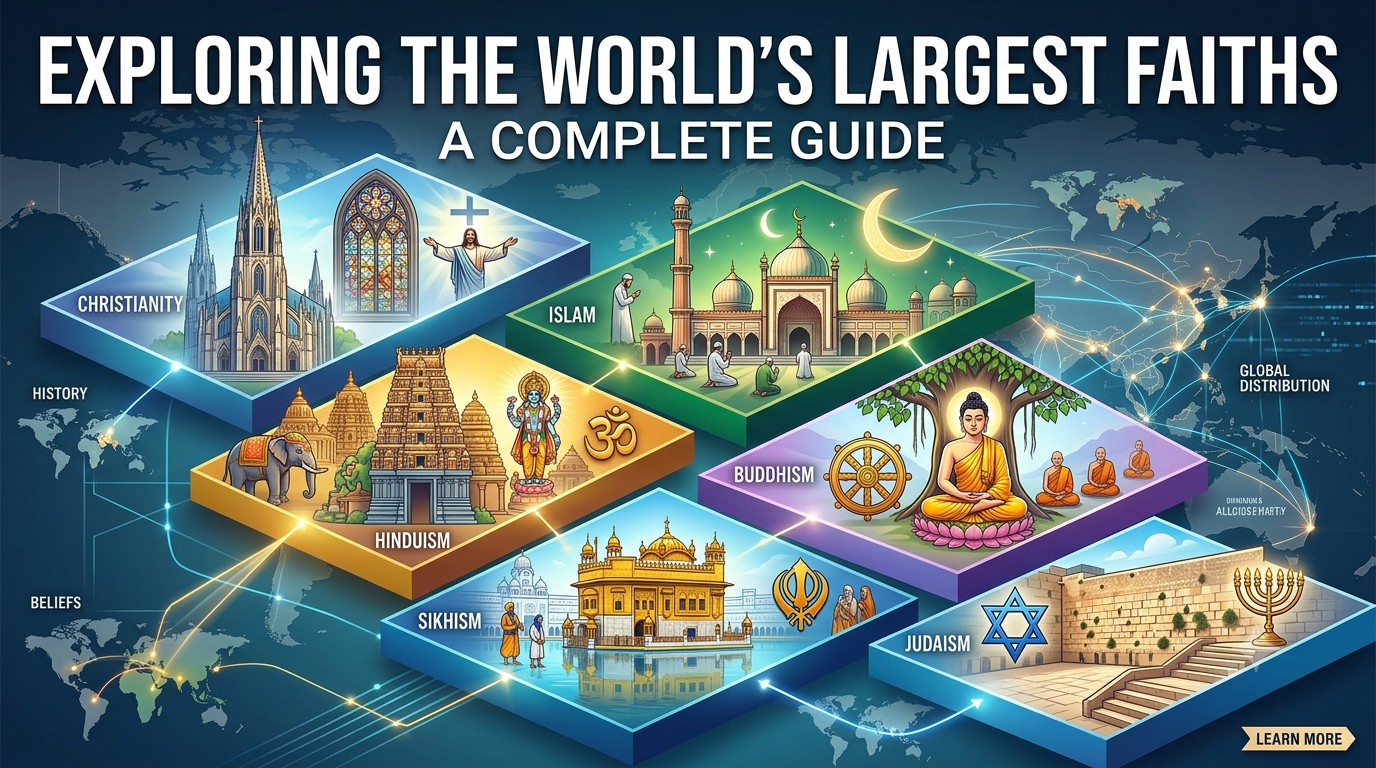
Throughout human history, religion has played an indispensable role in shaping cultures, societal norms, moral frameworks, and legal systems. Today, out of the thousands of distinct faiths and spiritual practices existing across the globe, a select few account for the vast majority of the world’s population.
Understanding the world’s largest faiths is essential for fostering cross-cultural understanding, global awareness, and historical context. This complete guide explores the demographics, origins, foundational beliefs, and geographic distributions of the most popular religions practiced today.
Global Religious Demographics at a Glance
According to demographic studies by major research centers such as the Pew Research Center, more than 85% of the global population identifies with a specific religious group or spiritual tradition.
| Religion | Estimated Followers | Percentage of World Population | Dominant Geographic Regions |
| Christianity | ~2.4 Billion | ~30% | Americas, Europe, Sub-Saharan Africa |
| Islam | ~1.9 – 2.0 Billion | ~25% | Middle East, North Africa, South & Southeast Asia |
| Secular / Unaffiliated | ~1.2 Billion | ~15% | East Asia, Western Europe, North America |
| Hinduism | ~1.2 Billion | ~15% | South Asia (India, Nepal) |
| Buddhism | ~500 Million | ~6% | East and Southeast Asia |
| Folk / Traditional | ~400 Million | ~5% | Africa, Asia, Indigenous Americas |
| Sikhism | ~30 Million | ~0.4% | India (Punjab), Global Diaspora |
| Judaism | ~15 Million | ~0.2% | Israel, United States |
1. Christianity
With approximately 2.4 billion adherents, Christianity is currently the world’s largest religion. Originating in the 1st century CE within the Roman province of Judea, Christianity grew from a small Jewish sect into a major global tradition.
Key Details & Origins
- Founder: Jesus of Nazareth (Jesus Christ).
- Sacred Text: The Holy Bible (comprising the Old Testament and New Testament).
- Core Concept: Christianity is centered on the life, death, and resurrection of Jesus Christ. Christians believe Jesus is the Son of God and the promised Messiah who offers salvation and eternal life to humanity.
Core Beliefs
- The Trinity: Belief in one God existing in three persons: God the Father, God the Son (Jesus), and God the Holy Spirit.
- Salvation and Grace: Eternal life in heaven is granted through faith in Jesus Christ and God’s grace, which redeems humanity from sin.
- The Commandments: High ethical emphasis on love, compassion, forgiveness, and following moral guidelines such as the Ten Commandments and the teachings of the Sermon on the Mount.
Major Branches
- Roman Catholicism: Headed by the Pope in Vatican City, it represents over half of all Christians globally.
- Protestantism: Originated during the 16th-century Reformation; includes Lutherans, Baptists, Methodists, Pentecostals, and Evangelicals.
- Eastern Orthodoxy: Preserves ancient liturgical and theological traditions, primarily in Eastern Europe and the Mediterranean.
2. Islam
Islam is the world’s second-largest religion, with roughly 1.9 to 2 billion followers. It is also recognized as the fastest-growing major religion globally due to demographic factors and birth rates in key regions.
Key Details & Origins
- Founder: Prophet Muhammad.
- Sacred Text: The Holy Quran (Qur’an) and the Hadith (sayings and actions of Muhammad).
- Core Concept: Islam is an Arabic word meaning “submission” to the will of God (Allah). A follower of Islam is called a Muslim.
The Five Pillars of Islam
Muslim practices are anchored by five fundamental duties:
- Shahada (Declaration of Faith): Reciting the statement that there is no god but Allah, and Muhammad is His messenger.
- Salah (Prayer): Performing ritual prayers five times daily facing Mecca.
- Zakat (Almsgiving): Giving a percentage of one’s wealth to help the poor and needy.
- Sawm (Fasting): Fasting from dawn to sunset during the holy month of Ramadan.
- Hajj (Pilgrimage): Undertaking a pilgrimage to Mecca at least once in a lifetime for those who are physically and financially able.
Major Branches
- Sunni Islam: Comprises approximately 85-90% of the world’s Muslim population.
- Shia Islam: Makes up roughly 10-15% of Muslims, holding distinct views on early Islamic leadership after the death of Prophet Muhammad.
3. Hinduism
Hinduism is the world’s third-largest religion, boasting around 1.2 billion followers. Unlike most major faiths, Hinduism has no single founder, specific theological origin point, or unified institutional authority.
Key Details & Origins
- Origins: Rooted in the ancient Vedic traditions of the Indian subcontinent, dating back more than 4,000 years.
- Sacred Texts: The Vedas, Upanishads, the Bhagavad Gita, and epics such as the Ramayana and Mahabharata.
- Core Concept: Known natively as Sanatana Dharma (“The Eternal Way”), Hinduism is a complex synthesis of diverse philosophical, spiritual, and cultural traditions.
Core Beliefs
- Brahman: The ultimate, supreme cosmic reality or absolute truth that permeates all existence.
- Karma: The universal law of cause and effect; moral actions in this life determine future circumstances.
- Samsara & Moksha: Samsara is the cycle of death and rebirth (reincarnation). The ultimate goal of life is Moksha—liberation from this cycle to unite with Brahman.
- Dharma: Ethical duties, righteousness, and cosmic order that guide personal behavior.
4. Buddhism
Practiced by approximately 500 million people worldwide, Buddhism emerged in ancient South Asia during the 5th century BCE and spread extensively throughout East and Southeast Asia.
Key Details & Origins
- Founder: Siddhartha Gautama (The Buddha, meaning “The Awakened One”).
- Sacred Texts: The Pali Canon (Tripitaka), along with various Mahayana Sutras.
- Core Concept: Buddhism focuses on personal spiritual development, attaining wisdom, and understanding the nature of reality to overcome human suffering.
The Four Noble Truths
Buddhism is structured around four foundational insights:
- Dukkha: Life involves suffering and dissatisfaction.
- Samudaya: Suffering is caused by craving, attachment, and ignorance.
- Nirodha: Suffering can end by eliminating attachment and craving.
- Magga: The path to end suffering is the Noble Eightfold Path (focusing on ethical conduct, mental discipline, and wisdom).
Major Traditions
- Theravada: Prominent in Sri Lanka, Thailand, Myanmar, and Cambodia; focuses heavily on monastic traditions and original Pali teachings.
- Mahayana: Widespread in China, Japan, Korea, and Vietnam; emphasizes the path of the Bodhisattva (seeking enlightenment to aid all beings).
- Vajrayana: Practiced predominantly in Tibet, Mongolia, and Bhutan; incorporates esoteric ritual practices and visualizations.
5. Sikhism
Sikhism is the fifth-largest organized world religion, with approximately 30 million adherents. Founded in the 15th century CE in the Punjab region of South Asia, Sikhism emphasizes equality, social justice, and selfless service.
Key Details & Origins
- Founder: Guru Nanak Dev Ji (followed by nine human Gurus).
- Sacred Text: The Guru Granth Sahib (considered the eternal, living Guru).
- Core Concept: Sikhism preaches absolute devotion to one supreme God (Ik Onkar) and rejects social divisions based on caste, class, gender, or creed.
Core Principles
- Naam Japna: Remembering God at all times in daily life.
- Kirat Karo: Living an honest life and earning through hard work.
- Vand Chhako: Sharing one’s earnings with the needy through charity.
- Seva and Langar: Selfless service (Seva) is central. Every Sikh temple (Gurdwara) hosts a Langar—a free community kitchen serving meals to everyone regardless of religion or background.
6. Judaism
While Judaism has a relatively smaller global population of roughly 15 million people, its historical significance is vast. As the oldest monotheistic faith among the Abrahamic traditions, Judaism provided the spiritual foundation for both Christianity and Islam.
Key Details & Origins
- Origins: Traces back over 3,500 years to the ancient Near East, establishing a covenant between God and the patriarch Abraham.
- Sacred Texts: The Tanakh (Hebrew Bible, including the Torah) and the Talmud (rabbinic legal commentaries).
- Core Concept: Judaism is characterized by a commitment to the Covenant—a holy relationship between God and the Jewish people guided by divine laws (Mitzvot).
Major Branches
- Orthodox Judaism: Adheres strictly to traditional Jewish law and customs.
- Conservative Judaism: Balances historical tradition with modern adaptations.
- Reform Judaism: Focuses on the ethical imperatives of the faith, emphasizing personal choice in ritual practice.
Comparative Summary of World Religions
| Religion | Primary Focus / Ultimate Goal | Major Spiritual Practices |
| Christianity | Salvation through faith in Jesus Christ; Eternal life with God | Prayer, Sacraments, Scripture study, Charity |
| Islam | Submission to Allah; Achieving Paradise (Jannah) | Five Pillars (Prayer, Fasting, Pilgrimage, Alms) |
| Hinduism | Liberation (Moksha) from the cycle of rebirth | Yoga, Meditation, Temple Worship (Puja), Dharma |
| Buddhism | Attaining Enlightenment and Nirvana to end suffering | Meditation, Eightfold Path, Mindfulness |
| Sikhism | Union with God through devotion and moral living | Meditation (Naam Simran), Community Service (Seva) |
| Judaism | Fulfilling the Covenant through ethical action in this life | Torah study, Prayer, Observing the Sabbath and Commandments |
Conclusion
The world’s major religions represent diverse pathways through which humanity has sought meaning, morality, and connection with the divine. While each faith carries distinct beliefs, practices, and historical developments, they all share common values: promoting compassion, ethical living, charity, and respect for human dignity. As global connectivity grows, learning about these traditions provides a critical bridge toward mutual respect and peaceful co-existence.
Penulis: W.S





Post Comment