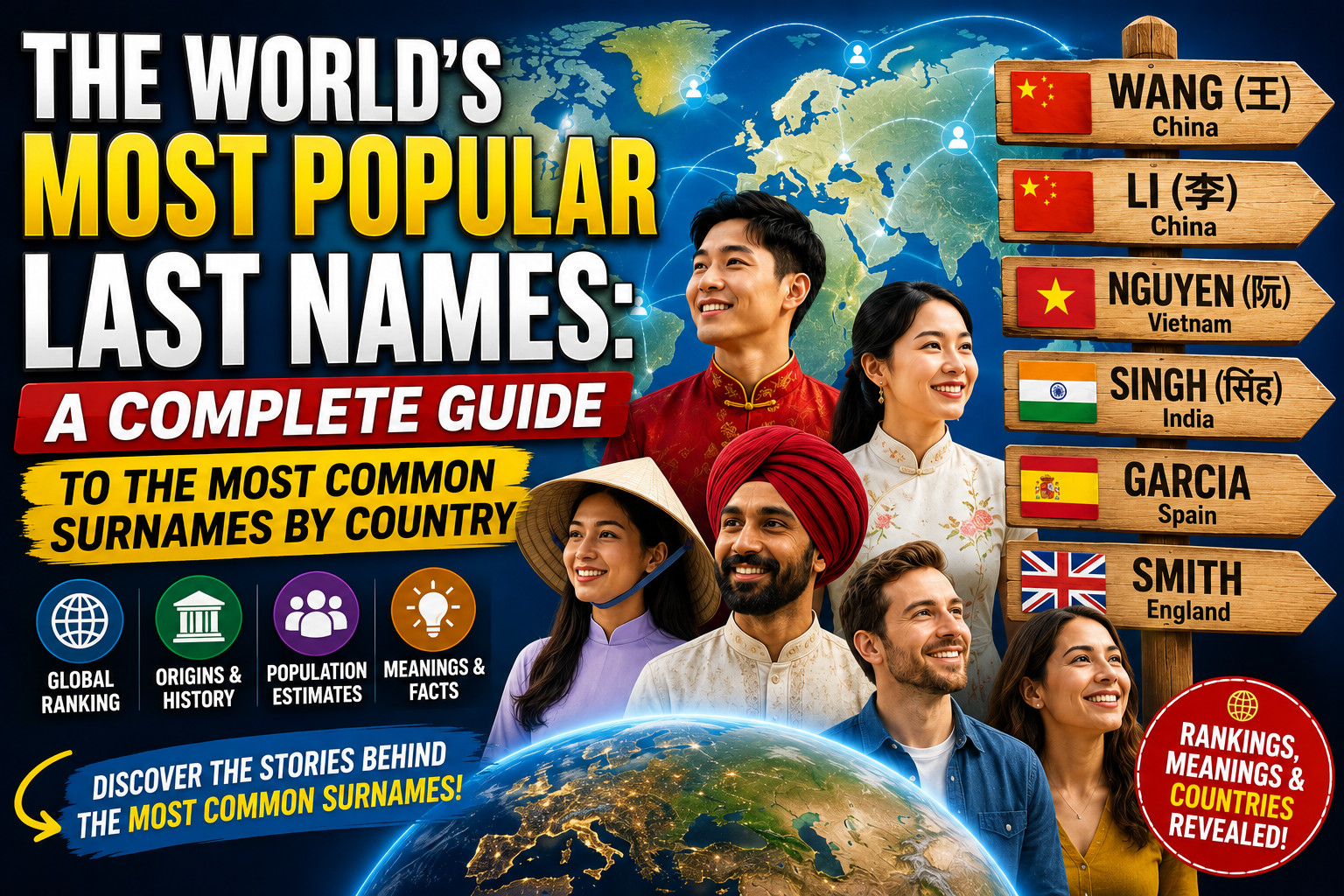
Surnames are more than simple legal identifiers; they serve as living linguistic archives that trace centuries of migration, social hierarchies, occupations, and ancestral legacies. Across the globe, billions of people share a surprisingly concentrated pool of family names. In some regions, a single surname can be shared by tens of millions of individuals, while in others, last names reflect dynamic patronymic traditions or local geography.
Understanding the world’s most common surnames offers a fascinating glimpse into human demographics, culture, and history. This guide explores the most popular last names across continents, breaking down their meanings, origins, and geographic distribution.
1. How Surnames Originated Around the World
Before diving into regional lists, it helps to understand how last names came to exist. Historically, surnames were introduced to resolve ambiguities as human populations grew and simple given names were no longer sufficient.
Most surnames across cultures fall into five primary categories:
- Occupational: Names derived from a trade or profession (e.g., Smith, Miller, Kuznetsov).
- Patronymic or Matronymic: Names based on an ancestor’s given name (e.g., Johnson [Son of John], Ivanov, Hernández).
- Topographic or Geographic: Names based on a physical location or landscape feature (e.g., Silva [forest], Yamada [mountain rice paddy]).
- Descriptive or Nicknames: Names based on physical traits or personality characteristics (e.g., Brown, Rossi [red-haired]).
- Clan or Ancestral: Names representing ancient tribes, lineages, or royal dynasties (e.g., Wang, Nguyen).
2. The Heavyweights: The Most Common Surnames Globally
When looking at total sheer volume, East and South Asian surnames dominate the global rankings due to the dense population of these regions and historically centralized naming systems.
Wang (王) — Over 100 Million People
- Primary Region: China
- Meaning: “King” or “Monarch”
- Context: Wang is currently considered the most common last name in the world. Originally adopted by descendants of ancient Chinese royal dynasties to signal noble heritage, the name is held by roughly 7.4% of China’s total population—meaning more people carry the last name Wang than the entire population of Germany.
Li / Lee (李) — Over 100 Million People
- Primary Region: China, Korea, Vietnam, Global Diaspora
- Meaning: “Plum tree”
- Context: Closely competing with Wang for the top global spot, Li was the imperial surname of the Tang Dynasty. In Korea, it is commonly transliterated as Lee or Rhee, representing one of the core traditional family names.
Zhang (张 / 張) — Over 95 Million People
- Primary Region: China
- Meaning: “To stretch a bow” / “Archer”
- Context: Originating as an occupational title for the official in charge of making bows for ancient Chinese rulers, Zhang remains one of the oldest recorded surnames in East Asian history.
Nguyen (阮) — Over 38 Million People
- Primary Region: Vietnam
- Meaning: Refers to an ancient Chinese musical instrument (the ruan)
- Context: Approximately 38% to 40% of all Vietnamese people share the surname Nguyen. Its prevalence is heavily tied to political history: during the reign of the Nguyen Dynasty (1802–1945), many citizens adopted or were awarded the imperial name to show loyalty or avoid persecution.
3. The Most Popular Surnames by Region
Asia & the Pacific
Naming conventions in Asia vary significantly between East Asia, South Asia, and Southeast Asia. While East Asian names tend to be short and heavily concentrated, South Asian surnames often reflect religious traditions, castes, or geographic roots.
| Country | Most Common Surname | Meaning / Origin |
| China | Wang (王) | King, Monarch |
| India | Devi / Singh / Kumar | Goddess (Devi), Lion (Singh), Prince (Kumar) |
| Japan | Sato (佐藤) | “Assisted Wisteria” (linked to the Fujiwara clan) |
| South Korea | Kim (金) | Gold |
| Vietnam | Nguyen (阮) | Musical instrument / Imperial Dynasty |
| Indonesia | Widjaja / Pranoto / (Varies)* | Indonesian naming often lacks fixed family surnames |
Note on South Korea: Three family names—Kim, Lee, and Park—account for nearly 45% of the entire South Korean population.
Note on India: Due to India’s vast cultural diversity, regional naming practices differ widely. Titles like Singh (predominantly among Sikhs and Rajputs) and patronymics/honorifics like Devi or Kumar frequently register as the most recorded last names in administrative census data.
Europe
European surnames heavily favor patronymics (suffix modifications indicating lineage) and occupations.
    Common European Surname Suffixes:
    ├── -son / -sen (Germanic/Scandinavian: "Son of") -> Johnson, Hansen
    ├── -ez / -es   (Iberian: "Son of")             -> Rodríguez, Fernandes
    ├── -ov / -eva  (Slavic: "Belonging to")        -> Ivanov, Smirnova
    └── Mac- / O'-  (Celtic: "Son of" / "Grandson") -> MacDonald, O'Brien
Western & Northern Europe
- United Kingdom: Smith (Occupational: metalworker or blacksmith). It remains the top name in England, Scotland, and Australia.
- Germany: Müller (Occupational: “Miller,” one who grinds grain).
- France: Martin (Patronymic/Devotional: derived from Saint Martin).
- Sweden: Andersson (Patronymic: “Son of Anders”).
Southern & Eastern Europe
- Spain: García (Etymology debated; likely pre-Roman Basque origin meaning “bear” or “young warrior”).
- Italy: Rossi (Descriptive: plural form of Rosso, meaning “red-haired” or “ruddy complexion”).
- Russia: Smirnov (Descriptive: derived from smirny, meaning “quiet,” “still,” or “submissive”).
The Americas
Surnames in North and South America closely reflect colonization, immigration patterns, and transatlantic trade history.
       [Top Surnames Across the Americas]

       North America (USA & Canada)
       └── 1. Smith (English)
       └── 2. Johnson (English/Scandinavian)
       └── 3. Williams (Welsh)

       Latin America (Central & South)
       └── 1. Gonzalez (Spanish: "Son of Gonzalo")
       └── 2. Rodriguez (Spanish: "Son of Rodrigo")
       └── 3. Silva (Portuguese: "Forest / Woods")
- United States: Smith leads the list with over 2.4 million individuals, followed by Johnson, Williams, and Brown. However, due to demographic shifts, Spanish surnames like Garcia, Rodriguez, and Martinez now rank comfortably within the top 10 most common U.S. surnames.
- Mexico: Hernández (Patronymic: “Son of Hernando/Fernando”).
- Brazil: Silva (Topographic: meaning “forest” or “thicket,” brought over by Portuguese settlers and widely adopted by local populations).
- Argentina: González (Patronymic: “Son of Gonzalo”).
Africa
African surnames reflect a blend of indigenous tribal languages, religious traditions (Christian and Islamic), and colonial influence.
- Nigeria: Mohammed and Ibrahim are among the most common in the north due to Islamic tradition, while names like Abebe, Okonkwo, or Adeboye dominate specific ethnolinguistic groups (Yoruba, Igbo, Hausa).
- Egypt: Mahmoud, Ali, and Ahmed are extremely widespread, following patrilineal naming systems where given names convert into ancestral surnames.
- South Africa: Nkosi (Nguni origin meaning “King” or “Leader”) and Jacobs (Afrikaans/Dutch lineage) are among the most common across demographic groups.
4. Quick Comparison: Most Common Last Name by Selected Countries
To get a quick overview of global trends, here is a snapshot of leading surnames by nation:
| Country | Top Surname | Primary Category |
| Australia | Smith | Occupation |
| Brazil | Silva | Topographic |
| China | Wang | Royalty / Status |
| Egypt | Mohamed | Religious / Patronymic |
| Germany | Müller | Occupation |
| Japan | Sato | Ancestral Clan |
| Mexico | Hernández | Patronymic |
| Russia | Smirnov | Descriptive Trait |
| South Korea | Kim | Material / Dynasty |
| United States | Smith | Occupation |
Summary: What Surnames Tell Us
Whether it’s the 100-million-strong global presence of Wang, the occupational universality of Smith, or the historical political shifts behind Nguyen, last names act as global cultural fingerprints. They highlight how human societies—despite vast distances and distinct languages—share fundamental instincts when naming themselves: honoring parents, noting professions, describing surroundings, and honoring heritage.
Penulis: W.S






Post Comment