The urban landscape of the United States is dynamic, diverse, and constantly evolving. From bustling financial capitals on the East Coast to fast-growing tech hubs across the Sunbelt, American cities reflect the country’s economic vitality, cultural diversity, and demographic shifts.
When analyzing American urban centers, it is essential to distinguish between city proper population (the population within officially defined city limits) and metropolitan statistical area (MSA) population (which includes surrounding suburban regions). The rankings below focus on official city proper population estimates from recent U.S. Census Bureau data.
Below is an in-depth breakdown of the Top 10 most populated U.S. cities, complete with population estimates, economic engines, unique cultural characteristics, and key facts.
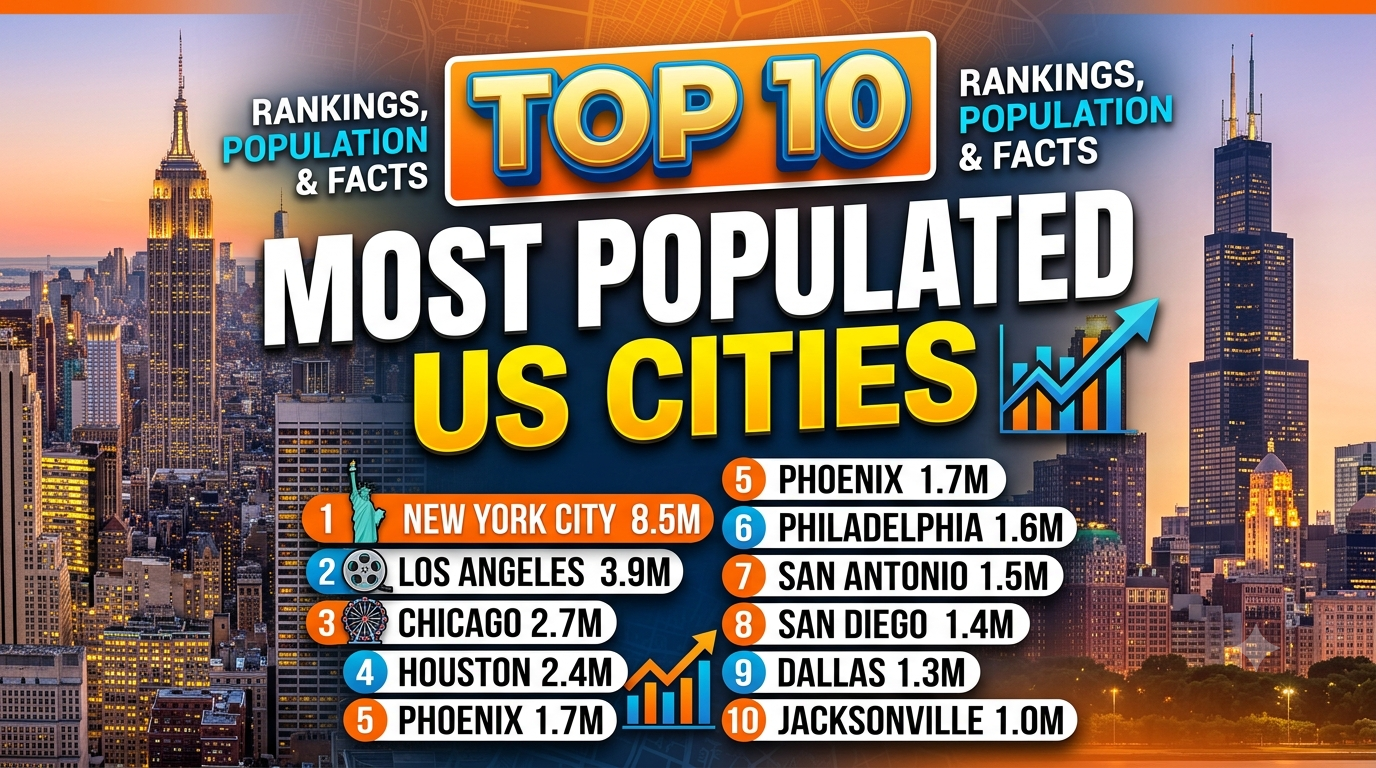
Quick Overview: Top 10 US Cities by Population
| Rank | City | State | Estimated Population | Primary Region | Key Economic Drivers |
|---|---|---|---|---|---|
| 1 | New York City | New York | ~8,478,000 | Northeast | Finance, Media, Tech, Culture |
| 2 | Los Angeles | California | ~3,878,000 | West | Entertainment, Aerospace, Trade |
| 3 | Chicago | Illinois | ~2,721,000 | Midwest | Finance, Logistics, Tech, Manufacturing |
| 4 | Houston | Texas | ~2,390,000 | South / Sunbelt | Energy, Healthcare, Aerospace, Shipping |
| 5 | Phoenix | Arizona | ~1,673,000 | Southwest | Semiconductor Tech, Finance, Healthcare |
| 6 | Philadelphia | Pennsylvania | ~1,573,000 | Mid-Atlantic | Education, Healthcare, Life Sciences, BioTech |
| 7 | San Antonio | Texas | ~1,526,000 | South / Sunbelt | Defense/Military, Tourism, Healthcare |
| 8 | San Diego | California | ~1,404,000 | West | Defense, Biotechnology, Tourism, Research |
| 9 | Dallas | Texas | ~1,326,000 | South / Sunbelt | Telecom, Financial Services, Real Estate |
| 10 | Jacksonville | Florida | ~1,009,000 | Southeast | Logistics, Banking, Military, Maritime Trade |
Detailed Rankings and Key Facts
1. New York City, New York
- Estimated Population: ~8,478,000
- Land Area: ~300 square miles
- Region: Northeast
New York City remains the undisputed heavyweight of American urban centers. Composed of five distinct boroughs—Manhattan, Brooklyn, Queens, The Bronx, and Staten Island—NYC has held the title of the most populous U.S. city in every single decennial census since 1790.
Key Facts & Highlights
- Economic Might: NYC is the financial capital of the world, hosting Wall Street, the New York Stock Exchange (NYSE), and NASDAQ.
- Global Diversity: Over 800 languages are spoken across the city, making it one of the most ethnically diverse places on Earth.
- Cultural Landmarks: Home to iconic sights like Times Square, Central Park, Broadway, the Statue of Liberty, and world-class museums.
- Transit Powerhouse: The New York City Subway operates 24/7 with 472 stations, making it the largest rapid transit system in the Western Hemisphere.
2. Los Angeles, California
- Estimated Population: ~3,878,000
- Land Area: ~469 square miles
- Region: West Coast
Known worldwide as the global center of film and entertainment, Los Angeles is the second-most populated city in the United States. Nestled between the Pacific Ocean and coastal mountain ranges, LA is famous for its sprawling geography, Mediterranean climate, and vibrant culture.
Key Facts & Highlights
- Entertainment Capital: Hollywood, major film studios, and recording labels drive the region’s creative economy.
- Global Port: The Port of Los Angeles, combined with neighboring Port of Long Beach, forms the busiest container port complex in the Western Hemisphere.
- Industrial Diversity: Beyond showbiz, LA is a powerhouse in aerospace, fashion, international trade, and clean technology.
- Olympic Host: Los Angeles previously hosted the Summer Olympics in 1932 and 1984 and is set to host again in 2028.
3. Chicago, Illinois
- Estimated Population: ~2,721,000
- Land Area: ~227 square miles
- Region: Midwest
Situated on the southwestern shore of Lake Michigan, Chicago is the economic and cultural hub of the American Midwest. Famous for its world-class architectural skyline, deep-dish pizza, and rich industrial history, “The Windy City” boasts one of the most diversified economies in the nation.
Key Facts & Highlights
- Financial Hub: Chicago houses global financial futures exchanges like the Chicago Mercantile Exchange (CME Group).
- Architectural Legacy: Known for pioneering modern skyscraper design following the Great Chicago Fire of 1871.
- Transportation Nexus: O’Hare International Airport is one of the busiest travel hubs globally, and Chicago serves as the primary railroad junction in North America.
- Cultural Treasures: Home to Millennium Park (The Bean), the Art Institute of Chicago, and iconic sports teams like the Bulls, Cubs, and Bears.
4. Houston, Texas
- Estimated Population: ~2,390,000
- Land Area: ~640 square miles
- Region: South / Sunbelt
Houston is the largest city in Texas and the fourth most populous in the U.S. Rapidly growing and exceptionally diverse, Houston is a sprawling metropolis known for energy production, space exploration, and medical research.
Key Facts & Highlights
- Energy Capital of the World: Home to more than 4,600 energy-related firms, including major oil, natural gas, and renewable energy headquarters.
- Space City: Houses NASA’s Johnson Space Center, where astronaut training and human spaceflight control operations take place.
- Medical Giant: The Texas Medical Center in Houston is the world’s largest medical complex, employing over 100,000 healthcare professionals.
- No Zoning Laws: Houston is unique among major American cities for having no formal municipal zoning land-use laws, enabling rapid commercial expansion.
5. Phoenix, Arizona
- Estimated Population: ~1,673,000
- Land Area: ~517 square miles
- Region: Southwest
Phoenix, known as the “Valley of the Sun,” is one of the fastest-growing major metropolitan areas in North America. Located in the Sonoran Desert, Phoenix has transformed from an agricultural center into a bustling desert metropolis driven by technology, finance, and semiconductor manufacturing.
Key Facts & Highlights
- Sunbelt Boom: Driven by warm weather, lower costs of living, and economic migration from the West Coast.
- Semiconductor Hub: Emerging as “Silicon Desert” thanks to multi-billion-dollar investments from companies like TSMC and Intel.
- State Capital: Phoenix is the most populous state capital in the United States and the only state capital with over 1 million residents.
- Year-Round Sun: Averages more than 300 sunny days per year, fueling a thriving resort and golf tourism industry.
6. Philadelphia, Pennsylvania
- Estimated Population: ~1,573,000
- Land Area: ~134 square miles
- Region: Mid-Atlantic
Philadelphia, affectionately called “Philly” or the “City of Brotherly Love,” is deeply steeped in American history. As the birthplace of the United States Constitution and Declaration of Independence, Philadelphia combines rich heritage with modern healthcare, education, and biotechnology sectors.
Key Facts & Highlights
- Historical Significance: Home to Independence Hall and the Liberty Bell; served as the temporary U.S. capital from 1790 to 1800.
- Eds and Meds Economy: Highly concentrated in higher education and healthcare, anchored by the University of Pennsylvania, Temple University, and major health systems.
- Cell & Gene Therapy Hub: Widely recognized as “Cellicon Valley” due to pioneering research in immunotherapy and cell therapy.
- Walkability: Known for grid-style urban planning laid out by founder William Penn in 1682, making it one of the most walkable large U.S. cities.
7. San Antonio, Texas
- Estimated Population: ~1,526,000
- Land Area: ~504 square miles
- Region: South / Sunbelt
San Antonio is the second-largest city in Texas and seventh-largest in the U.S. Known for its rich Hispanic culture, colonial history, and strong military presence, San Antonio offers a blend of historic charm and modern economic expansion.
Key Facts & Highlights
- Military City, USA: Hosts major U.S. military installations including Joint Base San Antonio (Lackland AFB, Fort Sam Houston, and Randolph AFB).
- The Alamo & Missions: Home to the historic Alamo mission and San Antonio Missions National Historical Park, a UNESCO World Heritage site.
- River Walk: The famous San Antonio River Walk (Paseo del Rio) serves as a primary pedestrian tourism and dining hub.
- Cybersecurity Hub: Possesses one of the largest concentrations of cybersecurity professionals outside the Washington, D.C. region.
8. San Diego, California
- Estimated Population: ~1,404,000
- Land Area: ~325 square miles
- Region: West Coast
Located directly on the Pacific border with Mexico, San Diego is renowned for its idyllic year-round climate, expansive beaches, and deep-water natural harbor. It is a major center for biotechnology, defense, international trade, and marine research.
Key Facts & Highlights
- Defense Infrastructure: Home to the U.S. Navy’s Pacific Fleet assets, including Naval Air Station North Island and Marine Corps Base Camp Pendleton nearby.
- Life Sciences Leader: Consistently ranks among the top life science and biotech innovation clusters in North America.
- Cross-Border Economy: Shares a direct economic ecosystem with Tijuana, Mexico, forming one of the busiest international border crossings globally.
- Attractions: World-famous for the San Diego Zoo, Balboa Park, and Scripps Institution of Oceanography.
9. Dallas, Texas
- Estimated Population: ~1,326,000
- Land Area: ~340 square miles
- Region: South / Sunbelt
Dallas anchors the northern half of the massive Dallas-Fort Worth (DFW) Metroplex. Highly business-friendly with zero state income tax in Texas, Dallas has attracted scores of Fortune 500 headquarters across telecommunications, banking, aviation, and energy sectors.
Key Facts & Highlights
- Corporate Magnet: Hosts corporate headquarters for AT&T, Southwest Airlines, Texas Instruments, and CBRE.
- DFW Airport: Dallas/Fort Worth International Airport is one of the largest and busiest airports globally by traffic.
- Arts District: The Dallas Arts District is the largest continuous urban arts district in the United States, spanning 20 contiguous blocks.
- Financial Services: Represents the primary financial center of the South Central U.S.
10. Jacksonville, Florida
- Estimated Population: ~1,009,000
- Land Area: ~747 square miles
- Region: Southeast
Jacksonville crossed the 1-million resident milestone, securing its position as the 10th most populous city in the United States and the most populous city in Florida. Due to a consolidated city-county government structure formed in 1968, Jacksonville is geographically the largest city in the contiguous United States by land area.
Key Facts & Highlights
- Massive Geography: Spans nearly 750 square miles, encompassing coastal beaches, major riverfronts, and deep suburban networks.
- Logistics & Ports: The Port of Jacksonville (JAXPORT) is a principal commercial gateway for international automotive and container shipping.
- Financial Tech Hub: Growing rapidly as a regional hub for banking, fintech, and insurance corporate operations.
- Military Footprint: Home to Naval Air Station Jacksonville and Naval Station Mayport.
Key Demographic Trends Shaping US Urban Growth
Several macro trends influence the growth patterns of the top American cities:
- The Sunbelt Shift: Over the past decade, cities in Texas, Arizona, Florida, and North Carolina have experienced rapid population gains driven by job opportunities, lower cost of living, and warmer climates.
- City Proper vs. Metro Area Dynamics: While suburban sprawl causes some city proper populations to remain stable or fluctuate slightly, their wider Metropolitan Statistical Areas (MSAs) continue expanding rapidly (e.g., Greater Dallas-Fort Worth boasts over 8 million residents).
- Corporate Relocations: Business-friendly tax structures in states like Texas and Florida continue to draw major company headquarters away from coastal centers.
What is the most populated city in the U.S.?
New York City is the most populated city in the United States by a significant margin, with approximately 8.5 million residents within city limits.
Why is Texas home to 3 of the top 10 cities?
Texas boasts three cities in the top 10 (Houston #4, San Antonio #7, and Dallas #9) due to strong job growth, affordable real estate, zero state income tax, and large geographic land areas that allow municipal expansion.
How does city proper population differ from metropolitan area population?
City proper population counts people living strictly within municipal corporate boundaries. Metropolitan area population includes the central city plus surrounding suburban counties that share economic and commuting ties. For example, Atlanta’s city proper population is around 500,000, but its metro area exceeds 6.2 million people.
Conclusion
The top 10 most populated U.S. cities represent the economic engines, cultural hubs, and innovation centers of the United States. From legacy metropolises like New York and Chicago to booming Sunbelt powerhouses like Phoenix, Houston, and Jacksonville, each city brings distinct advantages to the nation’s economy. As remote work, demographic movements, and industry expansions continue to evolve, these city rankings will remain a crucial benchmark for tracking America’s growth.
Penulis: W.S






Post Comment