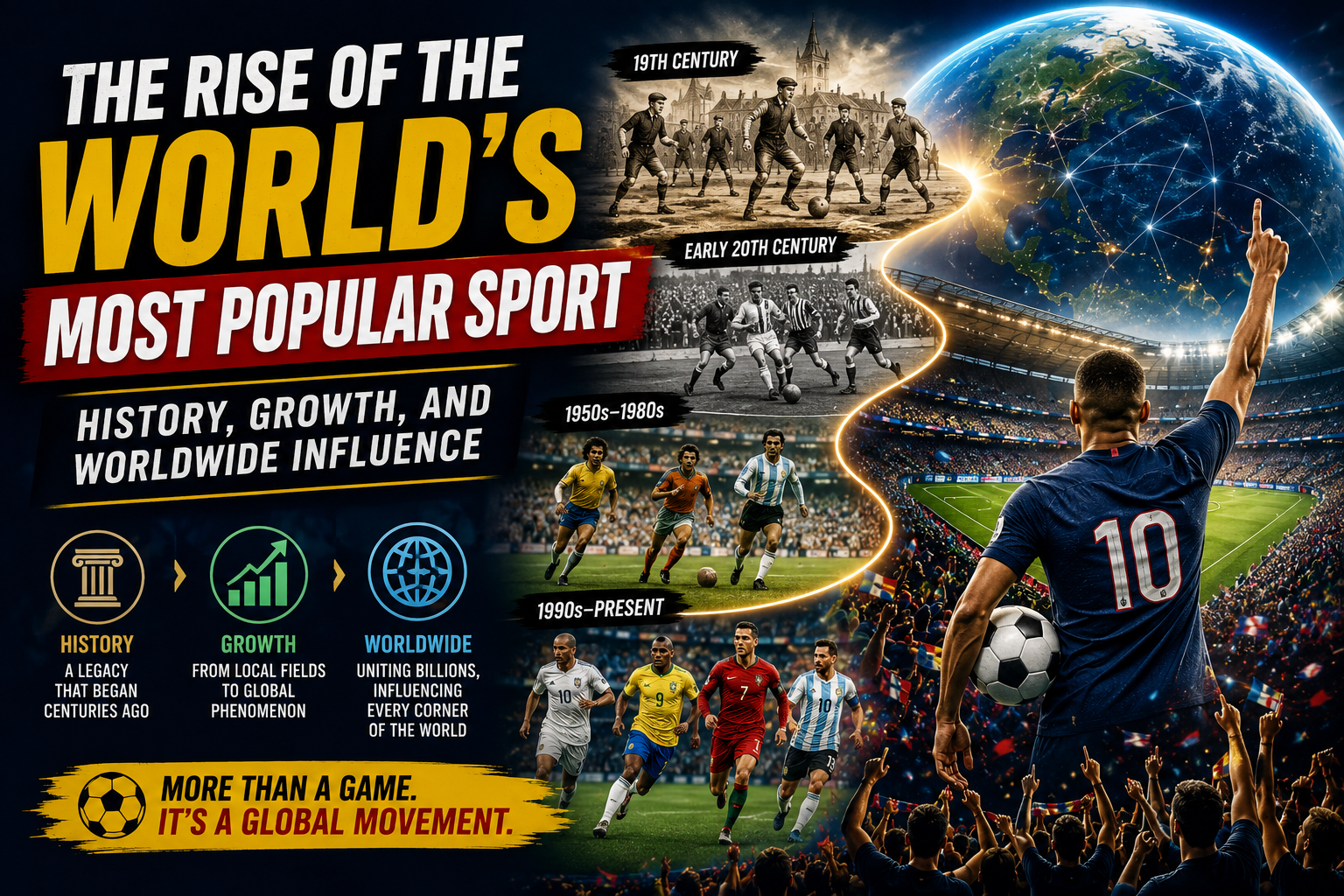
When a simple spherical ball rolls across a patch of grass, a dusty city street, or a concrete alleyway, billions of people across the globe stop to watch, cheer, and play. That sport is association football—known simply as football to most of the world and soccer in North America.
With an estimated global fanbase exceeding 3.5 billion people, football is not merely a game; it is a universal language, a multi-billion-dollar economic engine, and a cultural phenomenon. But how did an unregulated pastime played in medieval streets evolve into the undisputed king of global athletics?
This article explores the deep historical roots, explosive international expansion, and immense socioeconomic influence of the world’s most beloved sport.
1. The Ancient Roots of the Beautiful Game
While modern football was formalized in the 19th century, human beings have been kicking objects toward targets for millennia across diverse civilizations.
               [ Ancient Origins ]
  Cuju (China) ➔ Episkyros (Greece) ➔ Harpastum (Rome)
                        │
                        ▼
            [ Medieval Folk Football ]
             Unregulated & Violent
                        │
                        ▼
             [ 1863: The FA Rules ]
           Modern Association Football
Early Precursors Across Cultures
- China (Cuju): Recognized by FIFA as one of the earliest forms of football, Cuju (literally “kick ball”) originated during the Han Dynasty (206 BC – 220 AD). Used initially as a military conditioning exercise, players kicked a leather ball filled with feathers through a small net suspended between bamboo canes.
- Ancient Greece and Rome: The Greeks played Episkyros, while the Romans developed Harpastum. These were fast-paced, physical ball games that emphasized tactical movement and team coordination.
- Mesoamerica: Civilizations like the Mayas and Aztecs played Pok-ta-pok, a heavy rubber ball game with deep ritual and religious significance.
Medieval “Folk Football”
In medieval Britain, chaotic versions of ball games—often referred to as “mob football”—were played between neighboring villages during festival days. Entire towns would compete to push a inflated pig’s bladder into the opposing town’s center. With virtually no rules, hundreds of participants clashed in matches that frequently turned into violent riots, leading several English monarchs to ban the game entirely.
2. The Birth of Modern Football: From Chaos to Codification
The transformation of chaotic mob games into an organized sport occurred in 19th-century England.
Public School Standardization
During the early 1800s, elite English boarding schools like Rugby, Harrow, Eton, and Charterhouse adopted football as a tool to instill discipline, teamwork, and physical fitness among young men. However, each school played by its own set of rules—some allowed handling the ball, while others forbade it.
The Landmark Year: 1863
To resolve this confusion, representatives from various clubs met at the Freemasons’ Tavern in London on October 26, 1863. This historic gathering led to the creation of The Football Association (The FA) and the codification of the official Laws of the Game.
Key Milestone: The FA explicitly banned carrying the ball with hands and tripping opponents, drawing a clear line of division between Association Football (soccer) and Rugby Football.
| Year | Historical Milestone | Impact on Global Football |
| 1863 | Formation of The Football Association (FA) | Standardized rules across clubs globally. |
| 1872 | First official international match (Scotland vs. England) | Proved the feasibility of cross-border play. |
| 1888 | Establishment of the English Football League | Introduced weekly structured professional competition. |
| 1904 | Foundation of FIFA in Paris | Created a global governing body for international competitions. |
| 1930 | Inaugural FIFA World Cup in Uruguay | Established the ultimate world championship in sports. |
3. How Football Conquered the Globe
The rapid internationalization of football during the late 19th and early 20th centuries was fueled by trade, diplomacy, and migration.
British Exports: Sailors, Railway Workers, and Scholars
British engineers, merchants, and sailors carried leather balls and rulebooks wherever they established trade hubs.
- In South America, British expatriates introduced the game to port cities like Buenos Aires and Rio de Janeiro. Local populations quickly adopted and transformed the sport, blending tactical structure with individual flair and rhythm.
- In Continental Europe, students returning from English universities founded iconic clubs like FC Barcelona in Spain and AC Milan in Italy.
The Power of Simplicity and Accessibility
Unlike sports requiring expensive gear, specialized ice, or extensive facilities, football’s lower barrier to entry allowed it to spread organically across every socioeconomic stratum:
- Low Equipment Costs: A ball (or a improvised cluster of rags) and two markers for goalposts are all that is required.
- Universal Rules: The core principle—put the ball in the net without using your hands—is instantly understandable across cultures.
- Inclusivity: The sport accommodates all physical body types, rewarding agility, stamina, vision, and tactical intelligence over sheer physical size.
4. The Modern Global Football Ecosystem
Today, football operates as a complex, interconnected ecosystem involving international federations, elite club leagues, media broadcasting empires, and grassroots academies.
                   [ FIFA ]
         (Global Governing Body)
                    │
   ┌────────────────┴────────────────┐
   ▼                                 ▼
[ Confederation Tournaments ]   [ Domestic Leagues ]
(UEFA Champions League,         (Premier League, La Liga,
 Copa América, AFC Asian Cup)   Serie A, MLS, etc.)
   │                                 │
   └────────────────┬────────────────┘
                    ▼
           [ Global Fanbase ]
            (3.5+ Billion)
The FIFA World Cup Phenomenon
Held every four years, the FIFA World Cup is arguably the single largest sporting spectacle on Earth. The 2022 tournament in Qatar reached an estimated 5 billion total viewers across traditional broadcasts and digital platforms. The expanded 48-team format further expands this reach, bringing new nations into the global spotlight.
Elite Domestic Leagues and Global Brands
Clubs are no longer just local sports teams; they are international media franchises with fanbases spanning continents.
- The English Premier League (EPL): Broadcast in over 180 countries, generating billions in media rights.
- UEFA Champions League: The pinnacle of club competition, featuring elite talent from across Europe, South America, Africa, and Asia.
- Emerging Markets: Strategic investments in leagues like Major League Soccer (MLS) in North America and the Saudi Pro League are reshaping the global transfer landscape.
5. Sociocultural and Economic Impact
Football’s influence extends far beyond scorelines and trophy showcases. It acts as a powerful catalyst for political diplomacy, economic development, and social cohesion.
                       ┌── Social Inclusion & Diversity
                       │
[ Football's Impact ] ─┼── Economic Growth & Job Creation
                       │
                       └── Geopolitical Soft Power
1. Social Unity and National Identity
During major international tournaments, domestic political or socio-economic divides are frequently set aside as populations rally around national teams. Football has brought communities together, challenged racial and gender barriers, and offered youth in underserved regions a path to personal development.
2. Economic Driver
The football industry creates millions of jobs worldwide:
- Infrastructure construction (stadiums, training facilities).
- Sports tourism and hospitality.
- Sports marketing, broadcasting, and merchandising.
- Advanced sports science, medical technology, and performance analytics.
3. The Rise of Women’s Football
One of the most remarkable growth stories in modern athletics is the rapid expansion of women’s football. Record-breaking stadium attendances and unprecedented viewership figures for tournaments like the FIFA Women’s World Cup demonstrate that the sport’s global footprint continues to widen.
The Unstoppable Journey of the Beautiful Game
From its origins as an uncodified folk game in English public schools to a multi-billion-dollar global cultural engine, football has earned its title as the world’s most popular sport.
By uniting communities through shared passion, breaking cultural barriers, and constantly adapting through technological and strategic innovation, football proves that it is far more than a pastime. It remains a reflection of global humanity—a simple, dynamic game capable of capturing the hearts of billions.
Penulis: W.S






Post Comment